A Car Accelerates from Rest at a Constant Rate Alpha
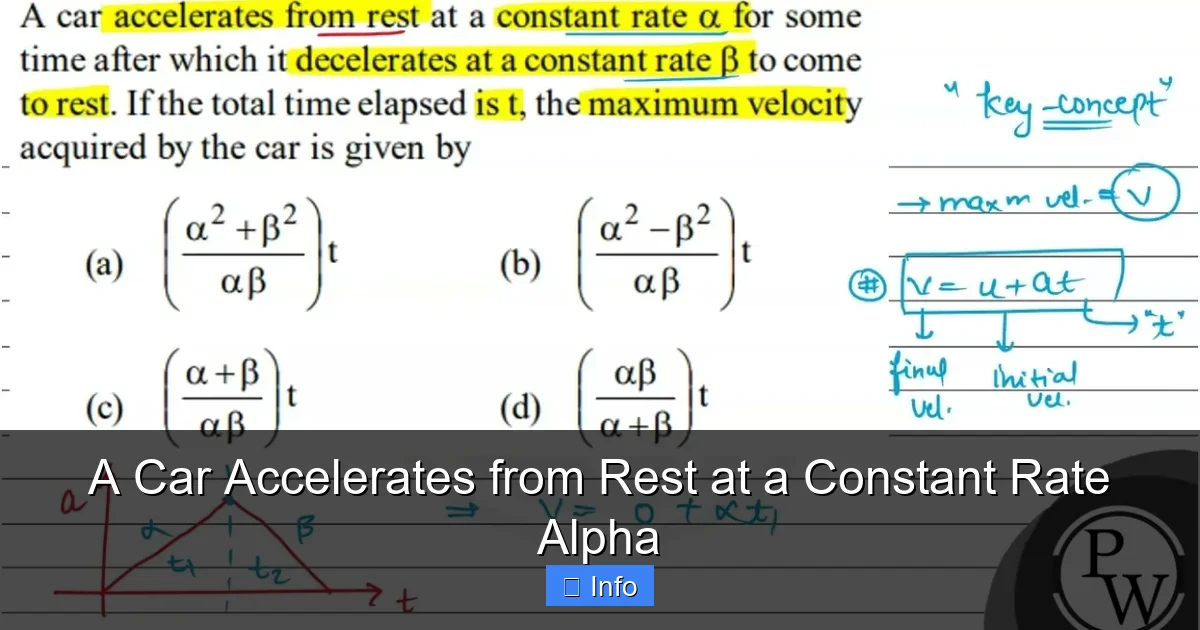
When a car accelerates from rest at a constant rate alpha, its velocity increases linearly with time. This article explains the key equations, real-world examples, and practical tips for understanding constant acceleration.
Have you ever wondered what happens when a car accelerates from rest at a constant rate alpha? It is a classic physics problem that also applies to real driving. The idea is simple: the car starts at zero speed and then picks up speed at a steady rate. This steady rate is called constant acceleration. In this article, we will break down the concept, show the math, give real examples, and share practical tips. Everything is written in plain language so you can grasp it quickly.
Constant acceleration is a building block of kinematics. It describes motion where the velocity changes by the same amount each second. When a car starts from a stoplight, the driver presses the gas pedal. If the pedal is held steady, the engine delivers a nearly constant force. That force creates a constant acceleration, assuming mass and resistance stay the same. We use the Greek letter alpha (α) to represent this constant acceleration. Understanding this helps you predict how fast the car will go and how far it will travel in a given time.
Key Takeaways
- Constant acceleration means steady increase in speed: The car gains the same amount of velocity every second.
- Initial velocity is zero: Starting from rest simplifies the equations of motion.
- Key formulas are v = αt and s = ½αt²: These let you find speed and distance at any time.
- Real-world factors affect acceleration: Engine power, mass, traction, and aerodynamics all play a role.
- You can measure acceleration with simple tools: A stopwatch and speedometer or a smartphone app work well.
- Smooth acceleration saves fuel and improves safety: Gentle throttle inputs are better for everyday driving.
- Understanding acceleration helps in emergencies: Knowing how quickly your car can speed up aids merging and overtaking.
📑 Table of Contents
What Is Constant Acceleration?
Acceleration is the rate of change of velocity. When we say constant acceleration, we mean the velocity increases by the same amount every second. For example, if α = 3 m/s², the car gains 3 meters per second of speed each second. After 1 second, it moves at 3 m/s. After 2 seconds, 6 m/s. After 3 seconds, 9 m/s. The pattern is linear and predictable.
Starting from Rest
“From rest” means the initial velocity is zero. This is a common scenario: a car at a red light, a car parked, or a car at the start of a drag race. With initial velocity zero, the math becomes simpler. You do not need to add an initial speed term. The equations we use are derived directly from the definition of acceleration.
Why Alpha?
Alpha is just a symbol. In physics, we often use α for angular acceleration, but here it represents linear acceleration. It is a constant value. If the car’s acceleration changes, then α is not constant and the simple formulas do not apply. In real life, acceleration is rarely perfectly constant due to gear shifts, traction limits, and air resistance. However, the constant acceleration model is a good approximation for short periods.
Key Equations of Motion
There are three main equations for constant acceleration starting from rest. They relate velocity (v), distance (s), time (t), and acceleration (α). You can use them to solve almost any problem about a car accelerating from rest at a constant rate alpha.
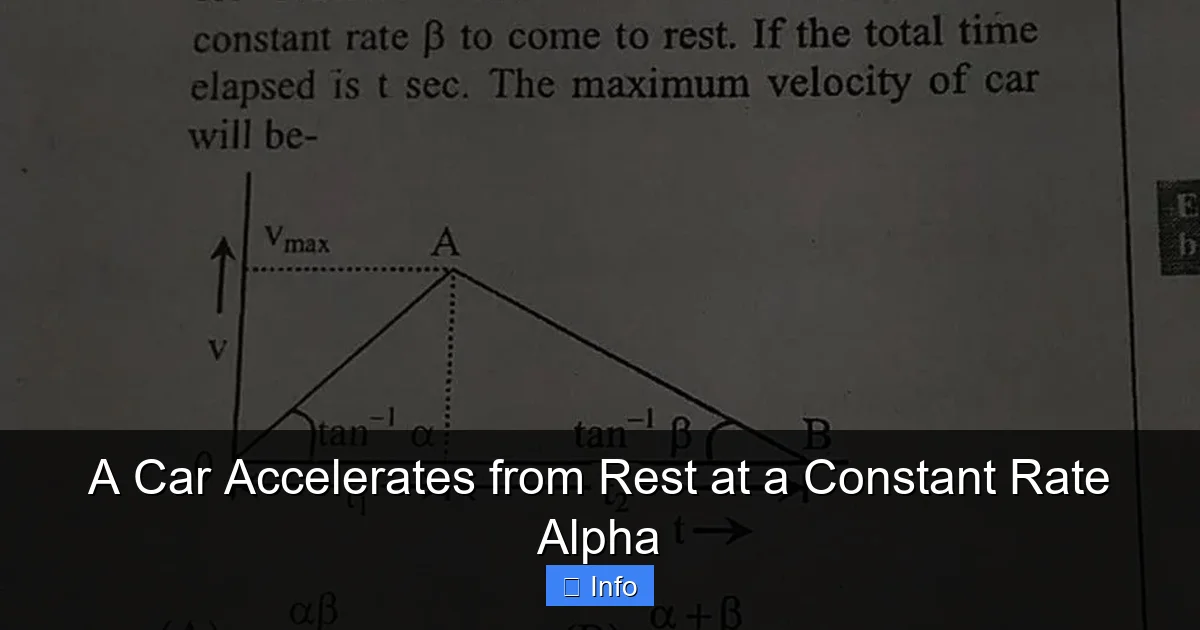
Visual guide about A Car Accelerates from Rest at a Constant Rate Alpha
Image source: classroom-images.cdn.askfilo.com
Velocity as a Function of Time
The first equation is v = αt. It says velocity equals acceleration multiplied by time. If you know α and t, you get v instantly. For instance, if α = 4 m/s² and t = 5 s, then v = 20 m/s. That is about 72 km/h. This equation shows the linear relationship.
Distance as a Function of Time
The second equation is s = ½αt². Distance equals one-half times acceleration times time squared. The t² term means distance grows faster than time. If α = 4 m/s² and t = 5 s, then s = 0.5 × 4 × 25 = 50 meters. The car covers 50 meters in 5 seconds.
Velocity as a Function of Distance
The third equation is v² = 2αs. It comes from eliminating time. If you know the distance and acceleration, you can find the final speed without knowing the time. For example, if a car accelerates at 3 m/s² over 100 meters, v² = 2 × 3 × 100 = 600, so v ≈ 24.5 m/s (about 88 km/h).
Using the Equations Together
You can combine these equations to solve for any unknown. If you have two knowns, you can find the other two. This is useful for planning a merge onto a highway or calculating stopping distance. Always keep units consistent: meters, seconds, meters per second, meters per second squared.
Real-World Examples
Let’s look at some everyday situations where a car accelerates from rest at a constant rate alpha. These examples make the abstract numbers concrete.
Stoplight Start
You are at a red light. The light turns green. You press the accelerator smoothly. Your car might accelerate at about 2 m/s². After 4 seconds, you are doing 8 m/s (≈ 29 km/h). You have traveled 16 meters. This is typical for city driving.
Highway On-Ramp
Merging onto a highway requires more acceleration. You might accelerate at 3 m/s². In 6 seconds, you reach 18 m/s (65 km/h) and cover 54 meters. If the ramp is short, you need higher acceleration. That is why sports cars have higher α values.
Drag Racing
In a drag race, the goal is maximum acceleration. A top fuel dragster can achieve α over 40 m/s². It reaches 100 m/s (360 km/h) in under 3 seconds. The distance covered is huge. This extreme shows the power of constant acceleration over a short time.
Electric Vehicles
Electric cars often deliver instant torque. They can maintain a very constant α from zero. For example, a Tesla Model 3 might accelerate at 5 m/s². It hits 27 m/s (97 km/h) in 5.4 seconds. The constant acceleration feels smooth and strong.
Factors That Affect Acceleration
In the real world, α is not a fixed property of the car. It depends on several factors. Knowing these helps you understand why acceleration varies.
Engine Power and Torque
The engine (or motor) provides the force. More power and torque mean higher possible α. However, the engine’s output changes with RPM. Gear ratios keep the engine in its optimal range. That is why acceleration feels different in each gear.
Vehicle Mass
Newton’s second law: F = ma. For a given force, more mass means less acceleration. A loaded SUV accelerates slower than a light sports car. Reducing weight improves α.
Traction and Tires
The tires must grip the road. If the force exceeds friction, wheels spin. This limits α. Good tires, dry pavement, and all-wheel drive increase the maximum usable α.
Aerodynamic Drag
At higher speeds, air resistance opposes motion. This reduces net force and thus α. Drag becomes significant above 60 km/h. Streamlined shapes help maintain acceleration at speed.
Transmission and Drivetrain Losses
Not all engine power reaches the wheels. Losses in the transmission, differential, and driveshafts reduce effective α. Efficient drivetrains preserve more acceleration.
Measuring Acceleration in Practice
You do not need a physics lab to measure α. There are simple ways to do it yourself.
Using a Stopwatch and Speedometer
Find a safe, empty road. Start from rest. Have a passenger note the time when the speedometer hits certain speeds. For example, time to 30 km/h, 50 km/h, 60 km/h. Convert speeds to m/s. Plot velocity versus time. The slope is α. If the line is straight, acceleration is constant.
Smartphone Apps
Many apps use the phone’s accelerometer and GPS to measure acceleration. They can give you real-time α values. Some even plot graphs. This is an easy way to see how your car performs.
Professional Tools
Race teams use data loggers with high-precision accelerometers. They record α at high sample rates. This data helps tune the car for maximum performance. If you want to test your car’s acceleration, you might need to know how to rev your car from the engine bay to get a good launch. Learn how to rev your car from the engine bay for better launch control.
Practical Tips for Drivers
Understanding acceleration is not just for physics class. It makes you a better driver.
Smooth Acceleration Saves Fuel
Rapid acceleration burns more fuel. Gentle, steady acceleration keeps the engine in an efficient range. It also reduces wear on tires and drivetrain. Try to accelerate as if there is an egg under the pedal.
Plan Your Merges
Know your car’s typical α. When entering a highway, estimate the time and distance needed to reach traffic speed. If your car accelerates at 2 m/s², you need about 10 seconds to go from 0 to 20 m/s (72 km/h). That requires roughly 100 meters. Check the ramp length.
Emergency Acceleration
Sometimes you must accelerate quickly to avoid danger. Practice in a safe area. Know how your car responds when you floor the pedal. Be aware that traction control may intervene. If your car alarm drains the battery, you might not be able to accelerate at all. Learn how to stop car alarm from draining battery to avoid this issue.
Winter Driving
On snow or ice, α is much lower. Wheels spin easily. Accelerate very gently. Increase following distance because stopping distance also increases. If your battery dies in cold weather, you might need to know how to start a dead car without jumping. Here is how to start a dead car without jumping.
Towing and Loading
Extra weight reduces α. When towing a trailer or carrying heavy cargo, allow more time and distance for merging and passing. Adjust your expectations.
Conclusion
We have explored what it means when a car accelerates from rest at a constant rate alpha. We covered the definition, the three key equations, real-world examples, factors that affect acceleration, ways to measure it, and practical driving tips. The concept is simple: constant acceleration means velocity grows linearly and distance grows quadratically. The math is straightforward with v = αt, s = ½αt², and v² = 2αs.
In real driving, acceleration is rarely perfectly constant. But the model gives a solid baseline. It helps you understand your car’s capabilities and limits. Whether you are a student learning physics or a driver wanting to merge safely, this knowledge is valuable. Next time you sit at a stoplight, think about α. Feel the steady push. That is physics in action.
Remember to drive smoothly, plan your maneuvers, and maintain your vehicle so it can deliver the acceleration you need when you need it. Stay safe and enjoy the ride.
Frequently Asked Questions
What does it mean when a car accelerates from rest at a constant rate alpha?
It means the car starts at zero speed and its velocity increases by the same amount every second. Alpha (α) is the symbol for that constant acceleration value.
What are the main equations for a car accelerating from rest at a constant rate alpha?
The three key equations are v = αt, s = ½αt², and v² = 2αs. They relate velocity, distance, time, and acceleration.
How can I calculate the distance traveled if I know the acceleration and time?
Use the formula s = ½αt². Multiply half the acceleration by the square of the time.
Why is acceleration not perfectly constant in real cars?
Factors like gear changes, engine torque curves, traction limits, air resistance, and vehicle load cause acceleration to vary.
How can I measure my car’s acceleration?
You can use a stopwatch and speedometer, a smartphone app with accelerometer, or professional data logging equipment.
Does constant acceleration apply to electric vehicles?
Yes, electric motors can provide very consistent torque from zero RPM, making constant acceleration a good approximation for EVs over a wide speed range.