Name the Type of Mirror Used in Headlights of Car
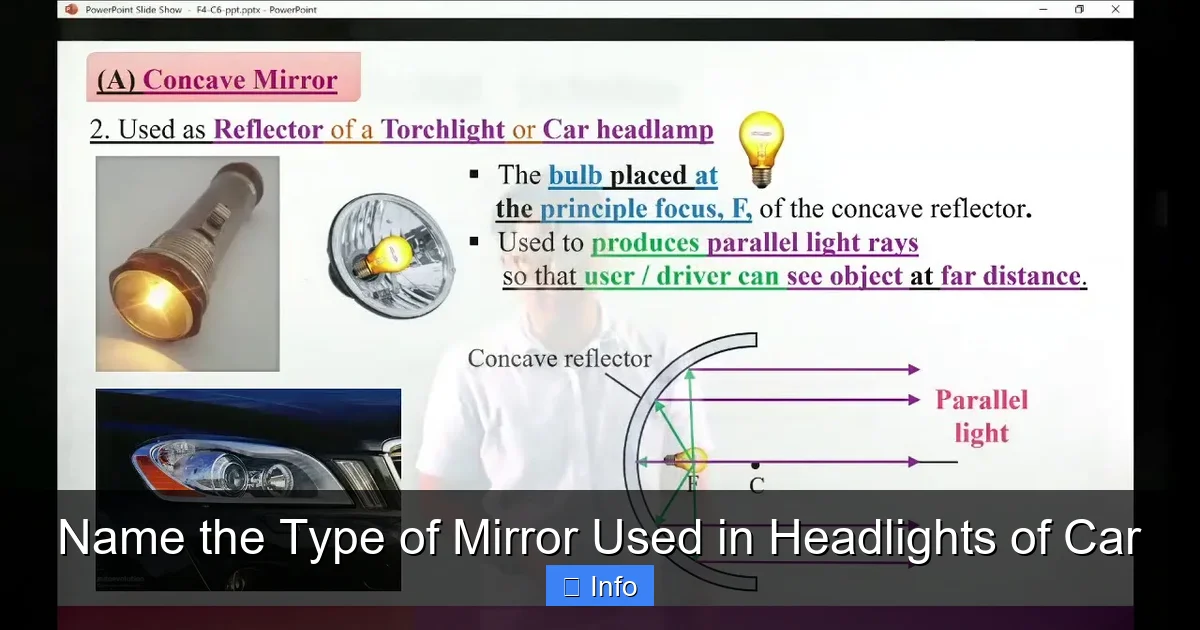
Understanding the type of mirror used in headlights of car is essential for grasping how automotive lighting works. This reflector directs light from the bulb onto the road, creating low‑ and high‑beam patterns that keep you safe. Learn which mirror type dominates modern headlights and how it affects visibility.
Key Takeaways
- Primary reflector: Most vehicles use a concave (parabolic) mirror as the type of mirror used in headlights of car to collect and focus light.
- Beam shaping: The mirror works with a lens to produce distinct low‑beam and high‑beam patterns without glare.
- Material choice: Aluminum coated with silver or chrome provides high reflectivity and durability for the type of mirror used in headlights of car.
- Common issues: Condensation, oxidation, and physical damage can degrade the mirror’s performance over time.
- Maintenance tip: Regular cleaning and proper sealing extend the life of the type of mirror used in headlights of car.
- Future tech: Emerging micro‑mirror arrays and laser‑phosphor systems are beginning to supplement traditional mirror designs.
📑 Table of Contents
- Introduction: Why the Headlight Mirror Matters
- What Is a Headlight Mirror and Why It Matters
- Types of Mirrors Used in Automotive Headlights
- The Most Common Mirror: Parabolic (Concave) Reflector
- How the Mirror Works with Bulbs and Lenses
- Maintenance and Common Issues
- Future Trends: Adaptive and Laser Headlights
- Conclusion
Introduction: Why the Headlight Mirror Matters
When you turn on your car’s headlights at night, a precise piece of optics throws a bright, controlled beam onto the road ahead. That piece is not a simple glass lens alone; it is a reflective surface that does the heavy lifting of gathering light from the bulb and sending it outward. Understanding the type of mirror used in headlights of car helps you appreciate how engineers balance brightness, spread, and safety in every drive.
Most drivers never think about the geometry behind their headlights, yet the mirror’s shape determines whether you see a narrow spotlight or a wide flood of illumination. It also influences how much glare is directed toward on‑coming traffic. In the sections that follow, we’ll break down the science, the common designs, and practical tips for keeping your headlights performing at their best.
By the end of this article you will know exactly which mirror type is found in the majority of vehicles, why it was chosen, how it interacts with bulbs and lenses, and what maintenance steps preserve its effectiveness. Let’s start with the fundamentals of what a headlight mirror actually does.
What Is a Headlight Mirror and Why It Matters
Basic Function of Headlight Mirrors
The primary job of the type of mirror used in headlights of car is to collect light emitted from the bulb and redirect it in a controlled direction. Unlike a lens that refracts light, a mirror reflects it, preserving most of the photon energy. This reflective action allows designers to create a compact yet powerful lighting package.
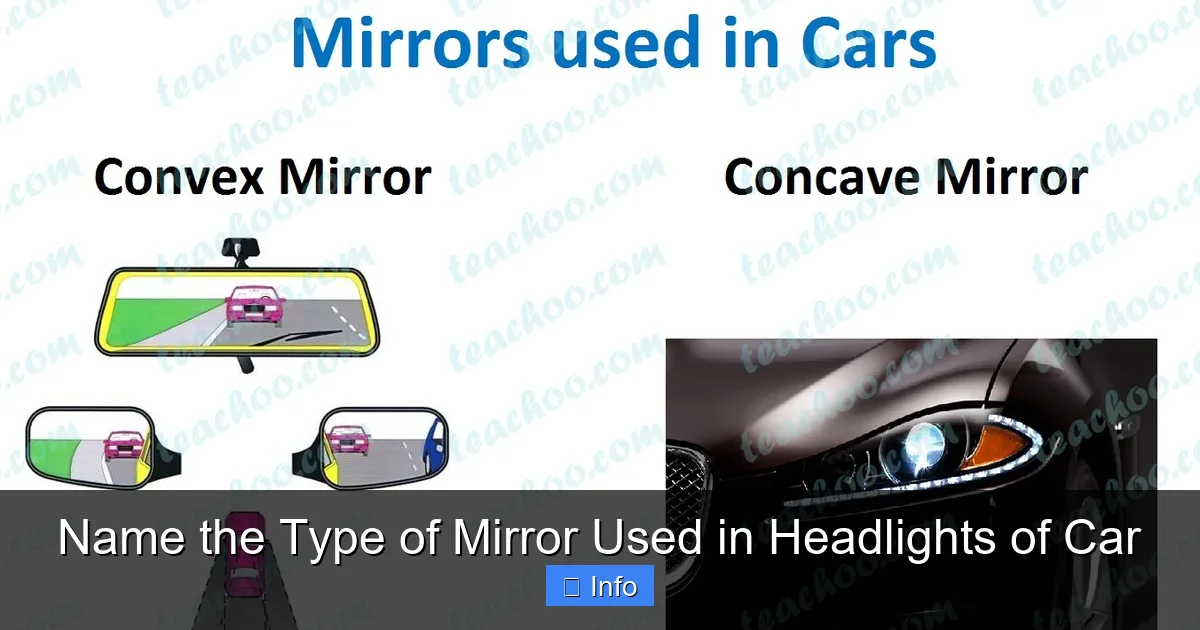
Visual guide about Name the Type of Mirror Used in Headlights of Car
Image source: d1avenlh0i1xmr.cloudfront.net
When the bulb emits light in all directions, the mirror captures a large portion of those photons and focuses them toward the front of the vehicle. The shape of the mirror dictates how the light converges or diverges, which directly shapes the beam pattern that reaches the road.
Safety and Beam Control
A well‑designed mirror ensures that the low‑beam illuminates the road directly ahead without blinding drivers in opposite lanes. The high‑beam, on the other hand, throws light farther and higher for better visibility on dark, unlit roads. The type of mirror used in headlights of car is therefore a critical safety component, as any deviation in shape or reflectivity can produce uneven illumination, hot spots, or excessive glare.
Because the mirror works in tandem with the lens and the bulb’s position, even a slight misalignment can dramatically affect performance. That is why manufacturers invest heavily in precise molding, coating, and alignment processes for the reflective surface.
Types of Mirrors Used in Automotive Headlights
Parabolic Reflectors (Concave Mirrors)
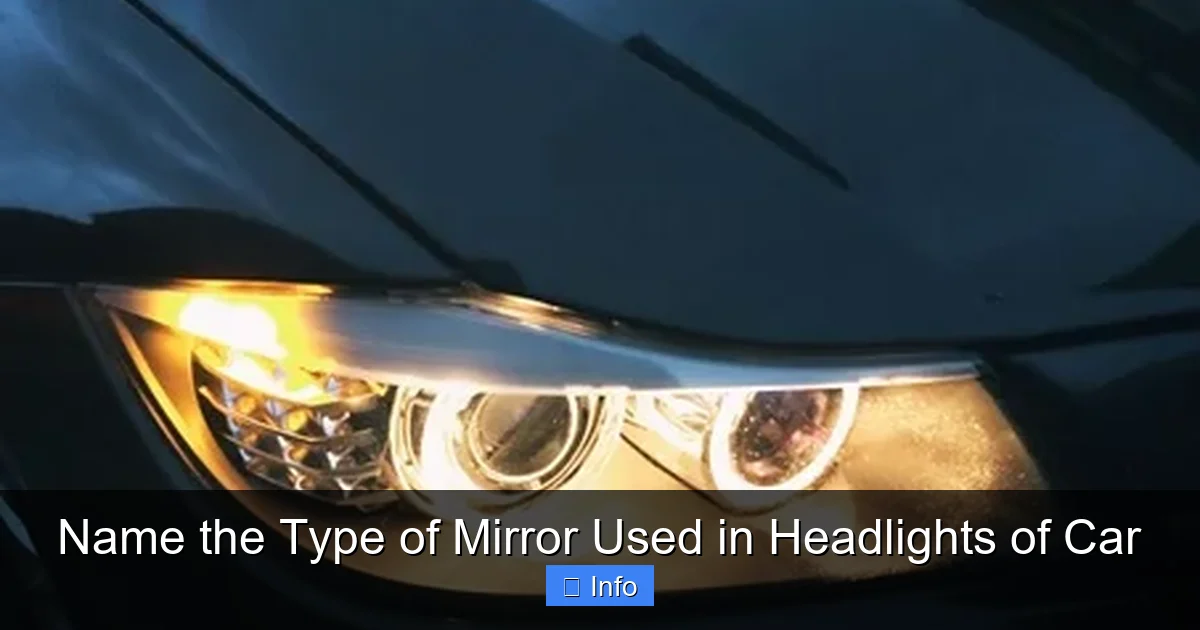
The most common type of mirror used in headlights of car is a concave, parabolic reflector. Its cross‑section follows a parabolic curve, which has the unique property of reflecting incoming parallel rays to a single focal point—and vice versa. When a bulb is placed at or near the focal point, the mirror sends out a relatively collimated beam.
Visual guide about Name the Type of Mirror Used in Headlights of Car
Image source: d1avenlh0i1xmr.cloudfront.net
Parabolic mirrors are favored because they are relatively simple to manufacture, provide good light collection efficiency, and produce a beam that can be easily shaped by a subsequent lens. Most halogen and many LED headlights rely on this design.
Elliptical Reflectors
Some premium or specialized headlights use an elliptical reflector. An ellipse has two focal points; placing the bulb at one focus causes light to reflect toward the other focus, where a lens or shutter can further shape the beam. This design can produce a sharper cutoff line for low‑beams, reducing glare.
While elliptical mirrors offer precise control, they are more complex to fabricate and align, which is why they appear less frequently in mass‑market vehicles.
Freeform (Complex) Reflectors
Modern computer‑aided design enables freeform reflectors that do not follow a simple geometric shape. These mirrors are optimized via simulation to produce a specific beam pattern that meets regulatory standards while maximizing light output. The type of mirror used in headlights of car in many newer LED and laser systems is often a freeform surface.
Freeform designs can reduce the need for additional lenses, lower overall headlight depth, and improve aerodynamics. However, they require advanced manufacturing techniques such as diamond turning or precision molding.
Lens‑Based Systems vs Mirror‑Based
It is worth noting that some headlight architectures rely more on lenses (such as projector systems) with a modest reflective element. Even in those cases, a small mirror or reflective coating is still present to boost efficiency. Thus, when we discuss the type of mirror used in headlights of car, we are usually referring to the primary reflective surface that works alongside the lens.
The Most Common Mirror: Parabolic (Concave) Reflector
Geometry and Light Collection
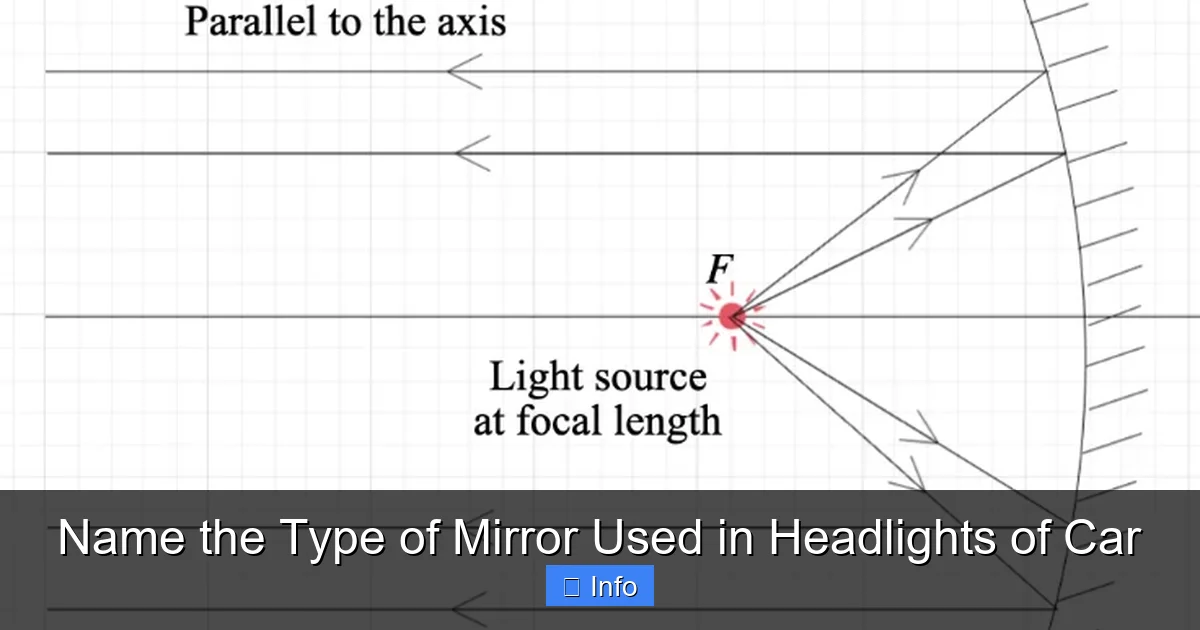
A parabolic mirror’s surface is defined by the equation y = x² / (4f), where f is the focal length. By placing the bulb at the focal point, rays that strike the mirror are reflected outward as parallel beams. In practice, the bulb is slightly offset to create a beam with a controlled spread rather than a perfectly collimated output.
Visual guide about Name the Type of Mirror Used in Headlights of Car
Image source: cmds-test.vedantu.com
This geometry allows the mirror to gather light from a wide angle and concentrate it into a usable beam. The efficiency of this collection is a key reason why the type of mirror used in headlights of car remains the parabolic design for most applications.
Advantages for Low‑Beam and High‑Beam
For low‑beam applications, the parabolic mirror works with a shield or cutoff lens that blocks the upper portion of the reflected light, creating a sharp horizon line. The mirror’s symmetry ensures that the light distribution left and right of the vehicle’s centerline is even, which improves peripheral vision without causing glare.
When the driver switches to high‑beam, the shield is retracted, allowing the full output of the mirror to illuminate the road. The same type of mirror used in headlights of car therefore serves both modes, simply by changing the optical path in front of it.
Manufacturing Materials (Aluminum, Silver)
The reflective surface is typically a substrate of aluminum or plastic that is vacuum‑coated with a thin layer of silver or aluminum. Silver offers the highest reflectivity in the visible spectrum, while aluminum provides better durability and resistance to oxidation. A protective overcoat (often silicon dioxide or a clear lacquer) shields the metal from environmental damage.
Because the mirror must withstand temperature swings, humidity, and occasional impact, the choice of coating and overcoat directly influences the longevity of the type of mirror used in headlights of car. Regular inspection can reveal early signs of coating degradation.
How the Mirror Works with Bulbs and Lenses
Light Source Placement
The position of the bulb relative to the mirror’s focal point is critical. In a halogen headlight, the filament is placed slightly behind the focal point to produce a beam with a slight divergence, which the lens then shapes. In LED headlights, multiple emitters are arranged on a circuit board that mimics a point source near the focal area.
If the bulb is too far forward or backward, the reflected rays will either converge too early or remain too divergent, resulting in a beam that is either too narrow or too wide. Engineers therefore use precise mounting brackets and adjustment screws to lock the bulb in the optimal location for the type of mirror used in headlights of car.
Beam Shaping with Lens
After leaving the mirror, the light passes through a lens (often a polycarbonate component) that fine‑tunes the beam pattern. The lens can introduce additional refraction to create the characteristic low‑beam cutoff and to spread light horizontally for better side‑road illumination.
The combination of mirror and lens is what gives modern headlights their distinct “cutoff line” – a sharp horizontal boundary that prevents light from shining into the eyes of on‑coming drivers. This synergy is why the type of mirror used in headlights of car is rarely discussed in isolation; it is part of an optical system.
Adjustment Mechanisms
Most vehicles provide vertical and horizontal aim adjusters that move the entire headlight assembly or the mirror itself. Proper aim ensures that the beam points slightly downward and straight ahead, maximizing road illumination while minimizing glare.
Misadjustment can cause the type of mirror used in headlights of car to project light too high (blinding others) or too low (reducing visibility). Periodic checks, especially after carrying heavy loads or after a collision, are recommended.
Maintenance and Common Issues
Condensation Inside Headlights
One of the most frequent problems that affects the reflective surface is moisture buildup inside the lens housing. When water condenses on the mirror, it can cause spotting, corrosion, and a reduction in reflectivity. If you notice fogging or droplets, you can learn how to get condensation out of headlights to protect the type of mirror used in headlights of car from damage.
Preventive measures include checking the seal integrity, replacing cracked lenses, and using silica gel packs inside the housing if your vehicle allows it.
Mirror Degradation and Oxidation
Over time, the silver or aluminum coating can oxidize, especially if the protective overcoat is compromised by UV exposure, road salts, or abrasive cleaning. Oxidation appears as a dull, hazy patch on the mirror surface and leads to scattered light rather than a focused beam.
Regular cleaning with a mild automotive soap and a soft microfiber cloth helps remove contaminants that could accelerate wear. Avoid harsh chemicals or abrasive pads that might scratch the coating.
Cleaning Tips (Link to Internal Resource)
For a deeper clean, especially when dealing with stubborn grime or oxidation, refer to the guide on how to clean headlights from the inside. This resource explains how to safely access the mirror surface, apply appropriate cleaning agents, and reassemble the housing without damaging the type of mirror used in headlights of car.
After cleaning, inspect the mirror for any signs of coating loss. If the reflective layer appears patchy or flaking, professional re‑coating or replacement of the headlight unit may be necessary.
When to Replace or Realign (Link to Internal Resource)
Electrical issues can also affect the mirror’s performance indirectly. For instance, if the actuator that adjusts the mirror’s angle fails, the beam may stay fixed in an improper position. You can consult how to tell if the electric mirror is not work to diagnose whether the problem lies with the mirror’s movement mechanism rather than the reflective surface itself.
If the mirror is physically cracked, corroded beyond cleaning, or no longer produces a consistent beam despite proper bulb and lens condition, replacing the entire headlight assembly is often the most cost‑effective solution.
Future Trends: Adaptive and Laser Headlights
Micro‑mirror Arrays (MEMS)
Emerging adaptive headlight systems use tiny micro‑electromechanical systems (MEMS) mirrors that can tilt thousands of times per second. These arrays replace the single large type of mirror used in headlights of car with many individually controllable elements, allowing the beam to be shaped dynamically around obstacles, pedestrians, or signs.
While still appearing mainly in luxury or concept vehicles, MEMS technology promises to reduce glare and improve illumination precision far beyond what static reflectors can achieve.
Laser‑Phosphor Systems
Laser headlights generate a intense blue laser beam that strikes a phosphor plate, producing bright white light. A small reflective component still directs the laser energy toward the phosphor, but the overall system relies less on a traditional type of mirror used in headlights of car for beam shaping.
The advantage is extremely high luminance in a compact package, enabling longer reach with lower power consumption. As costs drop, we may see more mainstream adoption of laser‑assisted lighting.
Integration with AI and Sensors
Future headlights will combine mirror‑based or micro‑mirror technology with camera and radar inputs. AI algorithms will adjust the mirror angles in real time, dimming sections of the beam to avoid blinding other drivers while boosting light where it is needed most.
Such systems will still benefit from the foundational principles of the type of mirror used in headlights of car—efficient light collection and direction—but will add a layer of intelligent control that adapts to changing road conditions.
Conclusion
The type of mirror used in headlights of car is far more than a simple shiny surface; it is a carefully engineered optical component that gathers light from the bulb, shapes it into a safe and effective beam, and works hand‑in‑hand with lenses, bulbs, and adjustment mechanisms. Most vehicles on the road today rely on a concave, parabolic reflector coated with silver or aluminum because it offers an excellent balance of efficiency, manufacturability, and performance.
Understanding how this mirror functions helps you appreciate why proper aim, clean lenses, and intact seals are essential for night‑time driving safety. Regular maintenance—such as checking for condensation, cleaning the reflective surface with appropriate products, and verifying alignment—keeps the mirror performing at its best and extends the life of your headlight assembly.
Looking ahead, innovations like micro‑mirror arrays and laser‑phosphor systems are beginning to supplement or even replace traditional reflectors in certain high‑end models. Yet, the core concept remains unchanged: a reflective surface that directs light where you need it most. By keeping the type of mirror used in headlights of car in good condition, you ensure that every drive after dark is illuminated with confidence and clarity.
Frequently Asked Questions
What is the most common type of mirror used in headlights of car?
The most common type of mirror used in headlights of car is a concave, parabolic reflector. This shape efficiently collects light from the bulb and directs it forward, where a lens then shapes the low‑ and high‑beam patterns.
Because of its simplicity and high light‑gathering ability, the parabolic mirror dominates halogen, many LED, and even some HID headlight designs.
How does the mirror affect low‑beam and high‑beam performance?
The same mirror serves both modes; a shield or cutoff lens blocks part of the reflected light for low‑beam, creating a sharp horizon line that prevents glare. When the switch moves to high‑beam, the shield is retracted, allowing the full output of the mirror to illuminate farther down the road.
Thus, the type of mirror used in headlights of car determines the basic beam shape, while the lens and shielding fine‑tune it for each setting.
Regular inspection of the mirror’s coating and alignment ensures that both beams remain effective and safe.
Can condensation damage the mirror inside my headlight?
Yes, moisture that condenses on the mirror surface can cause spotting, corrosion, and a reduction in reflectivity, which diminishes beam intensity and creates uneven lighting.
If you notice fogging inside the lens, follow the steps in our guide on how to get condensation out of headlights to dry the housing and protect the type of mirror used in headlights of car.
Maintaining good seals and replacing cracked lenses are the best ways to prevent future condensation.
What signs indicate that the headlight mirror needs replacement?
Visible oxidation or a hazy, dull appearance on the reflective surface, uneven beam patterns with dark spots, or persistent glare despite cleaning and bulb replacement are strong indicators that the mirror’s coating has degraded.
If cleaning does not restore clarity, or if the mirror is physically cracked or delaminated, replacing the headlight unit is usually the most reliable solution.
Consulting a professional can confirm whether re‑coating is an option or if a new assembly is required.
For electrical issues that affect mirror movement, refer to our article on how to tell if the electric mirror is not work.
Are there any aftermarket upgrades that improve the mirror’s performance?
Aftermarket upgrades often focus on improving the bulb (e.g., switching to higher‑output LED kits) or adding a clearer, more durable lens, rather than altering the mirror itself.
However, some premium replacement housings offer upgraded reflective coatings with better oxidation resistance or slightly altered curvature for a wider beam.
Before installing any aftermarket part, verify that it meets local regulations and that the type of mirror used in headlights of car remains compatible with your vehicle’s electronics and aiming system.
Proper installation and aiming are essential to ensure that the upgrade enhances safety rather than creating glare for other drivers.
How often should I check the aim of my headlights?
It is a good practice to check headlight aim every 12,000 miles or at least once a year, and whenever you notice changes in visibility after carrying heavy loads, after a collision, or after replacing the headlight assembly.
Improper aim can cause the type of mirror used in headlights of car to project light too high, creating glare for on‑coming traffic, or too low, reducing your ability to see obstacles.
Many service centers offer quick aiming checks using a wall or a specialized gauge, and the adjustment screws are usually accessible without removing the entire headlight.