Find the Maximum Velocity for Skidding for a Car
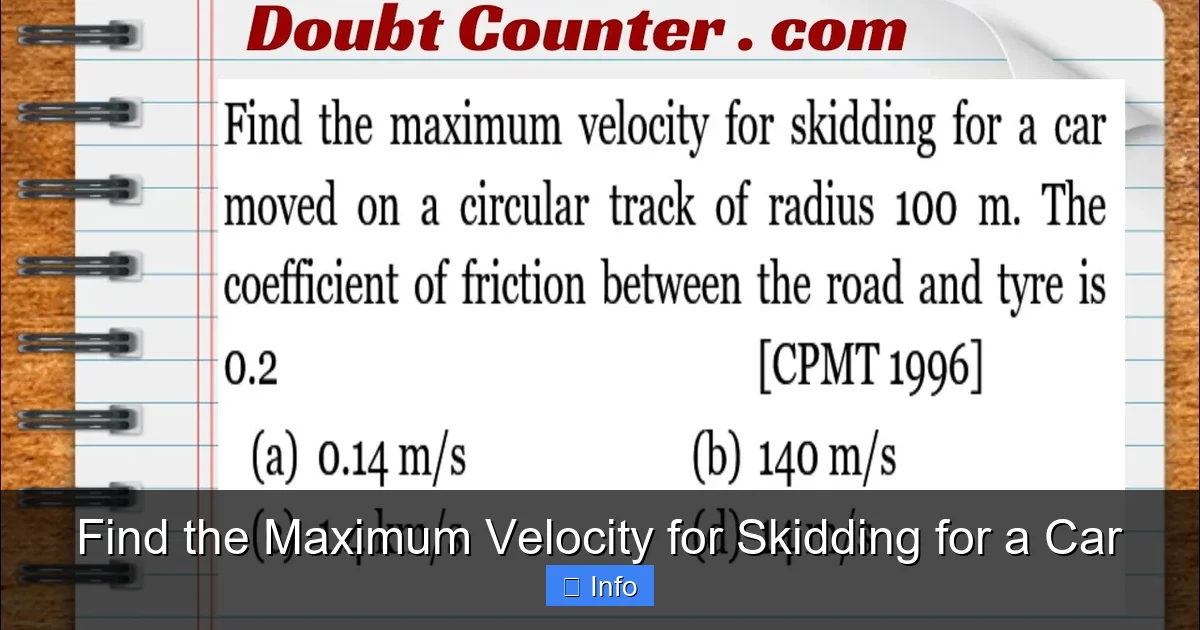
Knowing the maximum velocity for skidding helps drivers stay safe on the road. This guide breaks down the physics behind skidding, shows how to compute the limit, and provides tips to avoid losing control.
When you drive, especially on winding roads, there is a point where the tires begin to slide instead of roll. This point is known as the maximum velocity for skidding. Understanding this limit is crucial for maintaining control and avoiding accidents. In this article, we will explore the physics that define this speed, how to calculate it, and practical steps you can take to stay safely below it.
Whether you are navigating a mountain pass or simply turning around a corner, the principles remain the same. By breaking down the forces at play, we can gain insight into why skidding occurs and how to prevent it. The following sections will guide you through the key concepts, formulas, and real‑world considerations.
By the end of this guide, you will have a clear picture of how speed, friction, and geometry interact to set the boundary between controlled driving and a potential skid.
This knowledge can also help you advise passengers about safe speeds on unfamiliar roads.
Key Takeaways
- Point 1: Skidding occurs when the required centripetal force exceeds the maximum frictional force.
- Point 2: The maximum velocity for skidding is given by v_max = sqrt(μ * g * r).
- Point 3: A higher coefficient of friction or larger radius increases the safe speed.
- Point 4: Wet or icy surfaces reduce μ, lowering the skid limit.
- Point 5: Proper tire maintenance and correct inflation help maintain grip.
- Point 6: Defensive driving techniques reduce the chance of reaching the skid threshold.
📑 Table of Contents
Understanding Skidding and Its Causes
What Is Skidding?
Skidding is the loss of traction between a tire and the road surface. When this happens, the tire slides rather than rolls, which reduces the driver’s ability to steer and increases the distance needed to stop. The sensation can be alarming, and if not corrected, it may lead to a loss of control.
Factors That Trigger Skidding
Several conditions can initiate a skid. The most common are excessive speed, abrupt steering inputs, and low friction between the tires and the road. When the lateral force required to follow a curve exceeds the maximum frictional force available, the tires begin to slide. This balance between required force and available grip determines the maximum velocity for skidding.
In addition to speed, the angle of the steering wheel and the condition of the tires play a major role. A sharp turn combined with worn tread can bring you to the skid threshold much faster than a gentle curve on new rubber. Drivers often notice a subtle vibration or a change in the sound of the tires just before a skid begins, which can serve as an early warning.
The difference between a controlled turn and a skid often comes down to milliseconds of reaction time, making early recognition of the signs vital.
Modern vehicles equipped with traction control can intervene earlier, but they still rely on the same friction limits.
The Physics Behind Maximum Skid Velocity
Friction and the Coefficient of Friction
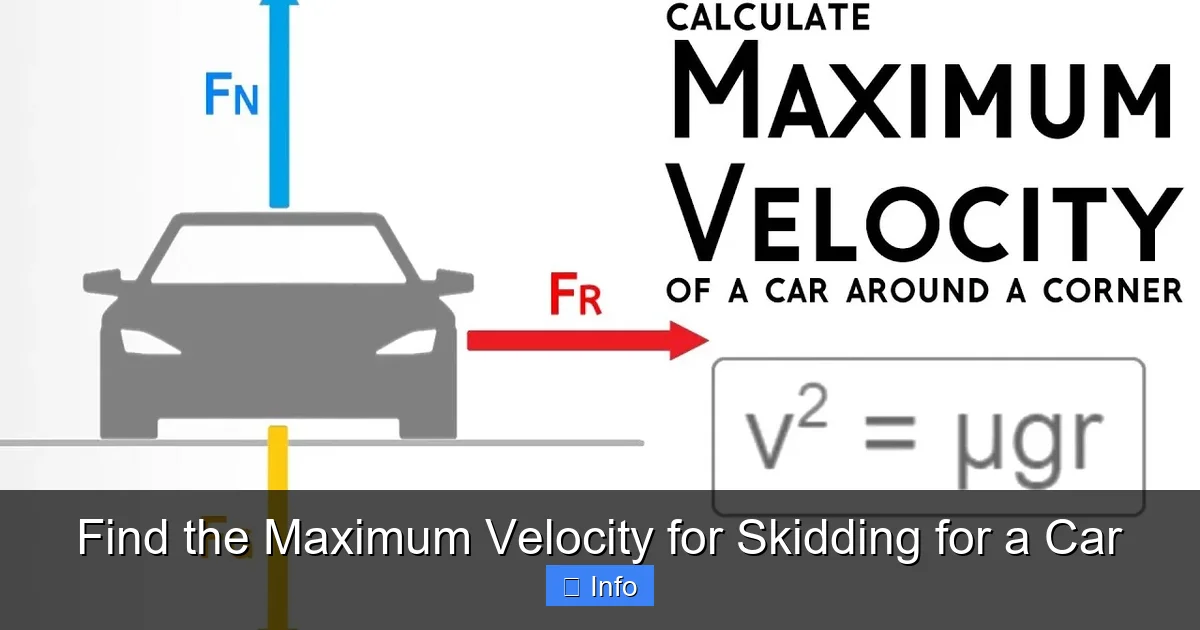
The force that resists sliding is called friction. It depends on two main factors: the normal force, which is the weight of the car pressing down on the road, and the coefficient of friction, μ, which varies with tire material and road condition. A higher μ means more grip and a higher possible speed before skidding occurs.
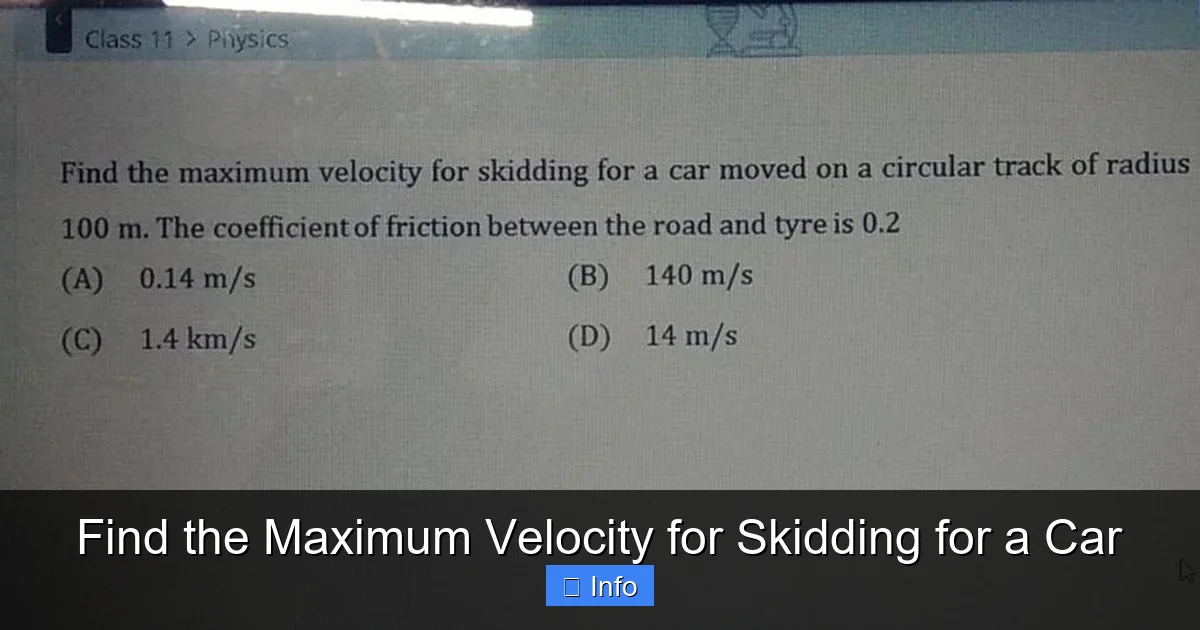
Visual guide about Find the Maximum Velocity for Skidding for a Car
Image source: classroom-images.cdn.askfilo.com
The normal force is simply the weight of the vehicle, which is mass times gravitational acceleration. This force presses the tires against the road, creating the friction that resists sliding.
Radius of the Turn and Centripetal Force
To move along a curved path, a vehicle requires a centripetal force directed toward the center of the curve. This force is given by the equation F = m * v^2 / r, where m is the mass of the car, v is its velocity, and r is the radius of the turn. The larger the radius, the smaller the required force for a given speed, which can allow a higher maximum velocity for skidding.
If the road is banked, the normal force changes, which can alter the maximum velocity for skidding. A banked curve can allow higher speeds because part of the centripetal force is provided by the banking angle.
A banked curve can increase the effective normal force, allowing a higher maximum velocity for skidding compared to a flat curve of the same radius.
Combining Forces to Find the Limit
At the point of skidding, the required centripetal force equals the maximum frictional force, which is μ times the normal force (μ * m * g). Setting these equal gives μ * m * g = m * v^2 / r. The mass cancels out, leading to the relationship v^2 = μ * g * r. Taking the square root provides the maximum velocity for skidding: v_max = sqrt(μ * g * r).
In the equation v_max = sqrt(μ * g * r), the radius r appears under the square root, meaning that doubling the radius increases the skid speed by about 41 percent.
Because mass cancels out, the maximum velocity for skidding is independent of the vehicle’s weight, a fact that surprises many drivers.
The value of g is constant near the Earth’s surface, but variations in altitude can slightly alter it.
How to Calculate the Maximum Velocity for Skidding
Step-by-Step Formula
To use the formula, you need three values: the coefficient of friction μ, the acceleration due to gravity g (approximately 9.81 m/s²), and the radius of the turn r in meters. Plug them into v_max = sqrt(μ * g * r) to obtain the speed in meters per second. Convert to kilometers per hour by multiplying by 3.6 if desired.
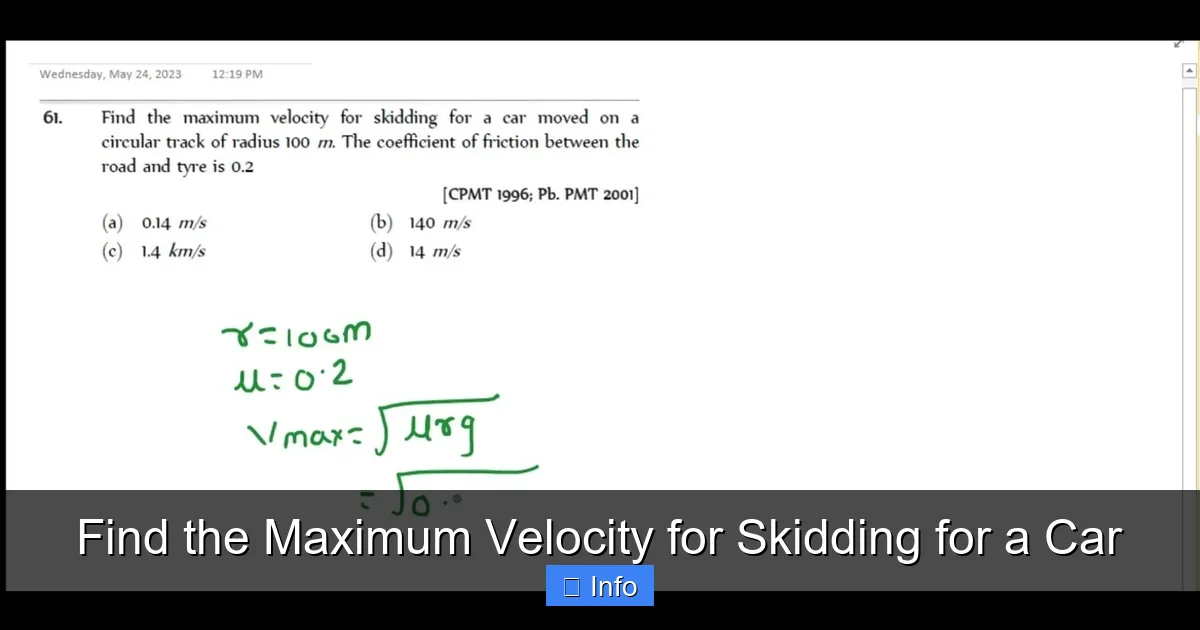
Visual guide about Find the Maximum Velocity for Skidding for a Car
Image source: i.ytimg.com
If you prefer to work in miles per hour, multiply the result in meters per second by 2.237.
Example Calculation
Consider a car traveling on a dry asphalt road with μ = 0.8 and approaching a curve with a radius of 50 meters. Substituting these numbers yields v_max = sqrt(0.8 * 9.81 * 50) ≈ 19.8 m/s. Converting to km/h gives about 71 km/h. This is the theoretical maximum velocity for skidding under those conditions.
For a deeper look at related dynamics, you can explore Calculate The Maximum Acceleration Of A Moving Car, which examines how acceleration limits compare to skid limits.
For instance, on a wet road with μ = 0.4 and a radius of 30 m, the maximum velocity for skidding drops to sqrt(0.4 * 9.81 * 30) ≈ 10.8 m/s, or roughly 39 km/h. This illustrates how sensitive the limit is to changes in friction.
When using the formula, always ensure consistent units; converting meters per second to kilometers per hour is straightforward with the factor 3.6.
For a more precise result, you can use g = 9.80665 m/s², though the difference is usually negligible.
Practical Factors That Alter the Theoretical Limit
Tire Condition and Type
The coefficient of friction is heavily influenced by the tires. Worn tread reduces the ability to channel water away, lowering μ. Different tire compounds, such as all‑season versus performance tires, also provide varying levels of grip. Choosing the right tires, like those reviewed in The Best Tires For A Car, can significantly affect the maximum velocity for skidding.
Visual guide about Find the Maximum Velocity for Skidding for a Car
Image source: i.ytimg.com
Under‑inflated tires reduce the contact patch, lowering μ and thus the safe speed. Conversely, over‑inflation can cause uneven wear and also reduce grip. The type of rubber matters: summer tires provide higher μ in dry conditions, while winter tires maintain better grip in cold and snowy environments.
Regularly checking tire pressure with a gauge ensures that the tires operate within the manufacturer’s recommended range, preserving μ.
Tire age also matters; tires older than six years may have reduced elasticity, lowering μ.
Road Surface and Moisture
Wet or icy roads dramatically decrease μ. Even a thin layer of water can reduce friction by more than half, cutting the safe speed by a similar factor. Snow or loose gravel further reduces grip, making skidding more likely at lower speeds.
Vehicle Weight and Load Distribution
While a heavier car increases the normal force, it also raises the required centripetal force. The net effect often slightly lowers the maximum velocity for skidding, especially if weight shifts to the rear during cornering. Proper load distribution helps maintain balanced grip.
Vehicle modifications such as lowering springs or larger wheels can affect the normal force distribution and may change the skid characteristics.
When carrying heavy cargo, the center of gravity rises, which can reduce stability and lower the skid threshold.
Tips to Reduce the Risk of Skidding
Driving Techniques
- Reduce speed before entering a curve.
- Avoid sudden steering or braking while turning.
- Keep a safe following distance to allow for unexpected stops.
- Use smooth, gradual inputs to maintain traction.
- Avoid using cruise control on wet or slippery roads, as it can delay your response to changing conditions.
Another useful habit is to scan the road ahead for signs of water, gravel, or debris that could reduce friction.
If you feel the tires beginning to slide, ease off the accelerator and steer gently in the direction you want to go; abrupt corrections can worsen the skid.
Electronic stability control (ESC) can assist by automatically applying brakes to individual wheels, but it is not a substitute for cautious driving.
Defensive driving courses often teach how to recognize the onset of a skid and how to recover without overcorrecting.
Maintaining a smooth throttle helps keep the tires in their optimal slip range, maximizing grip.
Vehicle Maintenance
- Inspect tire tread depth regularly and replace tires when wear indicators appear.
- Maintain proper inflation pressure as recommended by the manufacturer.
- Rotate tires periodically to ensure even wear.
- Check alignment and suspension components for optimal handling.
By incorporating these habits, you can stay well below the maximum velocity for skidding and preserve control in a variety of conditions.
Real-World Implications and Safety
Understanding Speed Limits
Speed limits are often set based on the expected maximum velocity for skidding under dry conditions. When the road is wet, icy, or otherwise slippery, you should reduce your speed accordingly to remain safe.
Emergency Maneuvers
If you find yourself approaching the skid limit, avoid abrupt actions. Smooth steering and gentle braking can help you regain traction. Sudden inputs are likely to trigger a slide, so practice calm, controlled movements.
For a concrete illustration of how velocity affects stopping distance, see A Car Traveling With A Velocity Of 80 Km Hr, which demonstrates the impact of speed on braking and skid behavior.
Many insurance companies consider skid-related accidents as high risk, which can lead to higher premiums after a claim.
In some jurisdictions, exceeding the speed limit by a large margin can result in severe penalties, especially if an accident occurs.
In racing, drivers often practice finding the exact point where the tires start to slip, a skill that translates to better control on public roads.
Some countries have specific regulations for winter tire usage, reflecting the importance of friction in cold climates.
Remember that the calculated maximum velocity for skidding is a theoretical upper bound; real‑world conditions usually require a safety margin.
In summary, the maximum velocity for skidding is a critical safety threshold that depends on friction, turn radius, and road conditions. By understanding the formula v_max = sqrt(μ * g * r) and recognizing the factors that lower μ, drivers can make informed choices to avoid losing control. Regular tire maintenance, cautious driving, and awareness of weather conditions are the best ways to stay safe on the road. By treating the maximum velocity for skidding as a guide rather than a target, you can enjoy the thrill of driving while keeping yourself and others safe.
Ultimately, respecting the maximum velocity for skidding is a simple yet powerful way to protect yourself and others on the road.
When you treat the limit as a guide, you create a safety buffer that protects you and your passengers.
Frequently Asked Questions
What is the maximum velocity for skidding?
The maximum velocity for skidding is the highest speed a car can travel on a curve before the tires lose grip and begin to slide. It depends on the coefficient of friction and the radius of the turn.
How is the maximum velocity for skidding calculated?
You can use the formula v_max = sqrt(μ * g * r), where μ is the coefficient of friction, g is gravity, and r is the curve radius. Plug in the values and take the square root to find the speed in meters per second.
What factors affect the maximum velocity for skidding?
The main factors are the coefficient of friction, the radius of the turn, and road conditions. Tire type, wear, and inflation also influence μ, while vehicle weight can slightly alter the limit.
Can tire type change the maximum velocity for skidding?
Yes, different tire compounds provide different coefficients of friction. Performance tires usually offer higher μ, increasing the safe speed, while worn or all‑season tires may lower it.
How does road moisture influence the skid limit?
Moisture reduces the coefficient of friction, often by more than half. As a result, the maximum velocity for skidding drops significantly on wet or icy roads.
What should I do if my car starts to skid?
Stay calm, ease off the accelerator, and steer gently in the direction you want to go. Avoid sudden braking or sharp turns, which can worsen the skid.