A Car Moving on a Straight Road Covers One Third
When a car moving on a straight road covers one third of the distance, it marks a useful checkpoint for monitoring speed, time, and efficiency. Understanding this milestone helps drivers plan stops, save fuel, and stay safe on long trips. This article breaks down the physics, calculations, and real‑world tips you need.
Key Takeaways
- Clear Definition: The phrase “a car moving on a straight road covers one third” describes the point when a vehicle has traveled exactly 33.3% of its total distance.
- Physics Basics: At constant speed, covering one third of the route means the car has used one third of the total travel time.
- Simple Math: Use distance = speed × time. If you know two variables, you can quickly find the third.
- Real‑World Use: Drivers can use this checkpoint for fuel stops, rest breaks, and estimating arrival times.
- Safety Focus: Monitoring progress at the one‑third mark helps keep attention high and reduces fatigue on long trips.
- Technology Aid: GPS and telematics make it easy to see when you’ve hit the one‑third point without looking at the clock.
📑 Table of Contents
- Introduction: Why “A Car Moving on a Straight Road Covers One Third” Matters
- The Physics Behind Covering One Third of a Straight Road
- Real‑World Examples of a Car Moving on a Straight Road
- Calculating One‑Third Coverage: Simple Formulas and Tips
- Tips for Drivers: Monitoring One‑Third Progress on Straight Roads
- Safety Considerations When Focusing on Distance Milestones
- Connecting to Broader Concepts: Motion in Physics
- Practical Applications in Fleet Management and Logistics
- Technology Aids: GPS and Telemetry for Tracking One‑Third Segments
- Conclusion: Why Understanding One‑Third Matters
Introduction: Why “A Car Moving on a Straight Road Covers One Third” Matters
When we talk about “a car moving on a straight road covers one third,” we are describing a simple yet powerful way to think about distance, time, and speed. Imagine you are on a long drive and you know the total distance to your destination. The moment your car has traveled exactly one third of that distance, you have reached a natural checkpoint. This milestone is more than just a number; it is a practical tool for planning fuel stops, managing fatigue, and keeping a steady pace. In this article, we will explore the physics behind that one‑third point, show you how to calculate it, and give you tips for using it on real roads.
Understanding this concept can also help you become a better driver. By recognizing when a car moving on a straight road covers one third of the way, you can adjust your speed, check your ETA, and make informed decisions about rest breaks. Whether you are a daily commuter, a road‑trip enthusiast, or someone who manages a fleet of vehicles, the one‑third rule offers a clear, easy‑to‑remember benchmark. Let’s dive into the details and see how this simple idea can improve your driving experience.
The Physics Behind Covering One Third of a Straight Road
Constant Speed and Linear Distance
When a car moving on a straight road travels at a constant speed, distance increases linearly with time. If the car’s speed is 60 km/h, then after 10 minutes it will have covered 10 km. The moment it reaches one third of the total trip distance is simply the time at which the distance equals total distance ÷ 3. This relationship is easy to see on a distance‑time graph: the line rises steadily, and the point where it crosses the one‑third line marks the milestone.
Because the road is straight, we can ignore curves and changes in elevation that would complicate the math. The straight‑line assumption lets us focus on the core idea: distance = speed × time. When the car has covered one third, the equation looks like this: (Total Distance ÷ 3) = Speed × Time. Rearranging gives us Time = (Total Distance ÷ 3) ÷ Speed. This formula is the backbone of many everyday calculations, from estimating fuel stops to planning a schedule.
Why One Third Is a Useful Benchmark
One third is special because it splits the journey into three equal parts. After the first third, you know you have two more equal segments ahead. This mental division helps drivers think in chunks rather than a massive, intimidating distance. For example, if the total distance is 150 km, the one‑third point is at 50 km. At that moment you can decide whether to continue, refuel, or rest. The same logic works for longer trips, like a 600 km drive, where the one‑third mark appears at 200 km.
Because the one‑third point is exactly one third of the total, it also simplifies calculations for average speed. If you know how long it took to reach the one‑third point, you can multiply that time by three to estimate the total travel time—assuming speed stays constant. This quick mental math is a handy shortcut for anyone who wants to keep track of progress without pulling out a calculator.
Real‑World Examples of a Car Moving on a Straight Road
City Commuting: Short, Frequent Segments
In a city, a car moving on a straight road may cover one third of a short block in just a few seconds. Imagine a 300‑meter residential street. One third equals 100 meters. As you drive, you can count the lampposts or use the GPS to see when you have passed the third marker. This micro‑level tracking can help you practice precise lane changes and speed control, especially when approaching an intersection.
Visual guide about A Car Moving on a Straight Road Covers One Third
Image source: storage.googleapis.com
Even on city streets, the one‑third concept can be used for planning. If you need to stop for coffee after covering one third of your commute, you can set a mental cue. When the car moving on a straight road reaches that point, you know it’s time for a brief break. This habit prevents you from driving too far, only to realize you missed your stop and have to turn around.
Highway Cruising: Long Distances, Steady Speed
On the highway, a car moving on a straight road often travels for hours. Suppose your destination is 450 km away. The one‑third point sits at 150 km. Most drivers will have already entered a new state by the time they reach that marker. Using cruise control, you can keep a steady speed and let the vehicle tell you when you have covered one third of the trip. Many modern cars display a “distance remaining” screen that updates in real time, making it easy to see when you hit the 150‑km mark.
At the one‑third point, many drivers also check fuel levels. If you know your car consumes about 7 L/100 km, you can estimate that you have used roughly 10.5 L of fuel after traveling 150 km. This information helps you decide whether to refuel now or wait until later, reducing unnecessary stops and saving time.
Calculating One‑Third Coverage: Simple Formulas and Tips
The Basic Equation
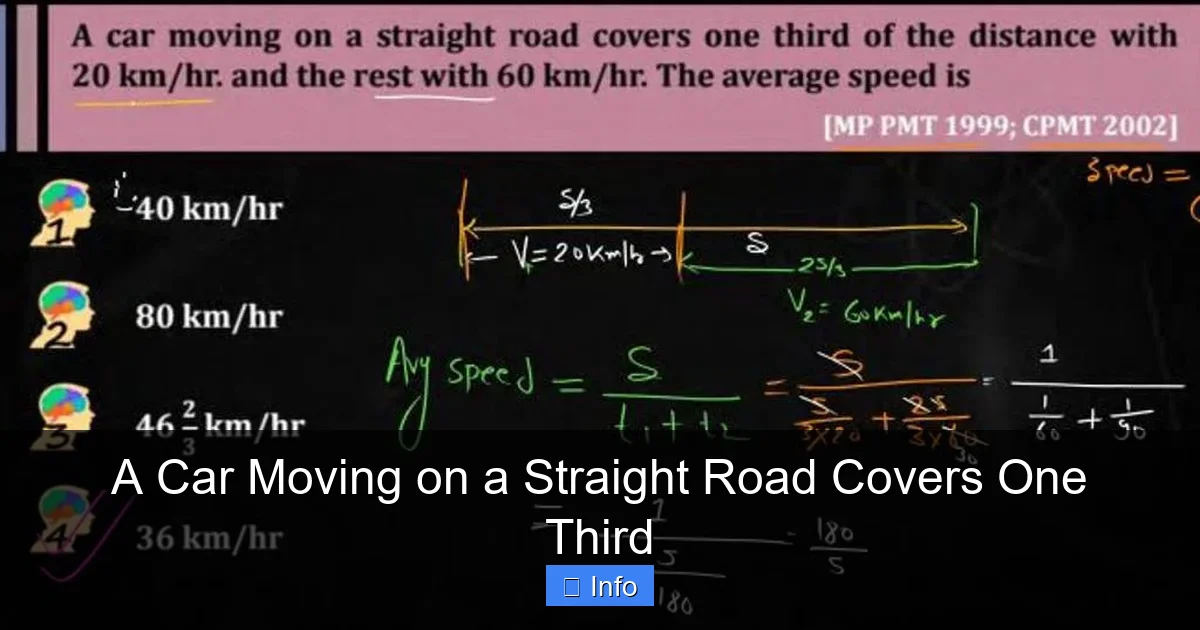
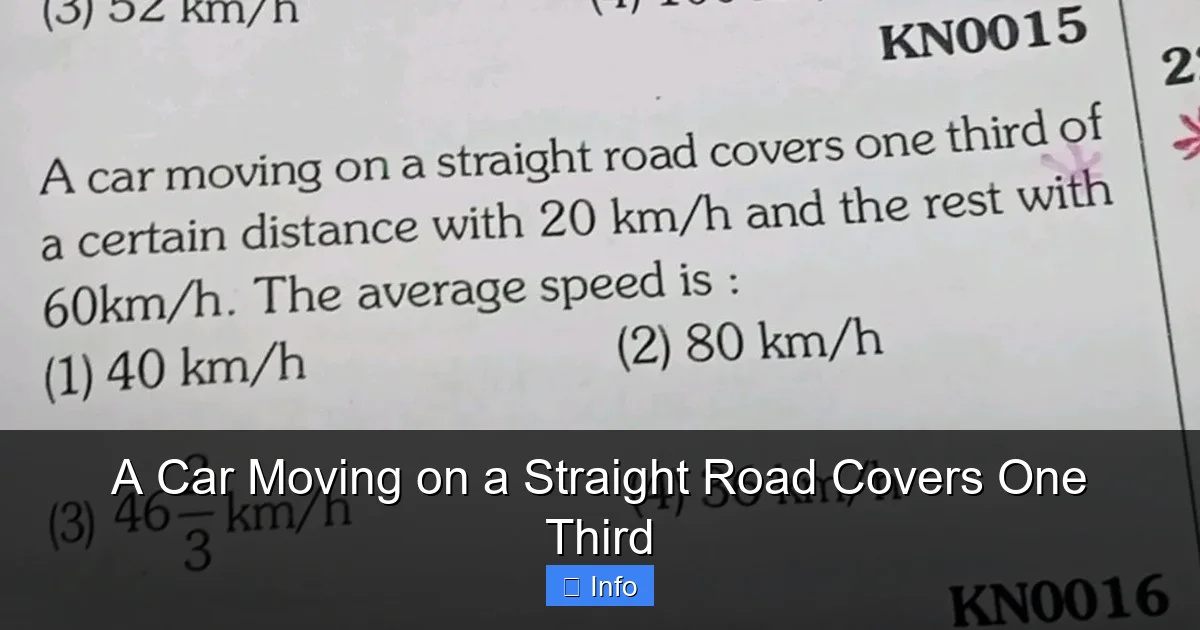
The core formula for any moving car is distance = speed × time. To find when a car moving on a straight road covers one third of the total distance, set distance equal to total distance ÷ 3. Rearranged, the time to reach the one‑third point is (Total Distance ÷ 3) ÷ Speed. For example, if the total distance is 300 km and you are traveling at 100 km/h, the calculation is: (300 ÷ 3) ÷ 100 = 100 ÷ 100 = 1 hour. So after one hour you will have covered exactly one third of the journey.
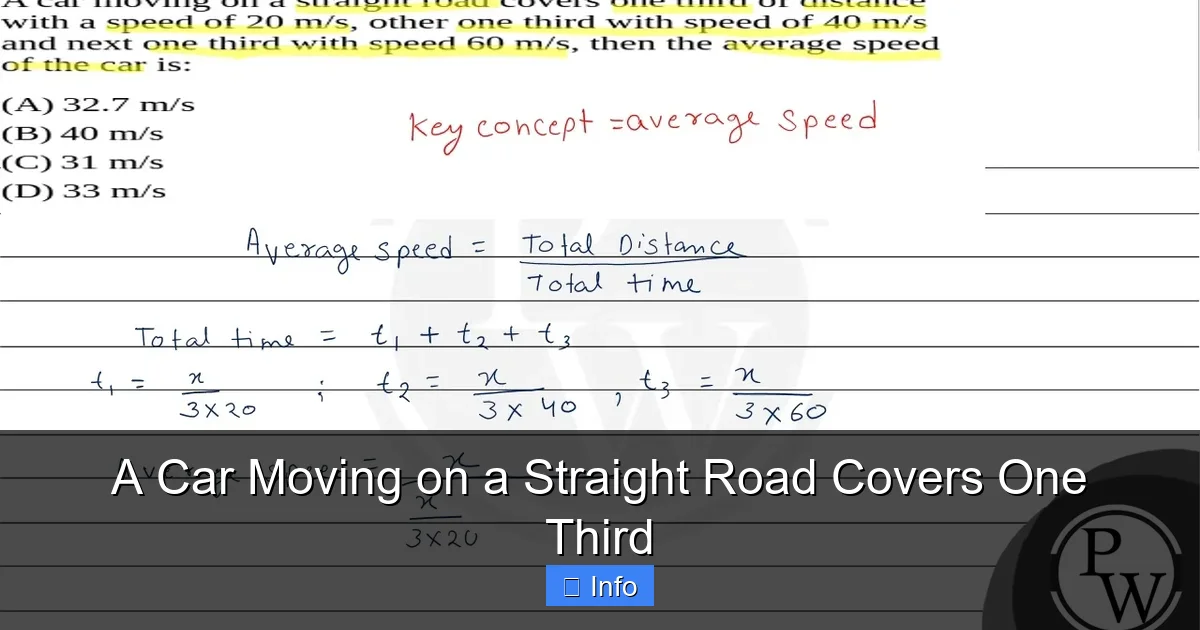
Visual guide about A Car Moving on a Straight Road Covers One Third
Image source: i.ytimg.com
If you prefer to work with minutes, just multiply the result by 60. In the same example, 1 hour equals 60 minutes. This quick conversion helps you set a timer or a phone alarm to remind you to check progress. The same method works for any unit—kilometers, miles, meters, or feet—as long as you keep speed and distance consistent.
Using Speed Variances
Real driving rarely stays at a perfectly constant speed. You may accelerate, brake, or encounter traffic. In such cases, you can still approximate the one‑third point by using an average speed over the segment. Calculate the average speed by dividing the distance traveled by the time taken. Once you have that average, plug it into the basic equation to estimate when you will hit the one‑third mark. This approach is especially useful for long trips where traffic conditions change frequently.
For more precision, you can break the trip into smaller sections and apply the formula to each. For instance, if the first 50 km took 45 minutes, you know you have covered one sixth of a 300 km trip. Continue this process, and you will naturally arrive at the one‑third point without needing a complex calculation. This incremental method also helps you stay engaged with the road, which improves safety.
Tools That Simplify the Math
Modern vehicles come equipped with trip computers that can display average speed, distance traveled, and estimated time remaining. These gadgets often let you set a “lap” or “segment” marker, which you can use to track when a car moving on a straight road covers one third of a predefined distance. If your car does not have this feature, a simple smartphone GPS app can do the job. Open the app, enter your total distance, and watch the progress bar move. When it reaches the one‑third position, you’ll receive a notification (if you enable it) or you can glance at the screen to confirm.
Some drivers also use a notebook or a spreadsheet to log mileage at regular intervals. By noting the odometer reading after every 10 km, for example, you can visually see when you have crossed the one‑third line. This low‑tech method is great for people who prefer tangible records and can be combined with a phone app for backup.
Tips for Drivers: Monitoring One‑Third Progress on Straight Roads
Maintain a Steady Speed with Cruise Control
Cruise control is a valuable ally when you want to keep a constant speed over long stretches of straight road. By locking in a speed, you reduce the need to constantly adjust the throttle, which helps you stay on a predictable distance‑time curve. This predictability makes it easier to know exactly when a car moving on a straight road will have covered one third of the total distance.
When using cruise control, set it to a comfortable highway speed, then focus on the road ahead. Periodically glance at the odometer or the trip computer to confirm that the distance traveled matches your expectations. If you notice you are consistently off by a few kilometers, you may need to adjust the speed for the remainder of the trip.
Use Visual Landmarks
Even with advanced technology, simple visual cues can help you gauge progress. On long highways, look for recurring landmarks—rest areas, bridges, mile markers, or large trees. When you pass the third landmark after the start, you have likely covered roughly one third of the distance (assuming the landmarks are evenly spaced). This technique works especially well on straight roads where there are few distractions.
If you are on a less‑traveled road, count the number of telephone poles or fence posts. Most roads have a pole roughly every 50 feet. By counting, you can estimate how far you have traveled and determine when you have reached the one‑third point. This method also keeps your mind engaged, reducing the risk of driver fatigue.
Plan Breaks at the One‑Third Mark
Many long‑distance drivers follow the “every two hours or every 100 miles” rule for rest. Combining that rule with the one‑third milestone can create an efficient break schedule. For a 300‑mile trip, the one‑third point falls at 100 miles. If you have not yet reached the two‑hour limit, you can still use the 100‑mile marker as a cue to stretch, grab a snack, or switch drivers.
Planning breaks at the one‑third point also helps with fuel management. Gas stations are often placed at regular intervals, and the one‑third mark may align with a convenient stop. By timing your stops this way, you avoid running low on fuel and reduce the chance of unexpected detours.
Safety Considerations When Focusing on Distance Milestones
Stay Alert, Not Distracted
Keeping an eye on distance markers can be a good way to stay focused, but it must not become a distraction. When you glance at the odometer or a GPS app, do it at a safe moment—when you are not merging, turning, or overtaking. Use voice commands or the car’s steering‑wheel controls to adjust your tracking without taking your eyes off the road.
If you are using a smartphone app, enable “hands‑free” mode or mount the device in a secure holder. This ensures you can see the progress without fumbling. Remember, the goal of monitoring when a car moving on a straight road covers one third is to improve planning, not to create a new source of stress.
Adjust for Weather and Road Conditions
Rain, snow, or ice can affect your speed and braking distance. When conditions change, the simple formula of distance = speed × time becomes less accurate. It is wise to increase the gap between your one‑third checkpoints to account for reduced traction. For example, if you normally plan a fuel stop at the one‑third point but are driving through a heavy rainstorm, you might postpone the stop until you feel the road is safer.
Also, be mindful of construction zones or sudden speed limit changes. These interruptions can shift the one‑third point in terms of time, even if the distance remains the same. Use your judgment and adjust your expectations accordingly. The one‑third rule is a guide, not a rigid law.
Communicate With Passengers
If you have passengers in the car, sharing the progress can make the trip more enjoyable. Tell them when you have reached the one‑third point and what you plan to do next—perhaps a quick stretch, a bathroom break, or a snack. This communication keeps everyone informed and reduces anxiety about how much further you have to go.
Passengers can also help watch for landmarks or check the GPS, especially if you need to focus on the wheel. By turning the one‑third tracking into a shared activity, you reinforce safe driving habits and make long drives feel shorter.
Connecting to Broader Concepts: Motion in Physics
Newton’s First Law and Constant Velocity
Newton’s first law states that an object in motion stays in motion unless acted upon by an external force. When a car moving on a straight road covers one third of its journey at a constant speed, it is essentially experiencing zero net force (ignoring friction and air resistance). This ideal scenario is a perfect example of uniform motion, a cornerstone concept in introductory physics.
Understanding this principle helps you see why maintaining a steady speed is efficient. Any acceleration or deceleration requires additional energy, which translates to more fuel consumption. By aiming to keep the speed constant, you align your driving with the physics of motion, making each segment of the trip as economical as possible.
Kinematics Equations in Everyday Life
Kinematics equations describe the relationship between displacement, velocity, acceleration, and time. The simplest of these, s = vt, directly applies when a car moving on a straight road covers one third of the total distance at constant speed. More complex equations, like s = ut + ½at², become relevant when you need to account for acceleration or braking.
For example, if you start from rest and accelerate uniformly to reach the one‑third point, you can use the kinematic formula to calculate how long it took. This knowledge is useful for performance driving, fleet management, and even for understanding how electric vehicles optimize energy use during start‑up phases.
Energy Considerations
Energy consumption in a car is closely tied to distance traveled and speed. When a car moving on a straight road covers one third of its trip, it has used roughly one third of the total energy required, assuming constant efficiency. This relationship helps engineers design engines and transmissions that deliver optimal power at typical cruising speeds.
For electric vehicles, the one‑third point can also indicate battery state of charge. Drivers can plan charging stops based on the remaining two‑thirds of the journey, ensuring they never run out of power mid‑trip. The same principle applies to hybrid vehicles, where the internal combustion engine and electric motor share the workload.
Practical Applications in Fleet Management and Logistics
Route Planning and Delivery Windows
Fleet managers often need to split long routes into manageable segments. The concept of a car moving on a straight road covering one third can be used to create three equal delivery zones. By setting checkpoints at the one‑third and two‑third points, drivers can make quick decisions about refueling, loading/unloading, or taking mandatory rest breaks as required by law.
Using this method, a delivery company can schedule a quick inspection at the one‑third mark, ensuring that any mechanical issues are caught before they become serious. It also helps with driver accountability—each checkpoint can be logged in a telematics system, providing a clear record of progress and compliance.
Fuel Efficiency Tracking
When a car moving on a straight road covers one third of a route, fuel consumption typically follows a similar pattern. Fleet managers can compare actual fuel usage at the one‑third point with expected usage to identify inefficiencies. If the car has used more fuel than predicted, it may indicate aggressive driving, excessive idling, or unnecessary accessories.
By analyzing data at each one‑third segment, managers can adjust driver behavior, optimize routes, and ultimately reduce operating costs. This granular approach is far more effective than looking only at total fuel consumption for the entire trip.
Integrating Internal Resources
For those interested in a deeper dive, you can read more about this scenario in our detailed guide, A Car Moving On A Straight Road Covers One Third. This article expands on the physics, provides step‑by‑step calculations, and includes real‑world case studies from professional drivers. It’s a great supplement for anyone who wants to master the one‑third tracking technique.
Technology Aids: GPS and Telemetry for Tracking One‑Third Segments
Modern GPS Features
Most smartphones and dedicated GPS devices allow you to set waypoints and monitor distance in real time. By creating a waypoint at the start of a trip and another at the total distance, the device will automatically calculate the one‑third point. When a car moving on a straight road reaches that location, you’ll receive an audible alert (if enabled) and a visual marker on the map.
Some advanced GPS units even let you program “progress alerts” at specific percentages—25 %, 50 %, 75 %, and 100 %. This flexibility makes it easy to adapt the one‑third concept to any journey, whether you are planning a short city drive or a cross‑country road trip.
Telematics and Fleet Tracking Systems
Fleet tracking software collects data on speed, location, and engine performance. These systems can automatically flag when a vehicle has covered one third of a predefined route. Managers can view dashboards that highlight the exact moment the car moving on a straight road reaches the milestone, along with related metrics like fuel consumption and driver behavior.
Telematics also enable “geofencing,” where you can set virtual boundaries that trigger notifications when a vehicle enters or exits a zone. By combining geofencing with the one‑third calculation, you can create automated alerts for fuel stops, maintenance checks, or compliance breaks, all without manual intervention.
Mobile Apps for Personal Use
If you prefer a simpler solution, there are many free or low‑cost apps that let you log mileage and set distance milestones. For example, you can open the app, enter your total trip distance, and let it count down as you drive. When the car moving on a straight road covers one third, the app will highlight the progress bar and may send a notification.
Many of these apps also integrate with health and fitness trackers, allowing you to log physical activity alongside your driving data. This dual tracking can be useful for drivers who also cycle or run, helping them maintain an active lifestyle on the road.
Conclusion: Why Understanding One‑Third Matters
Tracking when a car moving on a straight road covers one third of its journey offers a simple yet powerful way to manage distance, time, and resources. Whether you are a daily commuter, a long‑distance traveler, a fleet manager, or a physics student, the one‑third rule provides a clear mental checkpoint that improves planning, safety, and efficiency. By applying basic formulas, using modern technology, and staying aware of road conditions, you can turn this concept into a practical tool for every drive.
Remember that the one‑third milestone is a guide, not a rigid constraint. It works best when combined with good judgment, regular breaks, and an eye for safety. As you continue to practice, you’ll find that this simple division of distance helps you stay focused, reduce stress, and enjoy the road more. So next time you set out on a long straight road, keep an eye on the one‑third point and let it guide you to a smoother, more organized journey.
Frequently Asked Questions
What is the one‑third milestone in driving?
The one‑third milestone refers to the point when a car moving on a straight road has traveled exactly one third of the total distance to its destination. It serves as a useful checkpoint for planning fuel stops, rest breaks, and monitoring progress.
How do I calculate when I will reach the one‑third point?
Use the formula: Time = (Total Distance ÷ 3) ÷ Speed. For example, on a 300‑km trip at 100 km/h, you will reach the one‑third point after 1 hour.
Can the one‑third rule be used in city driving?
Yes. Even short urban routes can be divided into thirds to help you remember stops, such as a coffee break after covering one third of your commute.
Does the one‑third rule account for traffic and stops?
No, the basic rule assumes constant speed. In real driving, you can use an average speed over the segment to estimate the one‑third point more accurately.
What technology helps track the one‑third point?
Modern GPS devices, smartphone navigation apps, and fleet telematics systems can automatically alert you when a car moving on a straight road reaches the one‑third milestone.
Is it safe to look at distance markers while driving?
Yes, as long as you do it safely. Use voice commands, steering‑wheel controls, or mounted devices to avoid taking your eyes off the road for long periods.