A Car Accelerates Uniformly from 18 Km
Understanding uniform acceleration helps you predict how a car moving at 18 km/h will change its speed over time. This guide breaks down the math, gives real‑world tips, and highlights safety steps you can take.
Key Takeaways
- Uniform acceleration basics: A car that accelerates uniformly from 18 km/h gains the same speed increase each second, making calculations simple.
- Core formulas: Use v = u + at, s = ut + ½at², and v² = u² + 2as to find speed, distance, and time.
- Real‑world relevance: City driving, highway merges, and racing tracks all use the same principles when a car accelerates uniformly from 18 km.
- Practical tips: Keep gear changes smooth, monitor brake distance, and adjust for road conditions to maintain uniform acceleration.
- Safety first: Understanding the math lets you anticipate required stopping distances and avoid sudden speed changes.
- Further learning: Explore related guides on constant rate acceleration and high‑speed uniform motion for deeper insight.
📑 Table of Contents
Introduction
When you sit behind the wheel, you probably notice the feeling when a car accelerates uniformly from 18 km/h. This might happen as you merge onto a highway or speed up in city traffic. The motion feels smooth because the engine delivers a steady force. Knowing why this happens can help you drive smarter. It also lets you predict how far you’ll travel in a given time. In this article we’ll explore the science behind uniform acceleration, show you how to calculate speed, distance, and time, and give you tips to apply these ideas safely on the road.
Why Uniform Acceleration Matters
Uniform acceleration means the car’s speed changes by the same amount each second. If a car accelerates uniformly from 18 km/h, it might reach 36 km/h after a set period, then 54 km/h after the same period again. This consistency makes the math predictable. You can use simple formulas to find out how long it takes to reach a target speed or how far the car travels while speeding up. Understanding this concept is useful for everyday drivers and aspiring engineers alike. It also ties into broader topics like uniform motion and constant rate acceleration.
What You’ll Learn
In the sections that follow we’ll break down the key equations, walk through example problems, and share practical driving tips. You’ll see how the theory works in real situations, from a city lane change to a highway merge. We’ll also discuss safety considerations so you can apply the knowledge without compromising control. By the end of this guide you’ll feel confident talking about a car that accelerates uniformly from 18 km and using the math to make better driving decisions.
Understanding Uniform Acceleration
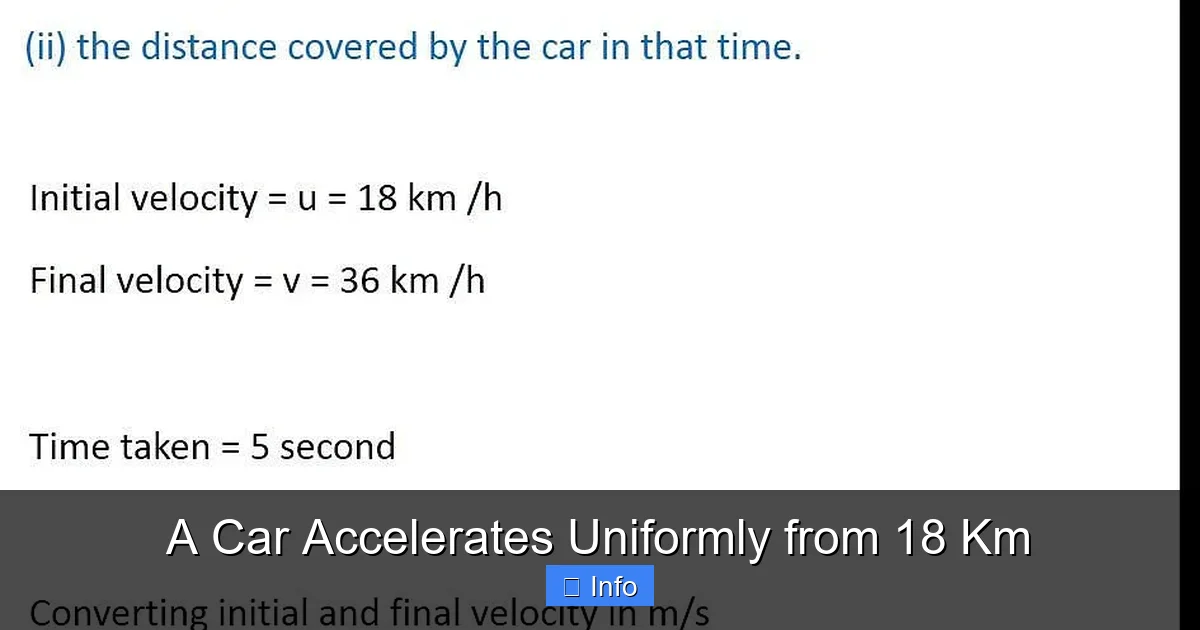
Visual guide about A Car Accelerates Uniformly from 18 Km
Image source: cdn.teachoo.com
What Is Uniform Acceleration?
Uniform acceleration is a change in velocity that occurs at a constant rate. In everyday language you might say the car speeds up steadily. If a car accelerates uniformly from 18 km/h, the increase in speed per second stays the same. For example, if the acceleration is 2 m/s², after one second the speed is 20 m/s, after two seconds it is 22 m/s, and so on. This steady increase makes the motion easy to describe with formulas.
How It Differs From Non‑Uniform Cases
Non‑uniform acceleration means the rate of speed change varies. You might feel the engine pulling harder at some points and softer at others. In real life traffic, acceleration is rarely perfectly uniform. However, many textbook problems and driver‑assist systems assume uniform acceleration to simplify calculations. When you know a car accelerates uniformly from 18 km/h, you can trust that the same acceleration applies throughout the period you are measuring.
Real‑World Relevance
Understanding uniform acceleration helps you predict how quickly a vehicle can reach a desired speed. This knowledge is handy for safe lane changes, merging onto freeways, and even for fuel‑efficiency planning. It also connects to broader concepts like constant rate acceleration and high‑speed uniform motion. By mastering the basics, you can better appreciate how modern driver‑assist features use these principles to keep traffic flowing smoothly.
Calculating Speed, Distance, and Time
The Basic Formulas
Three core equations govern uniformly accelerated motion:
- v = u + a t – final velocity equals initial velocity plus acceleration times time.
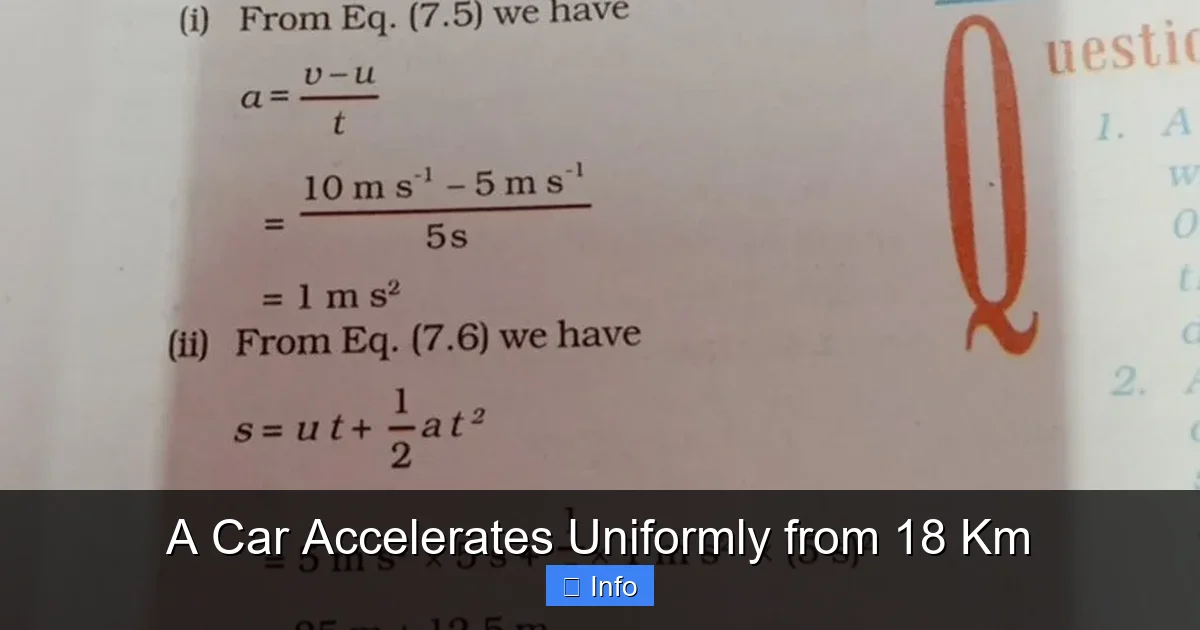
- s = u t + ½ a t² – distance equals initial velocity times time plus half acceleration times time squared.
- v² = u² + 2 a s – final velocity squared equals initial velocity squared plus twice acceleration times distance.
These formulas work for any situation where a car accelerates uniformly. They also work when the car starts from a non‑zero speed, such as when a car accelerates uniformly from 18 km/h.
Plugging In 18 km/h
Suppose the initial speed u is 18 km/h. First convert to meters per second: 18 km/h = 5 m/s (approximately). If the car accelerates at 2 m/s² for 3 seconds, you can find the final speed:
v = u + a t = 5 m/s + (2 m/s² × 3 s) = 11 m/s, which is about 39.6 km/h.
You can also find the distance traveled using s = u t + ½ a t² = 5 × 3 + ½ × 2 × 9 = 15 + 9 = 24 m. This shows how quickly the car covers ground while accelerating uniformly from 18 km/h.
Example Calculations
Let’s try another scenario. A driver wants to know how long it takes to go from 18 km/h to 54 km/h with a uniform acceleration of 1.5 m/s². Convert speeds: u = 5 m/s, v = 15 m/s. Use v = u + a t:
t = (v – u) / a = (15 – 5) / 1.5 = 6.67 seconds.
During those 6.67 seconds the car travels s = u t + ½ a t² = 5 × 6.67 + ½ × 1.5 × (6.67)² ≈ 33.35 + 33.35 = 66.7 m. This distance is useful for judging safe merging points.
Using the Equations in Practice
When you are behind the wheel, you can apply these formulas mentally to estimate stopping distances or acceleration needs. For instance, if you notice a gap that requires you to speed up from 18 km/h to 36 km/h, you can roughly calculate the time needed based on your acceleration capability. This mental math improves reaction time and confidence. It also ties back to concepts covered in constant rate acceleration articles, which explore similar calculations starting from rest.
Real‑World Examples and Tips
Visual guide about A Car Accelerates Uniformly from 18 Km
Image source: storage.googleapis.com
City Driving Scenario
In a city, you often start from a stop or a low speed like 18 km/h. When the light turns green, you may accelerate uniformly to reach the speed limit of the block. By applying the formulas, you can estimate how far you’ll travel before reaching the next intersection. This helps you time your acceleration so you don’t have to brake hard later. Smooth acceleration also reduces fuel consumption and wear on brakes.
Highway Merge
Merging onto a highway is a classic case for uniform acceleration. You start at 18 km/h and need to match the flow of traffic, perhaps 90 km/h. Knowing your vehicle’s acceleration capability lets you judge when to begin speeding up. Using the equation v = u + a t, you can calculate the time needed. For example, with an acceleration of 3 m/s², the time to reach 25 m/s (≈90 km/h) from 5 m/s is about 6.67 seconds. This helps you plan a safe merge without cutting off other drivers.
Practical Tips for Smooth Acceleration
- Keep revs steady. Avoid sudden throttle changes to maintain uniform acceleration.
- Use the accelerator pedal gently. A light foot creates a smoother speed increase.
- Check your gear. In automatic cars, staying in a suitable gear helps keep acceleration constant.
- Monitor the road. Adjust acceleration based on traffic, weather, and road surface.
These tips ensure that when you intend to accelerate uniformly from 18 km/h, you actually do so, which improves safety and comfort.
How to Apply These Calculations
Start by noting your current speed. Convert it to meters per second if you want to use standard physics formulas. Decide on a target speed and estimate your vehicle’s acceleration capability (you can find this in the spec sheet). Plug the numbers into v = u + a t to get the time needed. Then use s = u t + ½ a t² to see how far you’ll travel. This simple process lets you make informed decisions while driving, and it connects directly to concepts explored in constant rate acceleration guides.
Safety Considerations When Accelerating Uniformly
Maintaining Control
Uniform acceleration is safe only when you keep the vehicle’s traction and stability. Sudden increases in speed can overwhelm tire grip, especially on wet or icy surfaces. If a car accelerates uniformly from 18 km/h on a slippery road, you may still lose control if the acceleration is too high. Always match your speed to road conditions.
Braking Distance
Understanding acceleration also helps you calculate braking distance. If you know how quickly you can speed up, you can estimate how long it will take to slow down. The same formulas apply in reverse: a negative acceleration (deceleration) reduces speed over time. Keeping this balance reduces the risk of rear‑ending the vehicle ahead.
Adjusting for Weather
Rain, snow, or strong winds affect how uniformly a car can accelerate. In adverse weather, aim for a lower, more controlled acceleration rate. This preserves tire grip and ensures the car’s motion remains predictable. Using the uniform acceleration model as a baseline helps you recognize when conditions force you to deviate from it.
When to Use the Knowledge
You can apply these principles during lane changes, overtaking maneuvers, and city driving. For example, when you want to overtake a slower vehicle, you might accelerate uniformly from 18 km/h to a higher speed. Calculating the time and distance needed ensures you have enough clear road to complete the maneuver safely. This approach also aligns with advice found in articles about high‑speed uniform motion, which discuss similar scenarios at greater velocities.
Conclusion
Understanding how a car accelerates uniformly from 18 km/h opens the door to smarter driving and better vehicle control. By learning the basic formulas, practicing simple calculations, and applying real‑world tips, you can predict speed changes, judge distances, and make safer decisions on the road. Uniform acceleration is not just a physics concept; it is a practical tool for everyday drivers. Keep the key takeaways in mind, use the calculations when you need them, and always prioritize safety. With this knowledge, you’ll feel more confident whether you are merging onto a highway, navigating city traffic, or simply enjoying a smooth cruise. Safe driving!
Frequently Asked Questions
What is a car accelerates uniformly from 18 km?
a car accelerates uniformly from 18 km is an important topic with many practical applications.