
A Car Travelling at 60km Hr Overtakes
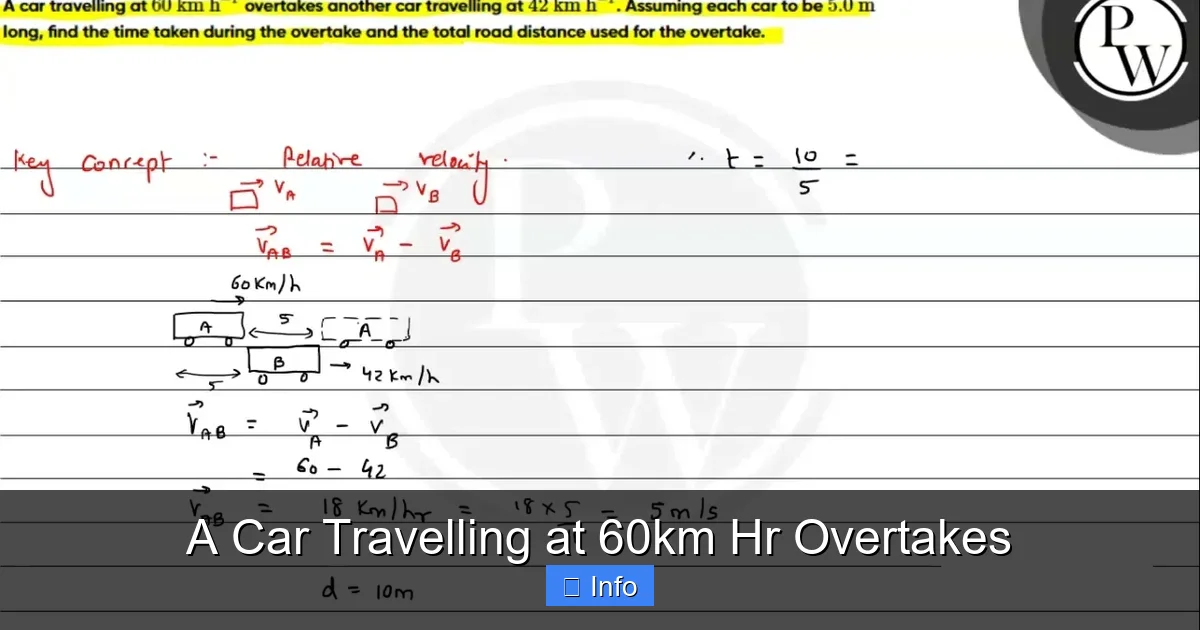
When a car travels at 60 km/h and decides to overtake, it must carefully assess speed differences, road conditions, and safety margins. This article explains the physics behind overtaking, offers practical tips, and highlights key considerations for drivers.
When you are behind the wheel and you see a slower car ahead, the thought of overtaking can be tempting. Understanding the dynamics of a car travelling at 60km hr overtakes is essential for both safety and efficiency. This article will guide you through the key concepts, from basic physics to real‑world application, helping you make informed decisions on the road.
Key Takeaways
- Understanding relative speed: The overtaking vehicle must be faster than the vehicle ahead, and the difference determines the time needed.
- Calculating overtaking distance: Use the formula distance = relative speed × time to estimate the required road length.
- Checking visibility and weather: Clear sight lines and good road conditions are essential for a safe overtake.
- Using signals and mirrors: Proper signaling and mirror checks help communicate intent and avoid blind‑spot accidents.
- Maintaining safe following distance: Keeping a buffer zone reduces the risk of collision if the lead vehicle brakes suddenly.
- Knowing when to abort: If conditions change, it is safer to stay behind rather than force the maneuver.
📑 Table of Contents
What Does It Mean When a Car Travelling at 60 km/h Overtakes?
Overtaking is a maneuver where one vehicle passes another that is traveling in the same direction. In our scenario, the overtaking car moves at 60 km/h, while the vehicle ahead may be moving at a lower speed, such as 50 km/h. The difference in speed, known as relative velocity, determines how quickly the overtaking car can close the gap and complete the pass.
Defining the Scenario
Imagine a straight, two‑lane road with clear visibility. The lead vehicle maintains a constant speed, while the overtaking car accelerates from 60 km/h to a higher speed to complete the maneuver. The key variables are the initial speed of the overtaking car, the speed of the lead vehicle, and the distance between them at the moment the driver decides to overtake. By assessing these factors, a driver can estimate whether the road ahead provides enough space for a safe pass.
Typical speeds for overtaking can vary. On a 60 km/h road, a driver might encounter a vehicle traveling at 55 km/h, 50 km/h, or even slower. The greater the speed difference, the shorter the time needed to pass, but also the higher the risk if something goes wrong. Understanding these dynamics helps drivers gauge when it is appropriate to initiate an overtake.
Legal considerations also play a role. In many jurisdictions, overtaking is prohibited on curves, hills, or when visibility is limited. Familiarizing yourself with local traffic laws ensures that your maneuver is not only safe but also compliant with the law.
The Physics Behind Overtaking
The act of overtaking is governed by Newton’s laws of motion. The first law, inertia, explains why both vehicles tend to maintain their current state of motion unless acted upon by a force. The second law, F = ma, describes how the overtaking car must produce a net force to accelerate and increase its speed relative to the lead vehicle.
Visual guide about A Car Travelling at 60km Hr Overtakes
Image source: i.ytimg.com
Newton’s Laws and Force
To overtake, the driver must apply a force through the engine, creating acceleration. The greater the force, the faster the car can increase its speed. However, the mass of the vehicle also plays a role; a heavier car requires more force to achieve the same acceleration. This relationship is fundamental to understanding how quickly a vehicle can change its velocity during an overtake.
Kinetic Energy and Power
The kinetic energy of a moving object is given by KE = ½ mv². When the overtaking car accelerates, its kinetic energy increases, requiring work from the engine. The power needed to achieve a certain acceleration can be calculated using P = Fv, where F is the force and v is the velocity. This relationship highlights why high speeds demand more engine power to maintain acceleration during an overtake.
Friction and Traction
The ability to accelerate during an overtake depends on the friction between tires and road. Slick or icy surfaces reduce traction, making it harder to achieve the necessary acceleration. In such conditions, even a small increase in speed can cause wheel slip, emphasizing the need for caution when overtaking on low‑friction roads.
Relative Velocity
The relative velocity between the two vehicles is the difference in their speeds. If the overtaking car travels at 60 km/h and the lead car at 50 km/h, the relative velocity is 10 km/h. This value is crucial for estimating the time needed to pass and the distance required. For a deeper dive into relative motion, see A Car Is Travelling Along The Road At 8M S, which explores similar concepts.
Converting between units is often necessary. For example, 10 km/h equals approximately 2.78 m/s, a conversion that is useful when estimating distances in meters. Being comfortable with these conversions allows drivers to quickly assess whether they have enough space to safely pass.
Estimating Time to Pass
A quick way to estimate the time needed to overtake is to divide the distance between the vehicles by the relative speed. For example, if the gap is 50 meters and the relative speed is 10 km/h (2.78 m/s), the time is roughly 18 seconds. This estimate helps drivers decide if they have enough time before reaching a curve or intersection.
Relative Speed and Distance Calculations
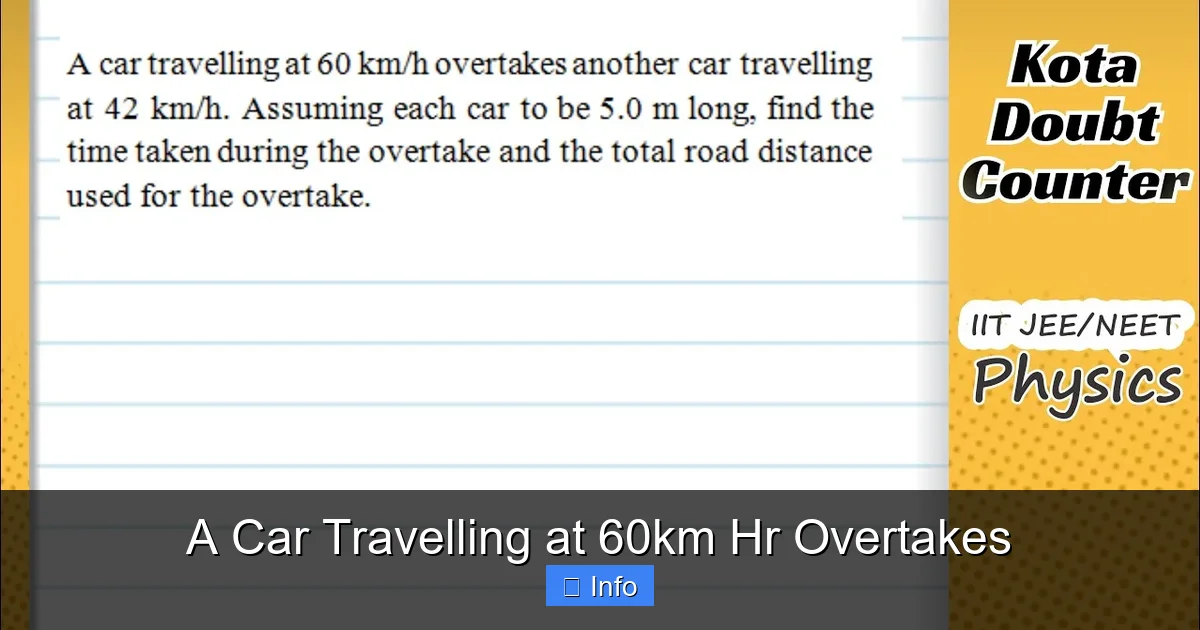
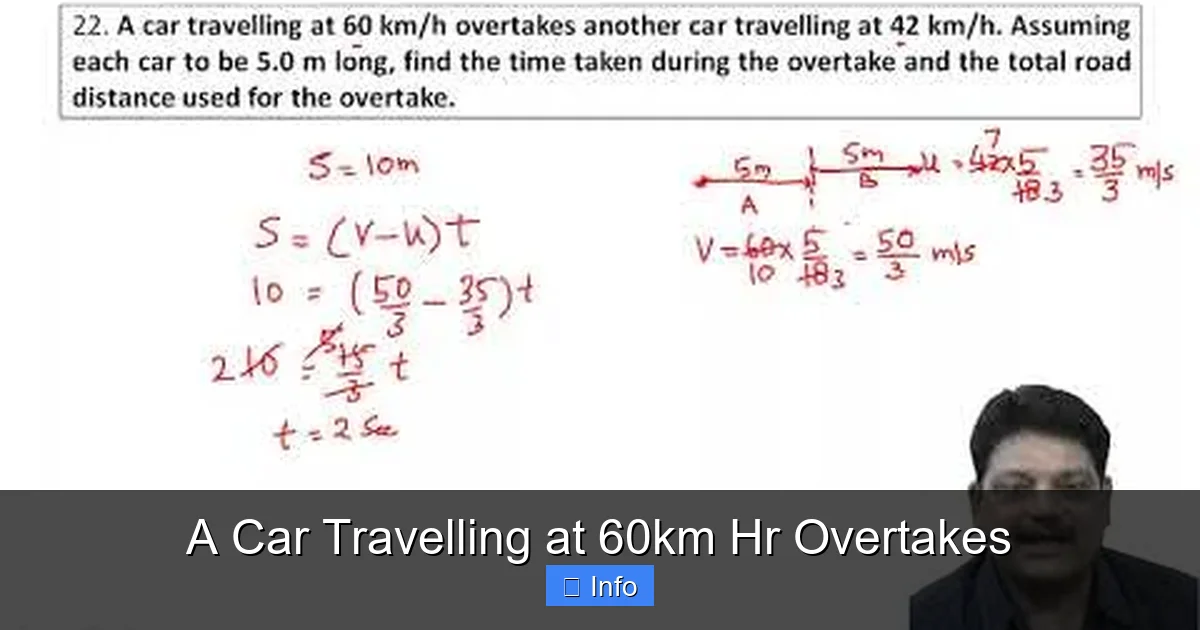
Knowing how to calculate the overtaking distance helps drivers decide whether it is safe to proceed. The basic formula is: distance = relative speed × time. By estimating the time required to pass, a driver can approximate the necessary road length. However, real‑world scenarios involve additional factors such as acceleration, deceleration, and road grade.
Visual guide about A Car Travelling at 60km Hr Overtakes
Image source: i.ytimg.com
Formula for Overtaking Distance
If the relative speed is 10 km/h (approximately 2.78 m/s) and the driver estimates it will take 5 seconds to complete the pass, the required distance is about 13.9 meters. This simplified calculation assumes constant relative speed, but in practice the overtaking car may accelerate, changing the relative speed over time. For a similar calculation with different speeds, refer to A Car Traveling With A Velocity Of 80 Km Hr, which explores overtaking at higher velocities.
Accounting for Acceleration
In reality, the overtaking car does not maintain a constant relative speed; it accelerates, which changes the relative speed over time. The distance required can be found by integrating the relative velocity over the time of the maneuver. A simplified approach is to use the average relative speed, which can be approximated as the initial relative speed plus half the increase in speed during the overtake.
Impact of Grade
When the road is uphill, the overtaking car must overcome an additional component of gravity, increasing the required force and extending the distance needed to pass. Conversely, on a downhill slope, the vehicle may accelerate more quickly, but the increased speed can also reduce control. Adjusting expectations based on road grade is essential for safe overtaking.
Wind Resistance
Strong crosswinds can push a vehicle sideways, making it harder to maintain lane position during an overtake. Drivers should be aware of wind direction and speed, especially in open areas or on bridges, and may need to reduce speed or postpone the maneuver if conditions are adverse.
Safety Factors and Road Conditions
Even with a perfect understanding of physics, safety must be the top priority. Several external factors influence whether an overtaking maneuver is advisable. Drivers should always consider visibility, weather, road layout, and traffic conditions before attempting to pass.
Visual guide about A Car Travelling at 60km Hr Overtakes
Image source: i.ytimg.com
Visibility and Weather
Clear sight lines are essential. Fog, rain, or glare can reduce visibility, making it difficult to judge distances. In such conditions, it is often safer to remain behind the lead vehicle. Understanding constant speed dynamics can also aid decision‑making; see A Car Traveling At A Constant Speed Of 20M S for more on steady‑state motion.
Road Layout and Markings
The presence of curves, hills, or intersections increases risk. Solid yellow lines indicate no passing, while broken white lines suggest it may be permissible. Always obey road markings and signals. Additionally, the width of the lane and the presence of oncoming traffic must be evaluated to ensure there is enough space for the maneuver.
Driver Fatigue and Distraction
Fatigue can significantly impair a driver’s ability to judge distances and react to changing conditions. A tired driver may misjudge the speed of the lead vehicle or fail to notice oncoming traffic. Similarly, distractions such as mobile phones or adjusting the radio can delay reaction times, making an overtake more dangerous. Ensuring alertness is a critical part of safe overtaking.
Road Surface Conditions
Wet or uneven pavement can affect braking and steering response. If the road is wet, the overtaking car may require a longer distance to stop if an emergency arises. Always consider the condition of the pavement before initiating an overtake, especially after rain or when debris is present.
Practical Tips for Safe Overtaking
Applying the theoretical knowledge to everyday driving requires a systematic approach. Below are actionable tips to enhance safety when overtaking. By following these guidelines, drivers can reduce the likelihood of accidents and increase confidence on the road.
Before the Maneuver
- Check mirrors and blind spots thoroughly to ensure no vehicles are approaching from behind.
- Signal your intention well in advance, using turn signals to communicate with other road users.
- Ensure there is sufficient space ahead without oncoming traffic, and verify that the road is straight and clear.
- Assess the speed of the lead vehicle; avoid overtaking if it is accelerating or if the gap is closing.
During the Overtake
- Maintain a steady acceleration; avoid sudden jerks that could cause loss of control.
- Keep a safe lateral distance from the overtaken vehicle, typically at least 1.5 meters on highways.
- Monitor the road ahead for unexpected obstacles, such as debris or animals.
- Return to the original lane only when the entire vehicle is clear of the lead car, and signal your intention to move back.
Utilizing Driver Assistance Systems
Many modern vehicles are equipped with lane‑keep assist, blind‑spot monitoring, and adaptive cruise control. These systems can provide warnings or even intervene to prevent unsafe lane changes. While they are helpful, they should not replace manual checks; always verify the surroundings before changing lanes.
In addition to driver assistance, maintaining a proper following distance behind the lead vehicle gives you more time to react if the lead car suddenly brakes. A common rule is the two‑second rule, which can be adjusted based on speed and road conditions.
Real-Life Scenarios and Examples
Seeing how these principles apply in everyday situations can reinforce understanding. Consider the following examples, which illustrate the importance of proper calculation and caution.
Highway Overtaking
On a multi‑lane highway, a driver traveling at 60 km/h may encounter a truck moving at 55 km/h. By calculating the relative speed and ensuring a clear view of the road ahead, the driver can safely pass the truck, returning to the right lane once the truck is fully behind. In this case, the relative speed of 5 km/h means the overtaking car gains 5 km/h on the truck, requiring a longer distance than if the speed difference were larger.
Urban Overtaking
In city traffic, a car moving at 60 km/h might need to overtake a slower bus. The driver must be extra cautious due to potential pedestrians, intersections, and tighter lane widths. In such cases, it is often wiser to wait for a safer opportunity, especially if the bus is stopping frequently or if there is oncoming traffic. The complexity of urban environments highlights the need for thorough situational awareness.
Rural Road Overtaking
On a rural two‑lane road, a driver at 60 km/h may encounter a slow‑moving tractor. The lack of streetlights and the presence of curves require extra caution. In such situations, it is often best to wait until a straight, clear stretch of road appears before attempting to pass.
Mountain Road Overtaking
On winding mountain roads, overtaking is often prohibited due to limited visibility and sharp curves. Even if the road appears clear, the presence of blind corners means that oncoming traffic may appear unexpectedly. In these environments, patience is the safest policy.
Conclusion
Overtaking is a common yet potentially hazardous driving maneuver. When a car travelling at 60km hr overtakes, success depends on understanding relative speed, calculating necessary distance, and adhering to safety practices. By applying the physics principles and tips outlined above, drivers can make informed decisions, reducing risk and improving overall road safety. Remember that patience and caution are often the best tools for a successful overtake.
Ultimately, mastering overtaking involves balancing speed with caution, and continuously refining your judgment through experience and education.
Frequently Asked Questions
What is the relative speed when a car travelling at 60 km/h overtakes a vehicle moving at 50 km/h?
The relative speed is the difference between the two speeds, which in this case is 10 km/h. This value determines how quickly the overtaking car can close the gap.
How much distance is needed to safely overtake at 60 km/h?
The required distance depends on the relative speed and the time needed to pass. A basic estimate uses distance = relative speed × time, but real‑world factors like acceleration and road grade must also be considered.
What are the main safety checks before overtaking?
Before overtaking, check mirrors and blind spots, signal your intention, ensure clear visibility, verify that the road is straight, and confirm there is no oncoming traffic.
How does weather affect overtaking?
Adverse weather such as fog, rain, or glare reduces visibility and can make it harder to judge distances. Wet roads also increase stopping distance, making overtaking more hazardous.
Can driver assistance systems help with overtaking?
Yes, systems like lane‑keep assist and blind‑spot monitoring can warn you of potential dangers, but they should not replace manual checks. Always verify the surroundings before changing lanes.
When should you abort an overtaking maneuver?
You should abort if visibility becomes poor, if the lead vehicle suddenly accelerates, if oncoming traffic appears, or if you feel uncertain about completing the pass safely.


