4 Inch Car Speakers with Good Bass
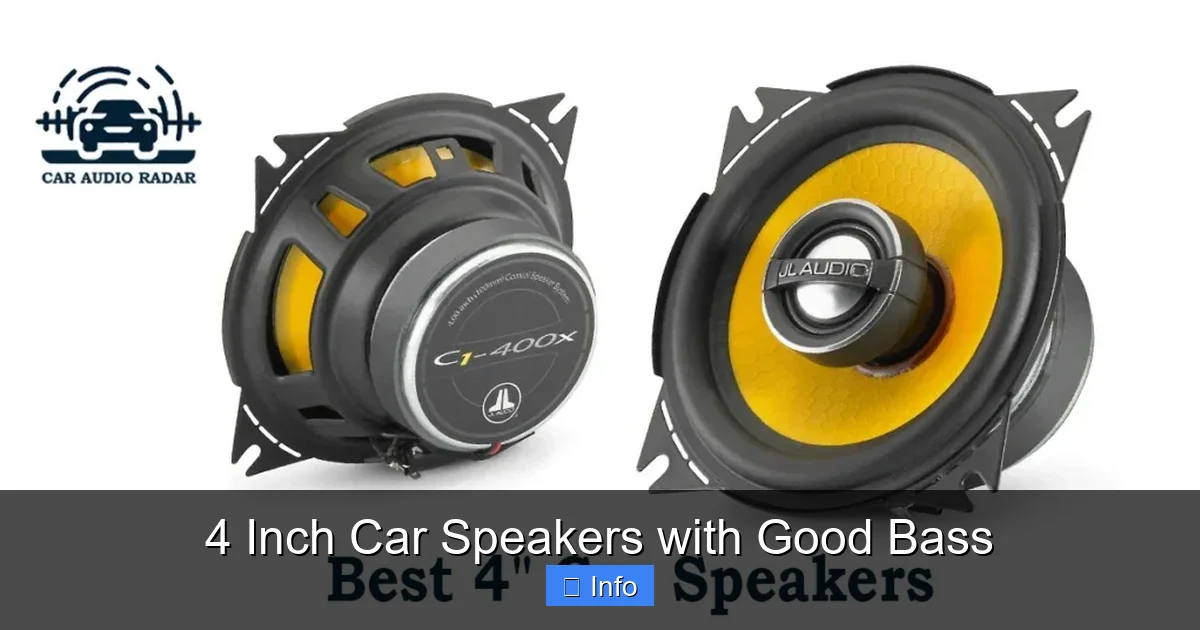
Upgrading to 4 inch car speakers with good bass is the smartest way to get punchy low-end without sacrificing space or requiring a massive amplifier. These compact drivers fit factory locations in most vehicles and deliver surprising depth when chosen correctly. This guide covers everything you need to know to pick the perfect set for your ride.
Key Takeaways
- Size matters: 4-inch speakers fit tight factory spots but need specific design features to produce real bass.
- Component vs. coaxial: Component sets offer better imaging and bass response, while coaxials are easier to install.
- Power handling is key: Match RMS ratings to your head unit or amp to avoid distortion at high volumes.
- Sensitivity ratings: Higher sensitivity (90dB+) means louder, cleaner bass with less power.
- Cone materials: Polypropylene or mica-injected cones resist heat and deliver tighter low-end than paper.
- Installation quality: Proper sealing and sound deadening dramatically improve bass output from small drivers.
- Budget vs. performance: Mid-range models often hit the sweet spot for bass quality per dollar spent.
📑 Table of Contents
- Why 4 Inch Speakers Are a Smart Upgrade
- Understanding Bass Physics in Small Drivers
- Coaxial vs. Component: Which Delivers Better Bass?
- Critical Specs That Actually Predict Bass Performance
- Top Design Features for Maximum Bass Output
- Installation Secrets That Unlock Hidden Bass
- Matching Speakers to Your System: Real-World Scenarios
- Common Mistakes That Kill Bass Performance
- Budget Tiers: What to Expect at Each Price Point
- When to Consider Larger Speakers Instead
- Final Thoughts: Small Speakers, Big Sound
Why 4 Inch Speakers Are a Smart Upgrade
Most factory sound systems use tiny drivers that barely move air. They sound thin, harsh, and completely lack low-end authority. Swapping them for quality 4 inch car speakers with good bass changes the entire character of your audio. You get tighter mid-bass, clearer vocals, and a soundstage that actually feels like music.
The beauty of this size is compatibility. They slide into most dashboard, door, and rear deck locations without cutting metal or building custom brackets. That means a weekend install with basic hand tools. No fiberglass work. No major wiring nightmares. Just better sound.
But not all 4-inch speakers are created equal. Marketing claims about “deep bass” often fall flat in real-world listening. You need to know what specs actually translate to performance. That’s exactly what we’ll break down here.
Understanding Bass Physics in Small Drivers
The Physics Challenge
Bass requires moving air. Larger cones move more air with less excursion. A 4-inch driver has roughly 8 square inches of surface area. Compare that to a 6.5-inch speaker at 33 square inches or an 8-inch sub at 50 square inches. The math is brutal.
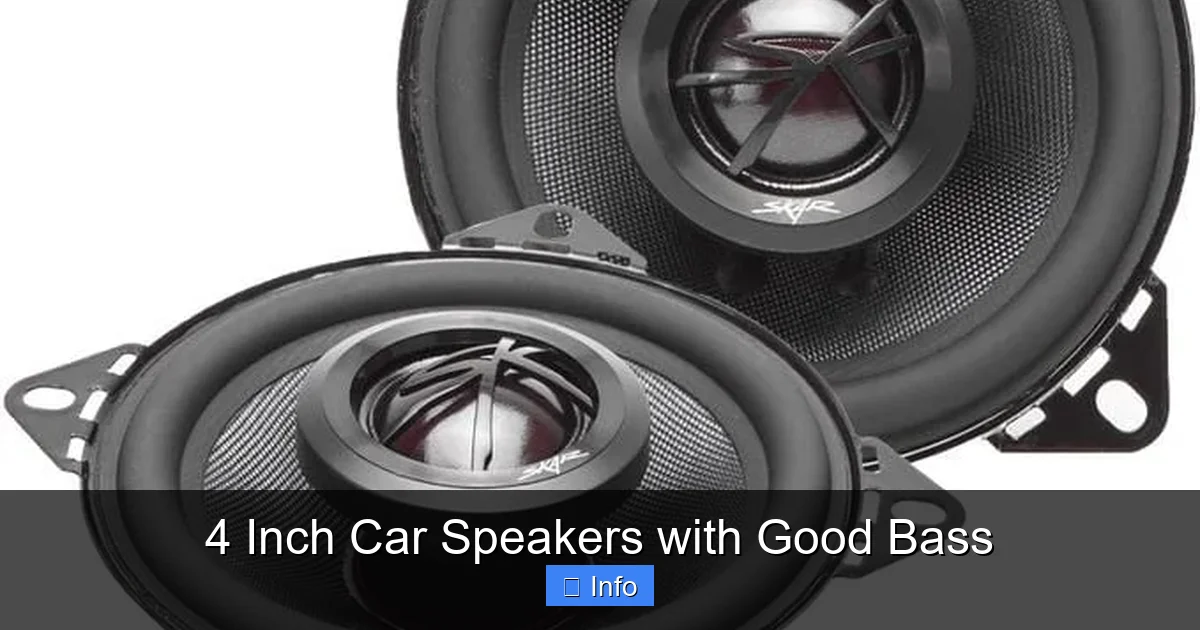
Visual guide about 4 Inch Car Speakers with Good Bass
Image source: audiospeaks.com
To compensate, engineers use three tricks: longer excursion (how far the cone moves), stiffer suspensions, and optimized enclosures. The best 4-inch designs maximize all three. They use high-roll surrounds, powerful motor structures, and cones that stay rigid under stress.
Frequency Response Reality
Ignore marketing claims of “30Hz response” on a 4-inch speaker. In a car door, physics dictates a realistic low-end around 60-80Hz. That’s mid-bass territory — the punch of a kick drum, the thump of a bass guitar. It’s not sub-bass you feel in your chest. For that, you still need a subwoofer.
But here’s the secret: most music lives in that 60-200Hz range. Nail that, and your system sounds full and balanced. Miss it, and everything sounds thin regardless of how much subwoofer you add later.
The Enclosure Effect
Your door panel is an enclosure. A leaky, resonant one. Sealing it with closed-cell foam tape and adding sound deadening (like Dynamat or cheaper alternatives) can add 3-6dB of mid-bass output. That’s like doubling your amplifier power for free. We’ll cover this more in the installation section.
Coaxial vs. Component: Which Delivers Better Bass?
Coaxial (Full-Range) Simplicity
Coaxials mount the tweeter on a pole piece above the woofer. One basket, one hole, two wires. Installation takes 20 minutes per side. Modern designs use neodymium tweeter magnets and phase plugs to minimize interference with the woofer cone.
For bass, coaxials have a slight disadvantage. The tweeter housing sits in the center of the cone, reducing effective radiating area by 10-15%. The pole piece can also create turbulence at high excursion. But good ones minimize this.
Component Sets: Separation Advantage
Components separate the woofer and tweeter. The woofer gets a clean, unobstructed cone. The tweeter mounts optimally for imaging — usually in the A-pillar or dash. Crossovers are higher quality, with steeper slopes protecting the woofer from low frequencies it can’t handle.
This separation lets the woofer focus purely on mid-bass. Result: cleaner, louder, more authoritative low-end. The tradeoff? More complex install. You need to run new tweeter wires, mount crossovers, and find tweeter locations.
Our Recommendation
If you’re running factory power (15-20 watts RMS), a high-quality coaxial is the smart play. The tweeter integration is optimized for low power. If you’re adding an amplifier (50+ watts RMS per channel), components pull ahead. The cleaner power lets their superior motor structures and crossovers shine.
For a curated list of top performers in both categories, check out our guide on best 4 inch car speakers and best 4 inch component car speakers.
Critical Specs That Actually Predict Bass Performance
RMS Power Handling: The Honest Number
Ignore peak power. It’s a marketing fantasy. RMS (Root Mean Square) tells you continuous power the speaker handles without damage or distortion. For 4-inch speakers, look for 40-60 watts RMS minimum. This ensures the voice coil and suspension can handle the excursion needed for bass without overheating or bottoming out.
Match this to your source. Factory head unit? 15-20 watts RMS is typical. Aftermarket head unit? 18-25 watts RMS. External amp? 50-75 watts RMS per channel is the sweet spot. Underpowering causes clipping distortion which kills speakers faster than clean overpowering.
Sensitivity: Your Volume Multiplier
Measured in dB at 1 watt/1 meter. Every 3dB increase equals doubling perceived loudness at the same power. A 92dB speaker plays twice as loud as an 89dB speaker on the same amp. For factory power, target 90dB+. For amplified systems, 87-89dB is fine since you have headroom.
High sensitivity usually means lighter cones and stronger magnets. Both help bass response. The cone moves faster and with more control.
Frequency Response Range
Look for a low-end number around 60-75Hz. Anything claiming below 50Hz on a 4-inch driver is either measured in a perfect infinite baffle (not your door) or at -10dB (barely audible). The high-end should reach 20kHz minimum for the tweeter.
More important than the numbers is the response curve. A flat response from 80Hz-5kHz matters more than a 50Hz spec with a huge dip at 200Hz. Read reviews with measurement graphs when possible.
Cone Material and Design
Polypropylene (PP): The standard. Light, stiff, water-resistant. Good all-rounder.
Mica-Injected PP: Stiffer, better damping. Reduces cone breakup resonance. Excellent for bass clarity.
Woven Fiber (Kevlar, Carbon, Glass): Very stiff, very light. Expensive. Can sound “clinical” if not damped well.
Aluminum/Magnesium: Rigid but can ring. Needs careful damping. Rare in 4-inch.
Paper (Treated): Classic sound. Good self-damping. Absorbs moisture unless coated. Less common now.
For bass, mica-injected PP or woven fiber usually win. They stay pistonic (move as one piece) at high excursion, keeping bass tight.
Surround Material
Rubber (butyl) surrounds last decades. Foam rots in 5-10 years. Cloth is vintage. For bass, you want a high-roll rubber surround. It allows maximum linear excursion (Xmax) without distortion. Check the spec sheet for Xmax in millimeters. 3-4mm is good. 5mm+ is excellent for this size.
Voice Coil and Magnet
Larger voice coils (1-inch vs 3/4-inch) handle more power and dissipate heat better. Kapton or aluminum formers handle heat better than paper. Neodymium magnets are strong and light — great for shallow mounts. Ferrite magnets are heavier but cheaper. Both work if the motor structure (BL product) is strong.
Top Design Features for Maximum Bass Output
Shallow Mount Engineering
Many 4-inch locations have depth limits of 1.75-2.25 inches. Shallow-mount speakers use compact motor structures and tweeter integration to fit. The best ones don’t sacrifice cone area or excursion. Look for mounting depth under 2 inches if you drive a modern compact car or truck.
Phase Plugs and Dust Caps
A phase plug (bullet-shaped center piece) replaces the dust cap. It reduces moving mass, improves cooling, and eliminates cavity resonance behind the dust cap. Result: cleaner midrange and more controlled bass. Common on higher-end components.
Vented Pole Pieces
A hole through the center of the magnet structure vents hot air from the voice coil gap. Keeps the motor cool during heavy bass passages. Reduces power compression (output drop as voice coil heats up). Standard on better speakers.
External Crossovers (Components Only)
Good crossovers use air-core inductors, film capacitors, and Zobel networks. They protect the woofer below its resonant frequency (Fs) where excursion spikes and distortion soars. A 12dB/octave high-pass at 80-100Hz is ideal for 4-inch woofers on amplifier power. On factory power, 6dB/octave at 100-120Hz works better to preserve mid-bass weight.
Installation Secrets That Unlock Hidden Bass
Door Sealing: The Single Biggest Upgrade
Your door has holes. Big ones. For window mechanisms, wiring, access panels. Each hole leaks bass energy. Seal them all. Use closed-cell foam tape (1/4 inch thick) around the speaker baffle. Cover large access holes with sheet metal or MLV (Mass Loaded Vinyl) sealed with butyl rope. This turns the door into a sealed enclosure. You’ll gain 3-6dB at 80-150Hz. That’s massive.
Sound Deadening: Kill the Panel Resonance
Door panels ring like bells. That resonance cancels bass and colors midrange. Apply constrained layer damping (CLD) tiles — Dynamat, HushMat, Kilmat, Noico — to the outer skin and inner panel. Cover 50-70% of flat surfaces. Focus on the large flat areas behind the speaker. This stiffens the panel, raises its resonant frequency, and stops it from absorbing your speaker’s energy.
Baffle Rings and Spacers
Don’t mount speakers directly to metal or plastic. Use MDF or HDPE baffle rings. They provide a rigid, non-resonant mounting surface. Add a 1/2-inch spacer ring if depth allows. This moves the speaker away from the door panel, reducing back-wave interference and improving mid-bass clarity.
Wiring and Polarity
Use 16-gauge OFC (Oxygen-Free Copper) speaker wire minimum. 14-gauge for runs over 15 feet or amplified systems. Solder connections or use quality crimp terminals. Verify polarity with a 9V battery test: positive to positive makes cone move OUT. Both sides must match. Reversed polarity cancels bass completely.
Break-In Period
New speakers need 20-40 hours of moderate playback to loosen suspensions. Bass will sound tight and restricted at first. Play varied music at moderate volume. Don’t judge final performance until broken in.
Matching Speakers to Your System: Real-World Scenarios
Scenario 1: Factory Head Unit, No Amp (Most Common)
Needs: High sensitivity (91dB+), low impedance (4 ohms nominal, but easy load), smooth response. Coaxial preferred.
Top picks: Look for models designed specifically for low power. They use lighter cones and stronger magnets. Avoid “competition” speakers with 85dB sensitivity and 4mm Xmax — they’ll sound lifeless on 15 watts.
Bass expectation: Clean mid-bass to 70Hz. No window-rattling. But vocals and drums gain weight and body.
Scenario 2: Aftermarket Head Unit, No External Amp
Needs: Good sensitivity (89dB+), 40-50 watts RMS handling. Components become viable.
Top picks: Mid-tier components from reputable brands. The cleaner preamp voltage (2-4V vs 0.5V factory) reduces distortion, letting the speakers show their true colors.
Bass expectation: Noticeable improvement. Kick drums have impact. Bass lines are audible, not just felt as vibration.
Scenario 3: External Amplifier (50-75W RMS x 4)
Needs: 50+ watts RMS handling, 87dB+ sensitivity, robust motor, good thermal management. Components strongly preferred.
Critical: Set amp high-pass filter to 80Hz, 12dB/octave. This protects speakers from sub-bass they can’t reproduce and eliminates distortion. Use the amp’s built-in crossover or an external DSP.
Bass expectation: Authoritative mid-bass to 60Hz. Chest-thump on kick drums. Bass guitar notes are distinct and tactile. This is where 4-inch speakers genuinely surprise people.
Scenario 4: Adding a Subwoofer Later
Strategy: Buy speakers that play clean to 80Hz. Set subwoofer crossover at 80Hz, 24dB/octave. This creates a seamless handoff. Don’t buy speakers hoping for 50Hz — they’ll distort trying, muddying the midrange where vocals live.
Pro tip: If you plan a sub, prioritize mid-bass clarity and power handling over ultimate low-end extension. The sub handles the deep stuff.
Common Mistakes That Kill Bass Performance
Mistake 1: Chasing Lowest Frequency Number
Buying a speaker claiming 45Hz response but measuring 85dB sensitivity. On factory power, it plays 45Hz at a whisper while distorting at 100Hz. You hear distortion, not bass. Prioritize sensitivity and power handling in your usable range.
Mistake 2: Skipping Door Treatment
Spending $300 on speakers and $0 on deadening. The door panel absorbs half the bass energy. A $50 deadening kit on $150 speakers beats $300 speakers in bare doors every time.
Mistake 3: Wrong High-Pass Filter
Running 4-inch speakers full-range on an amplifier. They bottom out at 40Hz, creating ugly distortion and risking damage. Always high-pass at 80Hz minimum. 100Hz is safer on factory power.
Mistake 4: Ignoring Polarity
One speaker wired backward. Bass cancels. Soundstage collapses to a mono blob. Always test with a battery.
Mistake 5: Overpowering Without Control
Feeding 100 watts to a 50-watt RMS speaker with no high-pass filter. The voice coil overheats, the former warps, the speaker rubs and dies. Clean power within specs beats dirty power over specs.
Budget Tiers: What to Expect at Each Price Point
Budget ($40-80/pair): Entry Coaxials
Brands: Pioneer, Kenwood, JBL, Rockford Fosgate Prime, Kicker CS. Polypropylene cones, rubber surrounds, 40-50W RMS, 89-91dB sensitivity. Decent upgrade over blown factory speakers. Bass: present but loose. Good for factory power.
Mid-Range ($100-200/pair): Performance Coaxials / Entry Components
Brands: Alpine, Focal Access, Hertz Dieci, Morel Maximo, JL Audio C1. Mica cones, better motors, 50-60W RMS, 90-92dB. Components start here. Bass: tight, controlled, extends to 65-70Hz. Excellent value.
High-End ($250-400+/pair): Reference Components
Brands: Focal K2, Hertz Mille, Morel Tempo, Brax, Dynaudio. Woven fiber cones, massive motors, vented poles, external crossovers, 70-100W RMS, 87-89dB. Require amplification. Bass: startlingly deep and articulate for 4-inch. Near-subwoofer mid-bass quality.
Our Sweet Spot Recommendation
The $120-180 component range delivers 80% of flagship performance for 40% of the cost. Pair with a 50W x 4 amp and proper door treatment, and you’ll question why anyone buys 6.5-inch speakers. For more speaker options across different sizes and budgets, see our guide on best speakers to put in your car.
When to Consider Larger Speakers Instead
4-inch speakers have hard limits. If your vehicle has 6.5-inch or 6×9 factory locations, use them. A mediocre 6.5-inch speaker often outperforms a great 4-inch speaker on pure bass output due to cone area alone. The larger cone moves more air with less excursion, meaning lower distortion at high volumes.
Only stick with 4-inch if: factory locations are 4-inch and you won’t cut metal, you want a stealth install, or you’re building a multi-way front stage with dedicated mid-bass drivers in kick panels or doors. In that case, 4-inch mids are perfect — they handle 100Hz-5kHz beautifully.
If you have the space and want maximum bass without a subwoofer, look at our article on best car speakers for bass without amp which covers larger formats optimized for low-end on low power.
Final Thoughts: Small Speakers, Big Sound
Great bass from 4-inch speakers isn’t magic. It’s physics respected. Choose drivers with strong motors, high sensitivity, and realistic specs. Install them into sealed, deadened doors with proper high-pass filtering. Feed them clean power. The result is mid-bass that punches, defines, and connects you to the music — all from speakers that fit in your palm.
Don’t let the size fool you. The best 4-inch setups outperform lazy 6.5-inch installs every day. It’s not about the inches. It’s about the engineering and the install.
Ready to shop? Start with our curated list of best 4 inch speakers for car to compare top models side-by-side. Your ears — and your passengers — will thank you.
Frequently Asked Questions
Can 4 inch car speakers really produce good bass?
Yes, quality 4 inch speakers can produce surprisingly good mid-bass (60-150Hz) when properly installed in sealed, deadened doors with adequate power. They won’t replace a subwoofer for deep sub-bass, but they deliver punchy, musical low-end that transforms a factory system.
Do I need an amplifier for 4 inch speakers to get good bass?
An amplifier (50-75W RMS) dramatically improves bass control, output, and clarity. However, high-sensitivity (91dB+) coaxial speakers designed for low power can still deliver noticeable bass improvement on a factory head unit alone.
What’s the difference between coaxial and component 4 inch speakers for bass?
Component speakers separate the woofer and tweeter, giving the woofer an unobstructed cone and better crossover protection. This typically yields cleaner, louder, more controlled bass than coaxials, especially on amplifier power.
How important is sound deadening for 4 inch speaker bass?
Critical. Sealing and deadening your doors can add 3-6dB of mid-bass output — equivalent to doubling or quadrupling amplifier power. It’s the single most cost-effective upgrade for bass performance.
What high-pass filter setting should I use for 4 inch speakers?
Set 80Hz at 12dB/octave for amplified systems. For factory power, 100-120Hz at 6-12dB/octave preserves mid-bass weight while protecting the speakers from damaging low-frequency excursion.
Are expensive 4 inch speakers worth it for bass?
Mid-range ($120-200/pair) components offer the best bass value. Flagship models ($300+) improve refinement and power handling but require amplification to shine. Budget models ($50-80) work on factory power but lack bass authority and control.