
A Boy Standing on a Long Railroad Car
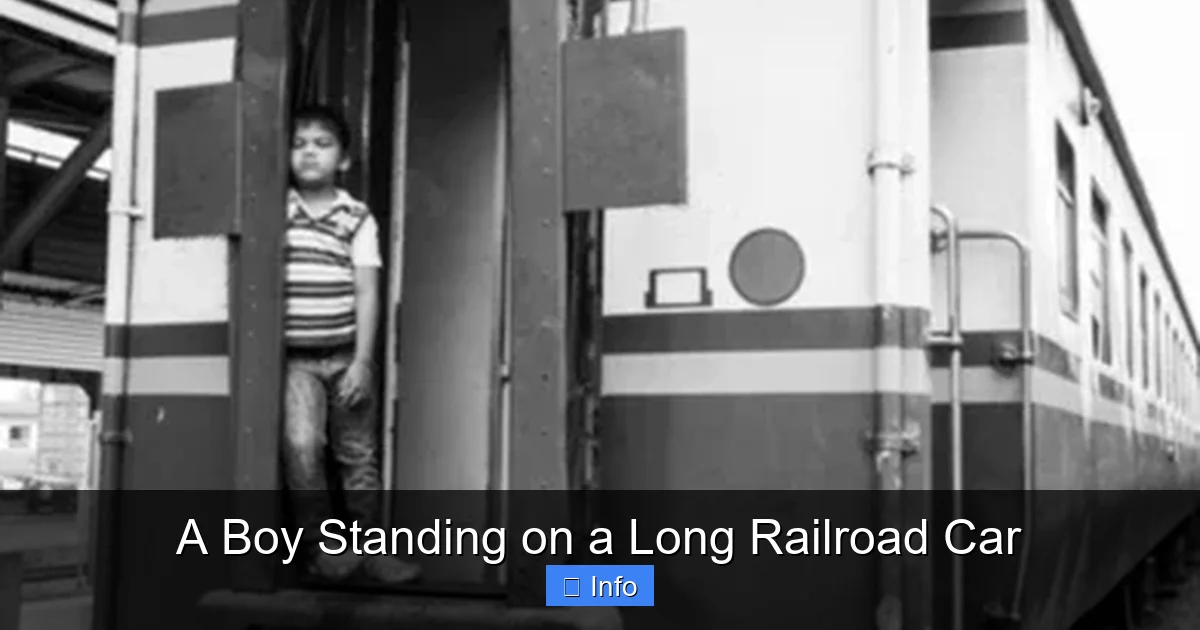
A boy standing on a long railroad car invites readers to explore both the physics of motion and the safety precautions needed in such a situation. The piece delves into relative velocity, friction, and the importance of supervision, while also offering creative writing prompts.
Imagine a bright morning on a quiet stretch of track. A boy stands on a long railroad car, his small frame balanced against the endless metal length. The scene captures a mix of childhood curiosity and the raw power of rail transport. It is a moment that invites both wonder and careful thought.
This article explores the many layers of that image. We will look at the physics that govern his balance, the safety measures that protect him, the history of railroad cars, and ways to turn the scene into creative writing. By the end, you will have a deeper appreciation for the boy on the car and the science behind it.
Key Takeaways
- Point 1: Understanding relative motion helps predict the boy’s position on the moving car.
- Point 2: Safety gear and adult supervision are essential to prevent falls.
- Point 3: Friction between shoes and metal affects stability and grip.
- Point 4: Historical trains provide context for railroad car design and usage.
- Point 5: Creative writing can explore the boy’s thoughts and feelings.
- Point 6: Simple experiments demonstrate physics principles like inertia.
📑 Table of Contents
The Allure of the Scenario
Visual Imagery
The image of a boy standing on a long railroad car is striking. The sleek metal surface stretches into the distance, while the boy’s small figure creates a contrast that draws the eye. The open sky above and the parallel rails below frame the scene, making it both simple and complex. The play of light on the steel adds a shimmering quality that emphasizes the car’s length and the boy’s isolation.
The gentle hum of the train’s engine blends with the distant call of birds, creating a soundscape that heightens the sense of motion. This auditory detail can be used to enrich descriptive writing, allowing readers to almost hear the rhythmic clatter of the wheels.
Emotional Connection
For many viewers, this scene evokes feelings of adventure and nostalgia. It reminds us of childhood explorations and the thrill of standing on something large and moving. The boy’s posture, perhaps a mix of caution and curiosity, invites viewers to imagine themselves in his place. This emotional resonance makes the image a powerful tool for storytelling and learning.
Such a scene often appears in paintings and photographs, where the contrast between the boy and the vast machine emphasizes the theme of innocence meeting industrial power. Artists use this juxtaposition to comment on the rapid changes brought by modernization.
Physics of Motion
Understanding the motion of the boy on the railroad car involves several key concepts. The car moves at a constant speed along a straight track, which provides a straightforward case for analysis. By examining forces, friction, and inertia, we can predict how the boy stays balanced. These principles are not only relevant to this scenario but also to many everyday situations involving motion.
Visual guide about A Boy Standing on a Long Railroad Car
Image source: c8.alamy.com
The constant speed of the car allows us to apply simple equations such as distance equals speed multiplied by time. For example, if the car travels at 10 meters per second, after 5 seconds it will have covered 50 meters, illustrating a linear relationship.
Relative Velocity
When the car moves, the boy shares its velocity relative to the ground. This relative motion means that, from his perspective, he is stationary while the world rushes past. In many physics problems, we start with a car moving on a straight road to simplify the analysis of relative velocity. The concept helps us understand how the boy can remain in place despite the car’s movement.
This concept is similar to the experience of sitting in a moving train while another train passes on an adjacent track. The relative motion can create an illusion of movement even when you are stationary, a phenomenon that has been studied in perception research.
Friction and Grip
The boy’s shoes create friction with the metal surface. This friction is essential to prevent slipping. The coefficient of friction between rubber and steel determines how much force is needed to keep him steady. If the surface were smoother, maintaining balance would be harder. Adding a thin layer of oil, for example, would reduce friction and increase the risk of falling.
In laboratory settings, the coefficient of friction can be measured using an inclined plane. By observing the angle at which an object begins to slide, scientists can calculate the frictional force, providing insight into the materials used in the boy’s shoes and the railroad car’s surface.
Inertia and Forces
Inertia tends to keep the boy moving at the same speed as the car. When the car accelerates or decelerates, the boy feels a force pushing him forward or backward. Consider a car moving on a straight road as a reference for constant velocity, where net force is zero and the boy remains in equilibrium. Understanding these forces helps us design safety measures and predict motion in various scenarios.
When the car suddenly stops, the boy’s body tends to continue moving forward due to inertia. This is why wearing a seatbelt or holding onto a rail is important; it provides the necessary force to keep him safe and prevent a forward fall.
Safety Considerations
Standing on a moving railroad car poses several risks. Proper safety measures are crucial to protect the boy from falls or injuries. Supervision by an adult and the use of protective equipment can greatly reduce these risks. In addition, awareness of the environment and potential hazards is essential for safe exploration.
In addition to physical dangers, the boy may experience psychological stress from being in a potentially hazardous situation. Teaching him to recognize fear and to seek help is an important part of safety education.
Personal Protective Equipment
Wearing a helmet and sturdy shoes is recommended. The helmet protects the head in case of a fall, while shoes with good grip help maintain traction on the metal surface. Additionally, clothing should be snug to avoid catching on any parts of the car. Using a safety harness can provide an extra layer of security, especially for younger children.
For older children, additional gear such as gloves can improve grip and reduce the risk of blisters. The gloves should be made of a material that offers both flexibility and durability, allowing the boy to maintain a firm hold on the metal surface.
Supervision and Environment
An adult should always be present to monitor the boy’s movements. The area around the track must be clear of obstacles. It is also wise to choose a time when the car is moving at a moderate speed, making it easier to react to any sudden changes. Regular safety checks of the car’s condition can prevent unexpected failures that might endanger the boy.
Creating a safety plan that includes clear signals for stopping and a designated meeting point can further protect the boy. Regular drills help reinforce the plan, ensuring that everyone knows how to respond in an emergency.
Historical and Cultural Context
The design of railroad cars has evolved over centuries. Early cars were simple wooden platforms, while modern ones feature advanced materials and safety features. Understanding this history helps us appreciate the engineering behind the scene. Moreover, the cultural significance of rail travel influences how we perceive such images today.
The transition from wood to steel not only improved durability but also changed the acoustic properties of the cars, creating a distinct clatter that has become iconic in popular culture. This sound often appears in films to signal travel or adventure.
Evolution of Railroad Cars
From the steam era to high‑speed trains, the construction of railroad cars has changed significantly. Early cars often had open ends, making it easier for workers to board. Today, enclosed cars provide protection from the elements but also limit access. The shift from open to closed designs reflects broader trends in safety and comfort.
Modern railroad cars incorporate sensors and automated systems that monitor speed and track conditions, enhancing safety. These technologies represent a significant leap from the manual controls of early trains, reflecting the ongoing pursuit of efficiency and security.
Representation in Literature
The image of a boy on a railroad car appears in many stories and poems. It symbolizes freedom, danger, and the transition from childhood to adulthood. Writers use this setting to explore themes of courage and responsibility. In some narratives, the boy’s journey on the car becomes a metaphor for life’s unpredictable path.
In poetry, the railroad car can serve as a metaphor for the journey of life, with the boy representing the individual navigating through time and space. This symbolism allows writers to explore existential themes in a concrete setting.
Creative Writing Prompts
This scenario offers a rich backdrop for storytelling. By focusing on the boy’s thoughts and surroundings, writers can create compelling narratives. Below are some prompts to spark imagination. These prompts can be adapted for different age groups and writing styles, encouraging both novice and experienced writers.
Writers can also experiment with different genres, such as mystery or science fiction, by placing the boy in a secret mission or a futuristic setting aboard the railroad car. The versatility of the scenario makes it suitable for a wide range of storytelling styles.
Narrative Techniques
Use first‑person perspective to convey the boy’s inner feelings. Describe the sound of the wheels on the tracks, the wind in his hair, and the rhythm of his heartbeat. If a car is moving on a straight road due north, its displacement can be found using basic kinematics, which can be mirrored in the boy’s journey. Incorporating sensory details can immerse readers in the experience.
Using dialogue can further develop the boy’s character, revealing his fears and aspirations through conversations with a companion or an internal monologue. This technique adds depth and allows readers to connect more intimately with his experience.
Character Development
Develop a backstory for the boy. Perhaps he is running away from home, or he is a young inventor testing a new device. His motivations will drive the plot and create emotional depth. Adding flaws and strengths makes the character relatable and memorable, enhancing the story’s impact.
Alternatively, the boy could be part of a group, each member representing different perspectives on the journey. This ensemble approach can highlight themes of cooperation and conflict, enriching the narrative with multiple viewpoints.
Practical Experiments and Learning Activities
Engaging in hands‑on activities helps reinforce the concepts discussed. Here are a few simple experiments that can be done in a classroom or at home. These activities encourage active learning and allow students to observe physics principles in action.
Teachers can incorporate these experiments into lesson plans, aligning them with curriculum standards for physics and engineering. By doing so, students gain hands‑on experience that complements theoretical instruction.
Model Railroad Car
Build a small model using cardboard and wheels. Observe how weight distribution affects stability. This model can demonstrate the principles of balance and friction in a controlled setting. By adjusting the model’s design, students can explore the effects of different materials and shapes on its performance.
Students can also experiment with different shapes, such as adding fins or changing the wheel size, to see how these modifications affect stability and speed. This encourages critical thinking and iterative design.
Motion Demonstrations
Use a toy car on a track to illustrate constant velocity and acceleration. By measuring the time it takes to travel a set distance, students can calculate speed and compare it to the boy’s situation on the full‑size railroad car. Recording data and creating graphs can further enhance understanding of motion concepts.
Advanced learners might use motion sensors or smartphone apps to capture real‑time data, creating graphs that illustrate acceleration and deceleration. Analyzing these visualizations helps deepen understanding of kinematic concepts.
The image of a boy standing on a long railroad car is more than a simple snapshot; it is a gateway to exploring physics, safety, history, and creativity. By examining the forces at play, we gain insight into how such a scene can be both thrilling and dangerous. The historical context reminds us of the evolution of rail travel, while creative writing allows us to imagine the boy’s inner world. Finally, practical experiments bring the concepts to life, making the learning experience tangible. Whether you are a student, a teacher, or a curious mind, this scenario offers a wealth of opportunities for discovery and imagination.
Frequently Asked Questions
What is the physics behind a boy standing on a moving railroad car?
The boy shares the car’s velocity relative to the ground, and his balance depends on friction between his shoes and the metal surface. Inertia keeps him moving with the car unless an external force acts on him.
How can we ensure safety when a child is on a railroad car?
Use a helmet, sturdy shoes, and close‑fitting clothing to protect against falls. An adult should supervise at all times, and the area around the track should be clear of obstacles.
What historical factors shaped the design of railroad cars?
Early railroad cars were simple wooden platforms, while modern cars use advanced materials and enclosed designs for safety and comfort. The evolution reflects changes in technology and passenger needs.
How can I use this scenario in creative writing?
Describe the boy’s inner thoughts, the sounds of the moving train, and the visual contrast between his small figure and the long car. Use first‑point perspective to create intimacy and tension.
What simple experiments demonstrate the concepts involved?
Build a model railroad car to study balance and friction, or use a toy car on a track to measure speed and acceleration. These hands‑on activities reinforce the physics principles discussed.
Are there any cultural references to a boy on a railroad car?
The image appears in literature and poetry as a symbol of adventure, transition, and the boundary between childhood and adulthood. It often represents freedom and the allure of the unknown.


