A Car Goes on a Horizontal Circular Road
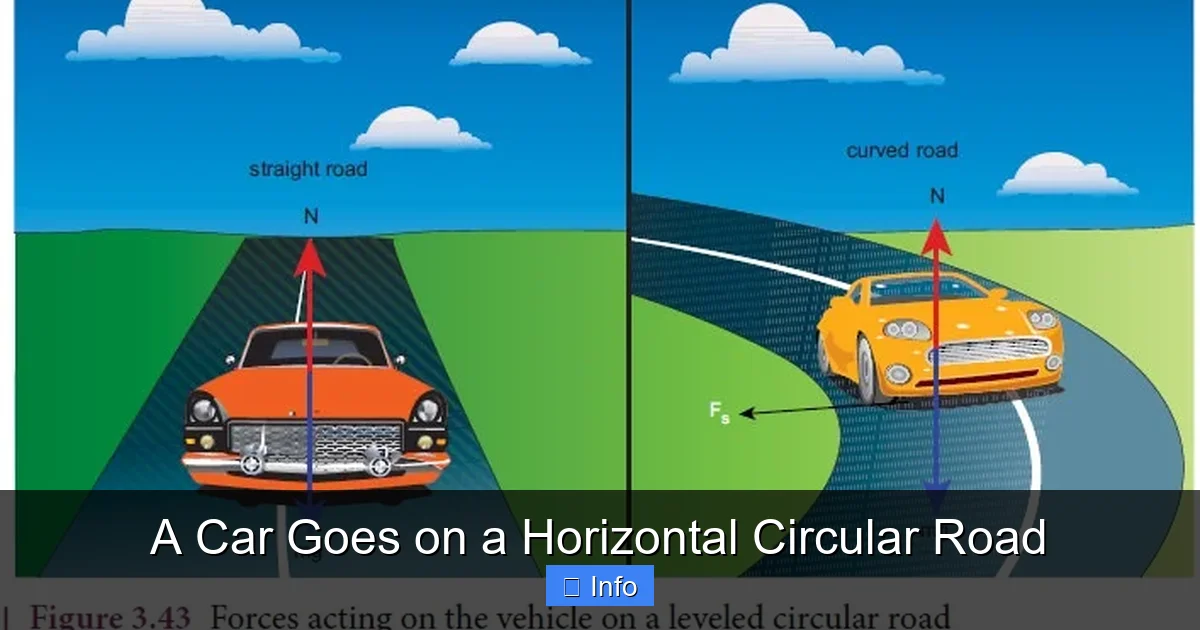
Driving on a horizontal circular road presents unique challenges that require careful attention to speed, traction, and steering. This guide breaks down the physics behind curve navigation, explains how vehicle dynamics change on circular paths, and offers practical safety tips for every driver. Whether you’re preparing for a track day or simply curious about road geometry, you’ll find valuable insights here.
Pushing your car through a horizontal circular road feels like walking a tightrope—except there’s a vehicle doing the balancing act. These winding loops demand more than just confidence; they require understanding how physics works inside your wheels. When you turn left on a horizontal circle, your car follows a curved path where gravity pulls you inward while your steering mechanism pushes outward. It sounds counterintuitive, but it’s exactly why centrifugal force and friction team up to keep you on the road instead of sliding off into the sky.
The magic happens right at the center of the circle. As your car accelerates toward the tighter curves, the required centripetal force increases dramatically. This means you need stronger tires and smoother inputs to maintain your path. Imagine trying to drive a bicycle on a merry-go-round—you feel pulled toward the center much faster than on straight roads. That same principle applies to your sedan or SUV. Each corner demands precise steering and steady throttle management to stay on course without skidding.
<<# H2 Understanding Horizontal Circular Roads: Physics and Geometry>>
One of the first things drivers must grasp is the relationship between radius, speed, and velocity on a circular path. The formula v²/r tells us that for a given radius, increasing speed requires exponentially more force to keep you moving along the curve. Think of it this way: a gentle arc is forgiving, but a sharp loop demands constant adjustment. Small mistakes in steering or imprecise throttle application can lead to losses of control.
Consider a racetrack turn versus a residential street roundabout. Both are horizontal circular roads, but they present different challenges. Race tracks often feature banked curves designed by engineers to reduce the need for excessive lateral grip. Meanwhile, city streets may have narrower radii where even moderate vehicles struggle to navigate quickly. The geometry of each shape affects how your car responds at different speeds.
<<# H2 Vehicle Dynamics on Curved Paths>>
Your car behaves very differently when it enters a horizontal circle compared to driving on straight pavement. The primary factor changing is traction—that sticky bond between rubber and asphalt that lets your wheels push the car forward. On a flat horizontal curve, friction creates two opposing forces: one pulling you sideways (centripetal), and one pushing back against that pull (the normal reaction).
When you approach a tighter bend, your car instinctively wants to continue straight due to inertia, like a ball rolling off a hill. The road surface provides resistance through friction, which is why skilled drivers slowly decrease speed before entering curves. Too fast, and the centrifugal effect overcomes friction at those critical moments. Modern cars have ABS systems and electronic stability programs that monitor wheel slip and intervene automatically. However, relying solely on technology doesn’t mean you don’t understand the fundamentals—it just helps you trust your senses better.
Steering also changes dynamically on circular routes. At high speeds, you need sharper steering angles to maintain your intended path. Beginners often find themselves understepping—the car continues straight despite turning the wheel—which is especially common in corners. Experienced drivers know to anticipate the exit angle and steer progressively. This subtle shift in input keeps the car’s weight distributed evenly across its tires, preventing one side from lifting or sinking too deeply into the curve.
<<# H2 Safety and Control Systems on Circular Routes>>
No discussion of driving on a horizontal circular road would be complete without addressing safety. The stakes are higher because a single mistake can send your vehicle spinning into traffic or worse. Always remember that curves demand slower speeds regardless of how tempting it might seem to blast past on a track day. The physics of circular motion makes this non-negotiable.
Braking becomes particularly tricky on circular roads. While you might expect less stopping distance on a curve (because you’re already turning), the opposite is often true. Going in too fast at the bottom of a curve reduces your available brake length. Skilled drivers slow down early rather than relying on brakes alone. This combination of pre-speed reduction and later braking creates optimal stopping distances even on twisting paths.
<<# H2 Practical Tips for Drivers Navigating Circular Roads>>
If you’re planning to drive a car on a horizontal circular road—whether for recreation, work, or competition—here are some actionable strategies. First, always perform a thorough pre-route inspection. Check your tire pressure, brake pads, and fluid levels. Underinflated tires lose grip rapidly, making sharp turns unpredictable. Similarly, worn brake pads won’t stop effectively when late in a curve.
Second, master the art of progressive braking. Start slowing down well before reaching a corner, then apply gentle braking while still steering smoothly. This staged approach prevents locking your wheels. Third, maintain consistent mirror checks. In a roundabout or oval track, you’ll see approaching traffic from multiple directions simultaneously. Constant awareness helps you react before collisions happen.
Fourth, consider your vehicle’s weight distribution. Heavier trucks or SUVs need wider, gentler arcs to avoid understeer. Lighter sports cars handle tighter corners but require exceptional skill. Fifth, practice emergency maneuvers regularly. Knowing how to recover from a spin-up situation or a loss of power takes years of experience—but simulation training can accelerate that learning curve.
For those visiting dedicated track facilities, <
When preparing for actual track events, <
Managing your car’s mechanical health during circular route trips is equally important. Consider carrying a portable air compressor or tire sealant kit to address minor punctures before they become catastrophic. Also, keep spare batteries accessible if your vehicle uses electric starting systems. Running low on battery charge mid-corner could be disastrous.
Finally, always inform others of your planned route, especially on highways or public roads. Share your destination and expected timeline. If something goes wrong on a horizontal circular road—literally or figuratively—knowing help is coming makes all the difference.
<<# H2 Maintenance Considerations for Circular Route Travel>>
Driving long distances on a horizontal circular road puts stress on certain system components that may not receive regular attention otherwise. The suspension bearings, for instance, endure repeated flexing and compression as you follow the same path repeatedly. Over time, this wear accumulates and can affect ride quality even on seemingly smooth tracks.
Brake components face similar fatigue patterns. Each stop-and-go maneuver on a circular path generates heat and mechanical stress. Regular inspections—checking pad thickness, rotor condition, and fluid level—prevent unexpected failures. If you notice vibrations during hard braking in curves, that’s a sign your rotors may need resurfacing or replacement.
<<# H2 Conclusion: Mastering the Art of Circular Road Driving>>
Navigating a horizontal circular road successfully combines physics knowledge, disciplined technique, and attentive stewardship of your vehicle. Understanding centripetal force, respecting speed limits, and mastering progressive braking form the foundation of safe circular driving. Remember that you cannot rely entirely on technology—modern assistance systems are powerful tools, but human judgment remains paramount.
Every turn, every acceleration, and every landing requires conscious decision-making. Treat each corner as an opportunity to demonstrate mastery rather than a challenge to conquer recklessly. The next time you encounter a circular path, approach it with patience, preparation, and respect for the machine beneath you. Your skills will improve with deliberate practice, and soon you’ll glide through curves with confidence and precision. The road bends, but with proper technique, your car will find its perfect path every time.
—
- Understanding centripetal force is essential for safe circular road driving.
- Tire grip decreases at higher speeds on curves, so gradual turns are crucial.
- Proper braking technique must account for reduced stopping distance on vertical drops.
- Regular tire inspection and proper inflation prevent dangerous handling issues.
- Track-day preparation includes warm-up runs and gear selection adjustments.
- Emergency procedures differ significantly when navigating circular paths at high speed.
Frequently Asked Questions
How does a car handle tight corners on a horizontal circular road?
On a horizontal circular road, proper handling depends on maintaining appropriate speed and using experienced steering techniques. Going too fast reduces the time available for corrective action when mistakes occur. Drivers should use gentle, progressive turns and gradually reduce speed before entering tight sections. The key is anticipating the turn ahead and adjusting both throttle and steering input accordingly.
What factors affect braking distance when driving on circular routes?
Braking distance on a horizontal circular road is influenced by several variables including your current speed, road surface condition, and whether your vehicle has advanced braking systems. Higher speeds dramatically increase stopping distance, making it impossible to rely solely on braking to prevent accidents. Modern vehicles benefit from anti-lock brakes and electronic stability control that assist in maintaining control during emergency stops.
Why do heavy vehicles need wider curves for safer driving on circular paths?
Heavy vehicles distribute their weight differently than lighter ones, creating greater downward forces during turns. These forces can cause front axle lift or rear-end sag, compromising traction control and increasing the likelihood of losing control. Additionally, heavier masses require more torque to initiate rotation, meaning even small steering corrections must be executed precisely. Lighter vehicles handle tighter curves more easily due to lower mass and quicker response times.
Can a car safely navigate a perfectly round road without modifications?
Yes, modern production vehicles are engineered to operate safely on standard horizontal circular roads. Most passenger cars have sufficient tire grip and braking capacity for typical driving conditions. However, extreme speeds, frequent aggressive maneuvers, or damaged components can make such drives hazardous. Regular maintenance ensures your car meets the safety standards necessary for confident circular road operation.
What are the most common causes of accidents on horizontal circular roads?
The leading causes include excessive speed, failure to signal turns in advance, and inadequate braking preparation. Drivers who enter curves too abruptly often lose steering control when the car slides outward. Poor visibility around corners compounds the problem, requiring extra caution and anticipation. Always assume other road users behave unpredictably in unfamiliar configurations.
Should I test my vehicle thoroughly before taking on complex circular routes?
Absolutely. Before attempting any demanding circular road navigation, conduct a full mechanical inspection of brakes, tires, and suspension. Perform low-speed precision tests in empty spaces to verify that all systems respond correctly. Practice steady-state driving on shorter arcs before committing to longer, more challenging loops. Familiarity with your vehicle’s behavior under load builds the confidence needed for success.