
Adjust Throttle Position Sensor
A throttle position sensor (TPS) tells the engine computer how far the throttle plate is open. If it is out of tune, the vehicle may idle badly, hesitate, or shift poorly; a correct adjustment can restore smooth response.
Adjust Throttle Position Sensor
A throttle position sensor (TPS) is a small part with a very big job. It tells the engine computer how far the throttle plate is open. That signal helps the car match power to what you ask of it.
When it is out of range, the engine may run rich, stall, hesitate, or shift late. The issue can feel like a bad fuel pump, dirty throttle body, or weak ignition part. A quick test can show if the sensor is the cause.
This guide explains how to adjust throttle position sensor systems on older vehicles. It also covers electronic units and idle learning. Always use the factory specs for your make and model, because values differ.
Key Takeaways
- Identify the sensor type: Older analog sensors may be adjustable, while many modern TPS units are sealed and require calibration or replacement.
- Check the symptoms: Rough idle, hesitation, stalling, poor mileage, and late shifts can all point to a faulty TPS reading.
- Use factory specifications: Voltage ranges and adjustment steps vary by vehicle, so consult the repair manual before turning the sensor.
- Backprobe carefully: Use a high-impedance digital multimeter and avoid forcing probes into sensitive wires.
- Test after adjustment: Confirm smooth voltage, stable idle, clean acceleration, and the absence of new warning codes.
- Do not force a modern sensor: If the signal jumps or wiring is damaged, diagnose the full system before replacing parts.
📑 Table of Contents
1. What the TPS Does and Why It Matters
A link between the pedal and engine
Press the gas pedal, and the throttle plate turns. In a cable car, the pedal moves a rod or cable. In many newer cars, the pedal sends an electronic signal. The TPS is linked to the throttle shaft and reports its angle.
The engine control module uses this reading with air, coolant, and pedal data. It can then set fuel, spark, and shift timing. A low reading can make the computer add too little fuel. A high reading can make it add too much.
Two main sensor types
Older analog sensors are usually three-wire potentiometers. They have a five-volt supply, a sensor ground, and a signal wire. Their housing can be turned a little and locked with mounting screws. Many modern sensors use two or more internal circuits. They report angle and often self-check. They are not adjusted by hand.
A one-wire sensor on some old carbureted engines works in a different way. It may change resistance instead of voltage. This makes the factory service manual even more important. The same words, “TPS,” do not mean every sensor has the same connector or test.
2. When Adjustment May Be Needed
Common warning signs
Do not adjust a good sensor just to change the idle. First, look for signs that match a bad reading. A faulty TPS may cause a high or low idle, a stumble at low speed, poor fuel economy, hard starting, or a lack of power. It can also cause late shifts or a flare when you ease onto the gas.
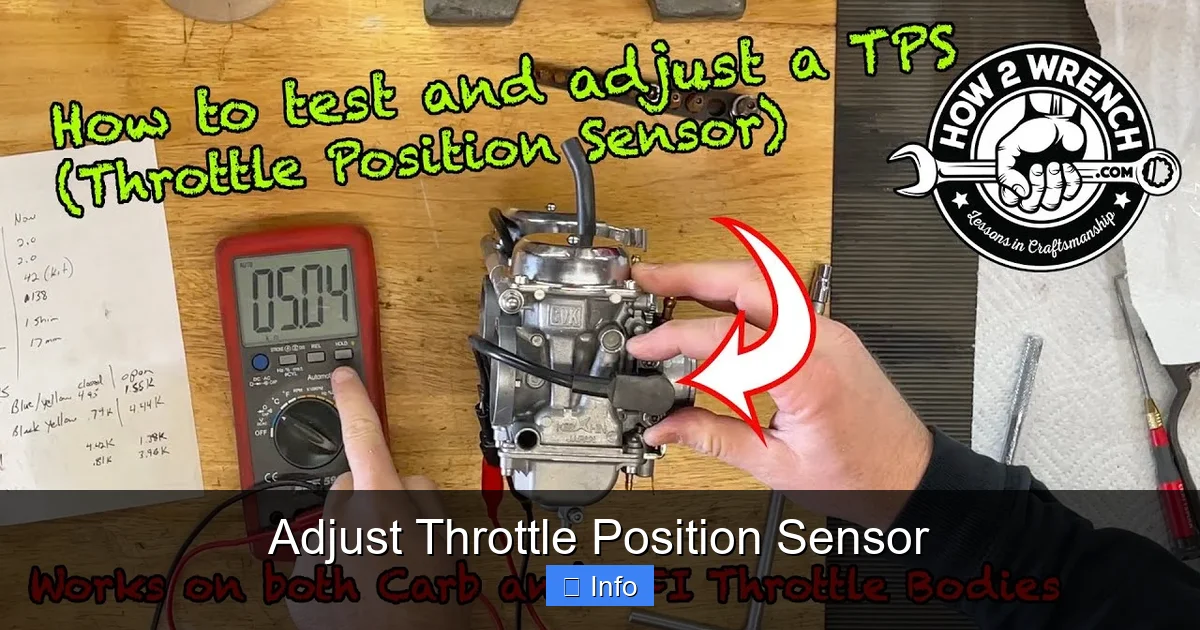
Visual guide about Adjust Throttle Position Sensor
Image source: i.ytimg.com
- Stalling: The engine dies at idle or when the throttle closes.
- Hesitation: The vehicle pushes back when you press the pedal.
- Bad idle: RPM jumps or settles far above the normal range.
- Rich smell: Black smoke or a strong fuel odor may point to too much fuel.
- Shift trouble: The transmission may shift late, harsh, or with a flare.
Check other causes first
A TPS fault can copy other problems. A vacuum leak can raise idle. A sticky throttle linkage can break the link between pedal and plate. A dirty throttle body can trap the plate. A bad accelerator pedal sensor can send a wrong request. A failing crankshaft position sensor can cause many driveability codes too. See our guide to how to check a crankshaft position sensor before blaming the TPS.
Clear codes only after recording them. Save the freeze-frame data. Then fix obvious faults and run the car again. If the same TPS code or live-data fault returns, adjustment may be the next step.
Tools and safety
You need a repair manual, a high-impedance digital multimeter, backprobe leads, basic hand tools, and often a scan tool. A test light is not safe for this circuit. It can feed too much current into the sensor. Use eye protection, set the parking brake, and keep hands clear of belts and fans.
- Work in a well-ventilated area.
- Let the engine cool before backprobing.
- Never force the sensor housing.
- Disconnect the battery only as the manual directs.
Why rough adjustment can make things worse
If you turn the sensor too far, you may hide one fault and create another. A low reading can cause a lean condition, while a high reading can flood the engine. Always note the first reading before touching the mounting screws. This gives you a clear comparison and helps you avoid overcorrecting.
3. How to Adjust Throttle Position Sensor on Older Vehicles
Find the correct setting
Most adjustable analog TPS units are set with the key on and engine off. Typical closed-throttle voltage is about 0.5 to 1.0 volt. Full throttle is often near 4.0 to 4.9 volts. These are only common ranges. Your manual may use degrees of opening or a different voltage range.
Do not guess from a forum value. Connector layouts and specs vary by engine. Confirm the signal wire and sensor ground. Never probe the five-volt supply with a test light.
Step-by-step adjustment
- Park safely. Place the car on level ground, set the parking brake, and open the hood.
- Record faults. Use a scan tool and write down current and history codes before clearing anything.
- Inspect the system. Check the connector, wires, throttle linkage, and throttle body. Clean carbon if needed. Review how to change the throttle body if the unit is damaged or cannot be cleaned well.
- Reconnect the sensor. Make sure the connector clicks into place and the throttle plate returns fully.
- Set the key. Turn the ignition on with the engine off unless your manual calls for a running test.
- Measure closed voltage. Attach the meter lead to the signal wire and sensor ground. Do not ground the signal wire.
- Loosen the mounts. Turn the screws just enough to allow small movement. Do not remove them unless needed.
- Turn the sensor. Move it in tiny steps until the closed-throttle reading matches the factory spec.
- Secure the housing. Snug the screws evenly. Stop if the mounting plate bends or the screws bind.
- Recheck the reading. Tightening the screws can shift the setting. Adjust again if needed.
- Run the engine. Start it, check idle quality, and make sure no warning light comes on.
Turn the sensor only a small amount at a time. One turn of its housing can move the reading a great deal. If screws bind, stop and clean the threads. Forcing the case can crack it.
A practical example
Suppose an older car has a closed reading of 0.30 volt, while the manual calls for 0.80 volt. The computer sees a much more closed throttle than reality. After a small adjustment to 0.80, idle may fall and hesitation may fade. If voltage jumps from 0.8 to 2.0 while the plate moves a little, the sensor track is worn. Adjustment will not fix that.
4. Electronic TPS and Idle Learning
Know when there is no screw to turn
On many modern cars, the TPS is built into the throttle body. It may have a digital signal or dual sensors that check each other. The computer learns the closed and wide-open points during normal operation. There is no external housing adjustment.
If live data shows a jump, the sensor may be bad. If data is smooth but idle is wrong, the throttle body may need a proper clean or an idle relearn. A simple battery disconnect does not always erase learned idle values.
Run the correct relearn
Idle relearn steps differ by maker. Some cars use a scan tool. Others use a set key-on and engine-off sequence. A common pattern is to warm the engine, turn off all loads, start the engine, and let it idle until the cooling fan cycles. Follow the exact order in the service manual.
Do not let the battery die during relearn. Use a quality maintainer if allowed. After the procedure, clear codes, start the engine, and watch live TPS angle. It should change in a straight line as you open the throttle by hand.
When replacement is better
If the case is cracked, the shaft is loose, or the signal drops, replace the part. Also replace it if adjustment will not hold after torque is applied. For the correct process, review how to replace a throttle position sensor for your vehicle.
5. Test, Troubleshoot, and Confirm the Fix
Static test after adjustment
Turn the key on, but do not start the engine. Check closed-throttle voltage again. Move the throttle slowly and watch for a steady rise. There should be no zero reading, sudden spike, or flat spot. Then turn the key off and reconnect any plugs you removed.
A scan tool can add a second view. Compare the TPS percent or angle with pedal position. At rest, values should be close. At full pedal input, they should rise together. A large mismatch may point to the accelerator pedal sensor or wiring.
Road test with care
Start the engine and let it reach normal idle. Listen for a steady rhythm. Check for warning lights, rough running, and sudden RPM changes. On a safe road, ease onto the gas at low speed. Then make a few gentle accelerations. The response should be steady, not delayed or surging.
Common results
- Low closed voltage: The idle may run high, and a lean code may appear.
- High closed voltage: The engine may smell rich or produce black smoke.
- Signal drop: A stumble or flat spot may occur as the throttle moves.
- Zero volts: Check the sensor ground, fuse, connector, and open wires.
- Five-volt signal: Look for an open signal wire or a missing supply voltage.
- Smooth voltage, bad idle: Check for an air leak, carbon, or a needed relearn.
A real-world fix
After a throttle-body clean, an older car may idle at 1,500 rpm because the plate does not fully close. First remove carbon and inspect the linkage. If the plate reaches its stop, perform the TPS setting and any idle relearn. If carbon holds the plate open, adjustment alone will fail. In that case, review how to change the throttle body if cleaning is not enough.
Do not stop at the first good idle
Let the engine run for several minutes, then check idle again. Some computers adapt slowly. If the idle drifts, scan for pending codes. A warning light may not appear right away. A stable reading during cold and warm tests gives stronger proof than one good start.
6. Conclusion: Adjust With Care, Then Verify
An accurate TPS helps the engine manage air, fuel, and power with confidence. On an older adjustable sensor, a small turn can restore smooth idle and response. On a modern unit, correct diagnosis and a proper relearn are usually the answer.
Never force the housing or ignore a wiring fault. If readings jump, the sensor may need replacement. Take time to match the factory test, secure every connector, and verify the result. That careful work is the best way to adjust throttle position sensor issues safely.
Frequently Asked Questions
Can I adjust a throttle position sensor with the engine running?
Only if your repair manual says to do so. Most adjustments are made with the key on and engine off, so never touch hot or moving parts.
How do I know if the throttle position sensor is out of adjustment?
Common signs include a rough idle, stalling, hesitation, rich exhaust, or late shifts. A multimeter or scan tool can confirm whether the voltage or angle reading is outside the factory range.
Do all throttle position sensors need adjustment?
No. Many older analog sensors can be adjusted, but many modern units are sealed inside the throttle body. These newer sensors usually need a proper relearn, repair, or replacement.
Can I drive if the throttle position sensor is out of adjustment?
You may be able to move the vehicle, but it is not a good idea. A bad reading can raise fuel use, damage the catalytic converter, or cause a sudden loss of power.
How much does it cost to adjust or replace a TPS?
An adjustment may only require basic tools, while replacement costs include the sensor and labor. The final price depends on the vehicle and whether the sensor is separate or built into the throttle body.
Does the TPS need resetting after throttle-body cleaning?
Sometimes, yes. Cleaning can change how the throttle plate closes, so the computer may need an idle relearn. Check the service manual and scan for pending codes after the work.


