Best Second Hand Car Under 5 Lakhs
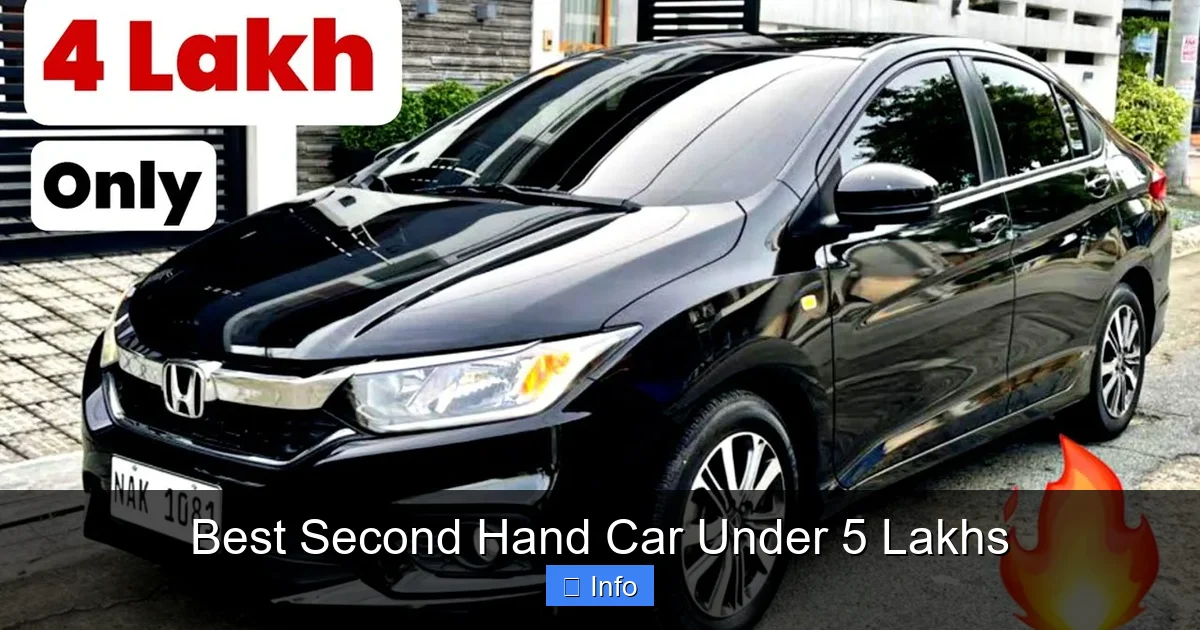
Finding the best second hand car under 5 lakhs doesn’t have to be overwhelming. This guide covers top reliable models like the Maruti Suzuki Swift, Hyundai i10, and Honda City, along with essential inspection tips and smart negotiation strategies to help you drive home a quality used car that fits your budget and lifestyle.
Buying a car is one of the biggest financial decisions most of us make, and when your budget caps at five lakhs, the pressure to choose wisely feels even heavier. The good news? The Indian used car market has matured tremendously over the past decade, and the best second hand car under 5 lakhs category is packed with genuinely excellent options that deliver reliability, comfort, and peace of mind.
Whether you’re a first-time buyer upgrading from two wheels, a family needing a second vehicle, or someone who simply understands that new cars depreciate fastest in their first three years, this price bracket hits a sweet spot. You’re looking at vehicles that have already taken their biggest depreciation hit but still have 60-70% of their useful life ahead of them. Let’s walk through everything you need to know to make a confident, informed purchase.
Key Takeaways
- Budget Sweet Spot: The 5 lakh range offers access to well-maintained 3-5 year old hatchbacks and entry-level sedans with plenty of life left.
- Maruti Dominance: Maruti Suzuki models like Swift, WagonR, and Alto lead the segment due to low maintenance costs and widespread service networks.
- Service History Matters: A complete service record from authorized centers is more valuable than low mileage alone when assessing a used car.
- Inspection Is Non-Negotiable: Always get a professional mechanic inspection or use a comprehensive checklist before finalizing any purchase.
- Certified Pre-Owned Adds Peace of Mind: Manufacturer-certified used cars come with warranties and thorough refurbishment, justifying a slight premium.
- Negotiate With Data: Research market prices for specific models and variants to negotiate confidently with sellers or dealers.
- Total Cost of Ownership: Factor in insurance, transfer fees, immediate maintenance, and fuel efficiency when calculating your real budget.
📑 Table of Contents
Why Choose a Second Hand Car Under 5 Lakhs?
The Depreciation Advantage
New cars lose 15-20% of their value the moment they leave the showroom, and up to 40-50% within the first three years. When you buy used at this price point, someone else has already absorbed that steep depreciation curve. You get more car for your money — often a higher variant with better features than you could afford new.
Lower Insurance and Registration Costs
Insurance premiums are based on the car’s Insured Declared Value (IDV), which drops with age. A three-year-old car costs significantly less to insure than a new one. Registration transfer fees are also lower than fresh registration charges in most states, saving you thousands upfront.
Proven Reliability Track Record
Models that have been on the road for 3-5 years have established reliability histories. You can research common issues, recall campaigns, and real-world ownership experiences from thousands of users. This transparency is impossible with brand-new models.
Certified Pre-Owned Programs
Almost every major manufacturer now runs certified pre-owned programs — Maruti Suzuki True Value, Hyundai H-Promise, Honda Auto Terrace, Toyota U-Trust, and more. These cars undergo 100-300 point inspections, come with 6-12 month warranties, and often include roadside assistance. The peace of mind is worth the slight premium over unorganized market purchases.
Top Contenders in the Under 5 Lakh Segment
Maruti Suzuki Swift (2017-2020 Models)
The Swift is arguably the best second hand car under 5 lakhs for most buyers. The third-generation model (launched 2018) brings modern styling, a peppy 1.2L K-Series petrol engine, and Maruti’s legendary service network. You’ll find well-maintained 2018-2020 VXi and ZXi variants comfortably within budget. The 1.2L engine delivers 83 PS and 113 Nm — enough for city sprints and highway cruising alike. Fuel efficiency averages 18-20 kmpl real-world.

Visual guide about Best Second Hand Car Under 5 Lakhs
Image source: i.ytimg.com
Look for the ZXi variant if you want touchscreen infotainment, push-button start, and automatic climate control. The VXi hits the value sweet spot with steering-mounted controls, rear parking sensors, and alloy wheels. Avoid base LXi variants unless the price difference is substantial — resale suffers on stripped-down trims.
Hyundai Grand i10 / Grand i10 Nios (2017-2020)
Hyundai’s tall-boy hatchback offers more cabin space than the Swift, especially rear headroom and knee room. The 1.2L Kappa engine is refined and returns 17-19 kmpl. The Nios (launched 2019) adds a modern design language, 8-inch touchscreen, wireless charging (on Asta), and better build quality. Pre-Nios Grand i10 (2017-2019) models are incredible value — often 50-70k cheaper for similar condition.
Magna and Sportz variants represent the best equipment-to-price ratio. The Asta adds projector headlamps, LED DRLs, and a rear camera — nice to have but not essential. Diesel variants (1.2L U2 CRDi) exist but are rarer; they make sense only if your monthly running exceeds 1,500 km.
Maruti Suzuki WagonR (2019-2021 Models)
The current-generation WagonR (launched 2019) on the HEARTECT platform is wider, safer, and more spacious than ever. The tall-boy design maximizes interior volume — four adults sit comfortably with luggage space to spare. The 1.0L and 1.2L K-Series engines are both reliable; the 1.2L is worth the small premium for highway confidence.
VXi and ZXi variants add the 7-inch SmartPlay Studio touchscreen, rear parking camera, and keyless entry. The AGS (AMT) automatic variant is a boon for city traffic and holds value well. WagonR’s boxy shape means minor parking dings are less noticeable — a practical bonus for new drivers.
Honda City (4th Gen, 2014-2017) / Amaze (2016-2019)
If a sedan fits your image or utility needs better, the 4th generation City is a standout. The 1.5L i-VTEC petrol engine is famously smooth and durable — 2.5-3 lakh km is routine with basic care. The cabin feels premium, rear seat comfort is class-leading, and the 510-liter boot swallows family luggage effortlessly. You’ll find 2015-2017 V and VX variants in the 4-5 lakh range.
The first-gen Amaze (2013-2018) is a compact sedan alternative with the same engine in a smaller package. It qualifies for lower road tax in some states (sub-4-meter length) and returns slightly better mileage. Both hold value exceptionally well — a testament to Honda’s engineering.
Tata Tiago (2017-2020) / Tigor (2017-2020)
Tata’s entry-level offerings punch above their weight on safety and build quality. The Tiago scored 4 stars in Global NCAP (adult occupant) — rare in this segment. The 1.2L Revotron engine is peppy (86 PS), and the ride quality handles Indian roads beautifully. The Tigor sedan shares the platform and adds a 419-liter boot.
XZ and XZ+ variants bring Harman audio, 7-inch touchscreen, Android Auto/Apple CarPlay, and projector headlamps. AMT versions are available. Resale lags behind Maruti/Hyundai, but that works in your favor as a buyer — you get more car for less money.
Ford Figo / Aspire (2016-2019)
Ford’s exit from India means used prices have softened, creating opportunity. The Figo hatchback and Aspire sedan share the excellent 1.2L Ti-VCT petrol (88 PS) and 1.5L TDCi diesel (100 PS) engines. Driving dynamics are the benchmark in this class — sharp steering, composed handling, and strong mid-range torque.
Parts availability and service support remain decent through Ford’s authorized network (now operating as service-only), and independent specialists are abundant. Titanium and Titanium+ variants are loaded with features — SYNC3 infotainment, push-button start, automatic headlamps, rain-sensing wipers. A diesel Figo/Aspire with 60-70k km is a driver’s bargain.
Hatchbacks That Deliver Maximum Value
Maruti Suzuki Baleno (2017-2019 Alpha/Delta)
The Baleno sits a segment above but early models dip into the 5 lakh ceiling. It’s wider, longer, and more premium than the Swift. The 1.2L K-Series with SHVS mild-hybrid (on Delta+) aids efficiency. Alpha variants get LED projector headlamps, UV-cut glass, 7-inch touchscreen with navigation, and rear AC vents — features usually reserved for pricier cars.
Watch for the CVT automatic (Delta/Alpha) if you want two-pedal convenience without AMT jerkiness. The Baleno’s 339-liter boot is class-leading. Resale remains strong, so act fast on well-priced examples.
Hyundai Elite i20 (2016-2019)
The Elite i20 brought premium hatchback styling and features to the masses. The 1.2L Kappa petrol and 1.4L U2 diesel are both solid. Magna and Asta variants offer the best balance — Asta adds sunroof, projector headlamps, touchscreen, and reverse camera. The diesel makes sense for high-mileage users; the petrol is smoother for city duty.
Build quality feels a notch above Maruti contemporaries. The rear seat accommodates three adults better than most. Check for clutch wear on high-mileage diesels and infotainment glitches on early units.
Volkswagen Polo (2016-2019) / Toyota Etios Liva (2016-2019)
The Polo’s 1.0L TSI turbo-petrol (on Highline/GT TSI) is a gem — 110 PS, 175 Nm, and genuine driving fun. Even the 1.0L MPI (76 PS) feels eager. Build quality is vault-like. Maintenance costs are higher than Maruti/Hyundai, but reliability is strong if serviced on schedule.
The Etios Liva is the anti-style choice — ugly to some, brilliant in function. The 1.2L/1.5L petrol engines are unburstable. Cabin space rivals cars two segments up. Toyota’s service network and parts pricing are reasonable. It’s a rational, high-mileage workhorse.
Sedans and Compact SUVs Worth Considering
Maruti Suzuki Ciaz (2016-2019)
The Ciaz redefined the mid-size sedan value proposition. The 1.4L K-Series (92 PS) and later 1.5L K15B (105 PS) with SHVS mild-hybrid deliver effortless performance and 20+ kmpl highway runs. The cabin is limousine-like — rear legroom, knee room, and headroom are best-in-class. The 510-liter boot is cavernous.
Delta and Zeta variants hit the value sweet spot. Zeta adds LED projector headlamps, 7-inch touchscreen, auto climate control, and cruise control. The SHVS system aids start-stop and torque assist but isn’t a full hybrid. Avoid the 1.3L Multijet diesel (Fiat-sourced) — parts are getting scarce and expensive.
Honda WR-V (2017-2019)
The WR-V is essentially a Jazz on stilts with crossover styling. The 1.2L i-VTEC petrol and 1.5L i-DTEC diesel share City mechanicals. Ground clearance (188 mm) and plastic cladding make it practical for rough roads. The Magic Seats (rear seat folds flat, cushion flips up) enable versatile cargo configurations.
VX variant brings sunroof, touchscreen, push-button start, and LED DRLs. The diesel is torquey and efficient. Resale is decent. Check suspension bushings and clutch on high-mileage examples.
Renault KWID (2017-2020 Climber/RXT)
If your budget is tight (3-4 lakhs), the KWID Climber 1.0L offers SUV styling, 184 mm ground clearance, and a surprisingly roomy cabin. The 1.0L SCe engine (68 PS) is adequate for city use. The 8-inch touchscreen (on Climber/RXT) supports Android Auto/Apple CarPlay — rare at this price.
Maintenance costs are low. Renault’s network has expanded significantly. The AMT variant works well. It’s not a highway cruiser, but as a city runabout with presence, it’s unbeatable value.
Critical Checks Before You Buy
Verify Documentation Thoroughly
Start with the Registration Certificate (RC) — ensure the seller’s name matches, engine/chassis numbers match the car, and there are no hypothecation entries (or a valid NOC from the financier). Check the insurance policy — is it active? Comprehensive or third-party? Request the original invoice, service book, and all previous ownership transfer records (Form 29/30).
For inter-state purchases, confirm the seller has a valid NOC from the original RTO for re-registration in your state. This process can take weeks and costs 5-15k depending on the state. Factor this into your timeline and budget.
Decode the Service History
A complete authorized service history is gold. Look for regular intervals (every 10k km or 12 months), major services (brake fluid, coolant, transmission oil, spark plugs at specified intervals), and any warranty claims or recall work. Gaps in history aren’t dealbreakers if the owner has bills from reputable independent workshops, but they warrant deeper inspection.
Cross-reference the last recorded odometer reading with the current one. Discrepancies suggest odometer tampering — a red flag. Digital odometers can be rolled back too, though it’s harder.
Exterior and Interior Inspection Checklist
Walk around the car in daylight. Check panel gaps — uneven gaps indicate accident repairs. Look for paint overspray on rubber seals, bolts, and under the hood — signs of repaint. Run a magnet gently over panels (with a cloth) — it won’t stick to filler-heavy repairs.
Inside, test every switch, knob, and feature: AC (all speeds, cooling effectiveness), infotainment (Bluetooth, USB, navigation, camera), power windows (one-touch, anti-pinch), central locking, steering controls, instrument cluster (warning lights, trip meters). Check seat adjustment mechanisms, seatbelt retraction, and upholstery condition. Smell for mustiness — indicates water leaks or flood damage.
Under the Hood and Underbody
Cold start the engine. Listen for rattles, knocks, or excessive vibration. Check oil level and color — milky oil suggests coolant mixing (head gasket failure). Look for oil/coolant leaks around the engine, transmission, and radiator. Inspect battery terminals for corrosion. Check belt condition (cracks, fraying).
Underbody inspection needs a ramp or pit. Look for rust on floor pans, suspension mounts, brake lines, fuel lines, and exhaust. Check for fresh undercoating — sometimes used to hide accident damage or rust. Inspect CV joint boots (tears leak grease), control arm bushings, and shock absorber leaks.
Test Drive — The Real Truth
Drive for at least 15-20 minutes covering city streets, a rough patch, and a stretch where you can hit 60-80 kmph. Test these specifically:
- Engine response — smooth power delivery, no hesitation or jerking
- Gearshift quality — precise, no grinding or excessive play (manual); smooth shifts, no flaring (automatic/AMT/CVT)
- Clutch engagement — smooth, progressive, biting point not too high or low
- Steering — no vibration, pulling, or play; returns to center cleanly
- Brakes — firm pedal, no pulsation, pulling, or squealing; ABS test on loose surface
- Suspension — absorbs bumps without crashing or excessive bounce; no clunks over potholes
- Noise — wind, road, and engine noise at speed; rattles from dashboard or doors
- AC performance — cools effectively at idle and speed
If possible, bring a knowledgeable friend or hire a professional inspection service. The 2-3k cost can save you lakhs in hidden repairs. You can also refer to our detailed checklist for buying a second hand car for a comprehensive step-by-step guide.
Smart Buying Strategies for Maximum Value
Dealer vs. Direct Owner vs. Certified Pre-Owned
Direct owner: Lowest price, no dealer margin. You get the full history from the person who drove it. But no warranty, no recourse if issues emerge, and you handle all paperwork. Best for buyers with mechanical knowledge or access to a trusted mechanic.
Used car dealers (unorganized): Convenience — they handle paperwork, may offer informal warranty (30-90 days), and often have multiple cars to compare. Prices are 30-60k higher than direct owners. Quality varies wildly — some refurbish thoroughly, others just wash and wax.
Manufacturer certified (True Value, H-Promise, etc.): Highest price (50-80k premium over market), but 100-300 point inspection, 6-12 month warranty, roadside assistance, and verified history. Best for risk-averse buyers, first-timers, or those financing — banks prefer certified cars and offer better rates.
Timing Your Purchase
Used car prices dip slightly during monsoon (July-September) and post-festive season (January-February) when demand slows. Year-end (December) sees dealers clearing stock for annual targets. New model launches depress prices of outgoing models — track automotive news.
Negotiation Tactics That Work
Research thoroughly. Know the fair market price for the exact model, variant, year, mileage, and condition. Use multiple valuation tools (Orange Book Value, CarDekho, CarWale, Droom) and scan listings for comparable cars. Print or screenshot listings.
Start 8-10% below your target price. Point out specific flaws — tires needing replacement (15-20k), brake pads (5-8k), battery (5-7k), minor dents/paint (10-15k), service due (5-10k). Be polite but firm. Walk away if needed — the best deals often happen when the seller calls you back.
For regional pricing insights, checking local listings helps — for example, if you’re in West Bengal, our guide on car price in Kolkata within 5 lakhs shows current market rates.
Financing and Insurance
Used car loan rates are 1-2% higher than new car loans. Tenure maxes at 5-7 years (vs. 7-8 for new). LTV (Loan to Value) is 70-85% of valuation. Compare banks, NBFCs, and dealer-arranged finance. Pre-approved loans give you cash-buyer leverage.
Insurance — transfer the existing policy if it has time left (saves pro-rata premium). Otherwise, buy comprehensive with zero depreciation add-on (if car is under 5 years), engine protect, and consumables cover. Compare online — savings of 20-30% over dealer quotes are common.
Post-Purchase Essentials
Immediately after purchase: transfer RC to your name (Form 29/30, submit within 14 days in most states), update insurance policy, get a fresh PUC certificate. Schedule a comprehensive service — engine oil, oil filter, air filter, cabin filter, brake fluid, coolant check, brake pads/discs inspection, tire rotation/alignment, battery health check. Replace timing belt/chain tensioner if history is unknown and car is near the interval (usually 80-100k km).
Join owner groups on Facebook/Telegram for your model — they’re goldmines for DIY tips, trusted mechanic recommendations, spare part sources, and common issue alerts.
Regional Market Considerations
Metro vs. Non-Metro Pricing
Metro markets (Delhi-NCR, Mumbai, Bangalore, Chennai, Hyderabad, Pune, Kolkata) have higher supply and more competitive pricing. Non-metro markets may have fewer options but also less buyer competition. Transporting a car 500-1000 km costs 8-15k via car carrier — sometimes worth it for a significantly better example.
State-Specific Factors
Road tax varies wildly — 8-15% of vehicle value depending on state and car age. Some states (Kerala, Karnataka) have high lifetime tax; others (Puducherry, Chandigarh) are low. Re-registration across states involves NOC, road tax refund (partial, slow), and fresh tax payment. Factor this if buying inter-state.
Emission norms matter. BS-IV cars (registered before April 2020) face restrictions in some cities (Delhi-NCR bans diesel BS-IV after 10 years, petrol after 15 years). BS-VI cars (post-April 2020) have longer compliance windows. Check your city’s current rules.
Popular Models by Region
Certain models dominate specific markets due to dealer strength, climate suitability, or cultural preference. Maruti dominates everywhere but especially North and West. Hyundai is strong in South and East. Honda has loyal followings in metros. Tata is gaining in all regions post-safety ratings. Ford/Mahindra have pockets of strength. For instance, if you’re in Karnataka, our article on second hand Swift car price in Bangalore provides localized insights.
Conclusion
Finding the best second hand car under 5 lakhs is ultimately about matching the car to your specific needs — daily commute distance, family size, parking constraints, feature priorities, and ownership horizon. A Swift ZXi suits the urban single professional perfectly. A Ciaz Delta serves the small family with highway ambitions. A WagonR VXi AGS solves the city traffic fatigue problem. A Tiago XZ+ delivers safety-first peace of mind for new parents.
The market rewards homework. Spend two weeks researching, shortlisting 3-4 models, scanning 50+ listings, test driving 5-7 cars, and getting 2-3 professional inspections. The time investment pays off in a car that serves you reliably for 5-7 years with minimal surprises. Remember — the best used car isn’t the one with the lowest price or the lowest mileage. It’s the one with the most transparent history, the cleanest inspection report, and the best fit for your life.
Don’t rush. The right car is out there. And when you find it — verified, negotiated, and paperwork-complete — that first drive home in your “new” used car feels every bit as good as a showroom delivery, with a much healthier bank balance to prove you chose wisely.
Before you finalize any purchase, make sure to review our comprehensive guide on what to check when buying second hand car to ensure you haven’t missed any critical inspection points.
Frequently Asked Questions
Which is the most reliable second hand car under 5 lakhs in India?
The Maruti Suzuki Swift (2018-2020 models) and WagonR (2019-2021) are widely considered the most reliable due to proven K-Series engines, extensive service networks, low parts costs, and strong resale value. Honda City 4th gen (2015-2017) is equally reliable for sedan buyers.
How many kilometers is too much for a used car under 5 lakhs?
For petrol cars, 60,000-80,000 km is ideal; up to 100,000 km is acceptable with full service history. For diesel, 80,000-100,000 km is the sweet spot. Avoid any car over 120,000 km unless it’s exceptionally maintained and priced accordingly.
Should I buy a certified pre-owned car or from a direct owner?
Certified pre-owned offers warranty, verified history, and easier financing — worth the 50-80k premium for peace of mind. Direct owners offer lower prices and full transparency but no warranty. Choose certified if you’re risk-averse or financing; direct if you’re mechanically savvy.
What documents must I check before buying a second hand car?
Essential documents: Original RC (matching engine/chassis numbers), valid insurance, pollution certificate (PUC), original invoice, service book, Form 29/30 (ownership transfer), NOC from financier if hypothecated, and NOC from original RTO if inter-state purchase.
Can I get a loan for a second hand car under 5 lakhs?
Yes, most banks and NBFCs offer used car loans for vehicles up to 8-10 years old. Expect 10-15% interest rates, 70-85% LTV, and 5-7 year max tenure. Pre-approved loans give negotiating power. Certified pre-owned cars get better rates.
What are the hidden costs when buying a used car under 5 lakhs?
Hidden costs include: ownership transfer fees (3-8k), road tax differences for inter-state (5-15k), immediate service (5-15k), tire/battery replacement if needed (10-25k), insurance transfer or new policy (8-15k), and dealer commission if applicable (15-30k). Budget 50-80k extra.