Can We Claim Gst Input on Car Insurance
Understanding whether you can claim GST input on car insurance is essential for any business. This guide walks you through eligibility, documentation, and the claim process, ensuring you maximize your tax credit while staying compliant.
Key Takeaways
- Eligibility: You can claim GST input on car insurance if the vehicle is used predominantly for business and your business is GST‑registered.
- Invoice requirement: The insurance invoice must display your business’s ABN or GST registration number.
- Documentation: Keep a logbook, invoice, bank statement, and any correspondence to support your claim.
- Claim process: Submit the claim through the ATO portal, upload documents, and report the credit on your BAS.
- Common pitfalls: Avoid claiming for personal use, missing details, or filing after the deadline.
- Maximizing credit: Review policies annually, consider bundling vehicles, and use accounting software for tracking.
📑 Table of Contents
- Introduction
- Understanding GST and Input Tax Credit
- Eligibility to Claim GST Input on Car Insurance
- How to Calculate Business Use Percentage
- Documentation Needed for Claim
- Step‑by‑Step Claim Process
- Common Mistakes to Avoid
- Tips to Maximize Your Credit
- Real‑World Example
- Tax Implications and Record Keeping
- Digital Record Keeping
- Choosing the Right Insurance Provider
- Common Scenarios
- ATO Tools and Resources
- When to Seek Professional Advice
- Final Checklist
- Related Reading
- Conclusion
Introduction
Many business owners ask themselves, “can we claim gst input on car insurance?” The answer is not always straightforward. It depends on how the vehicle is used, who is listed on the policy, and whether your business is registered for GST. In this article we will walk you through every detail so you can make an informed decision.
Understanding the rules can save you money and prevent errors when you file your tax return. We will cover the essential conditions, the paperwork you need, and the steps to submit a claim. By the end, you will know exactly how to claim the credit if you qualify.
Having a clear picture of the tax implications also helps you budget for your business expenses and avoid unexpected liabilities. This guide is designed to be practical, with real‑world examples and actionable advice.
Understanding GST and Input Tax Credit
What Is GST?
GST, or Goods and Services Tax, is a tax applied to most products and services sold in Australia. When you purchase car insurance, the premium you pay includes GST. This tax is collected by the insurer and paid to the Australian Taxation Office (ATO).
Visual guide about Can We Claim Gst Input on Car Insurance
Image source: policybachat.com
What Is Input Tax Credit?
An input tax credit allows a GST‑registered business to recover the GST it has paid on business expenses. If you use the car for work purposes, the GST portion of your insurance premium may be claimed back. This reduces your overall tax liability.
The credit works by offsetting the GST you collect from customers against the GST you pay on expenses. The net amount is either paid to the ATO or refunded, depending on your business’s cash flow.
Example of Input Tax Credit
Suppose your business sells widgets for $110 each, including $10 GST. You also buy a car insurance policy for $1,100, which includes $100 GST. If you are GST‑registered, you can claim the $100 as an input tax credit, reducing the GST you need to remit to the ATO.
Eligibility to Claim GST Input on Car Insurance
Business Use Requirement
The ATO requires that the vehicle be used predominantly for business activities. A car used mainly for personal travel does not qualify. You can calculate the business use percentage by keeping a logbook or using the ATO’s online calculator.
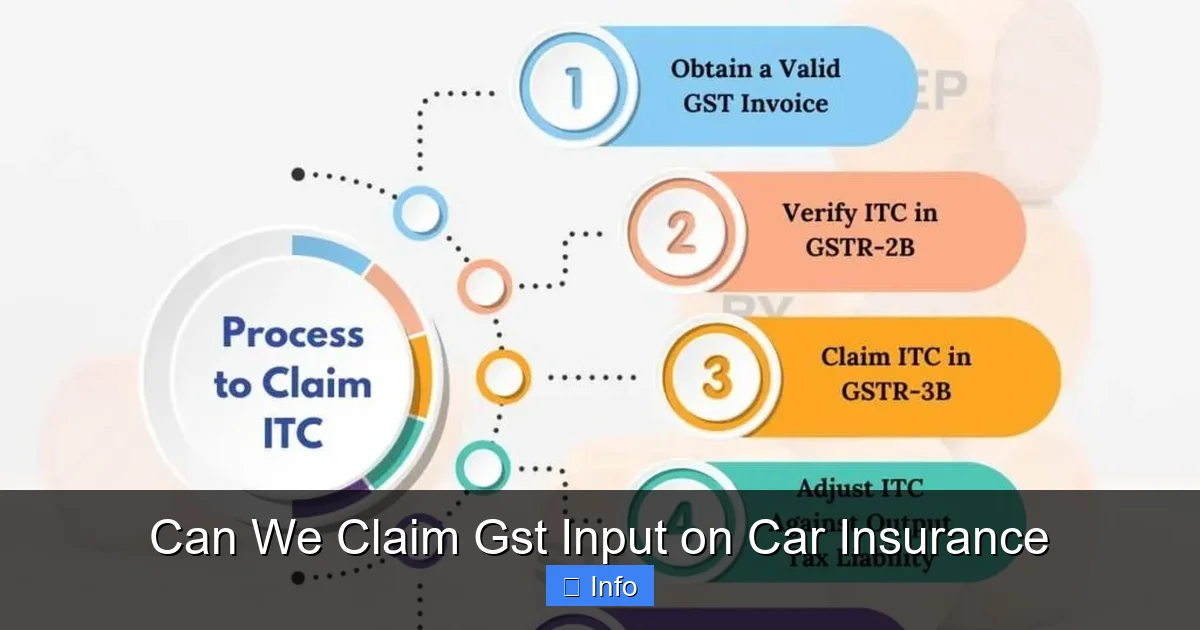
Visual guide about Can We Claim Gst Input on Car Insurance
Image source: ampuesto.in
Registration and Invoice Details
Your business must be registered for GST. The insurance invoice must display your business’s ABN or GST registration number. If the policy is in an employee’s name, you may need to adjust the claim accordingly.
Policy Ownership
The policy should be held in the business name or the name of a director who is also a GST member. A policy in the name of a non‑registered entity will block the credit.
ATO Guidelines and Legal Framework
The ATO provides specific guidelines in its Goods and Services Tax Ruling GSTR 2003/1. This ruling outlines the conditions for claiming input tax credits on motor vehicle expenses. It emphasizes the need for a direct and exclusive connection between the expense and your business activities.
Failure to follow these guidelines can result in the denial of your claim or even penalties for incorrect reporting. Always refer to the latest ATO publications when in doubt.
Partial Business Use
Even if the car is not used 100% for business, you can still claim a proportion of the GST. The ATO accepts claims based on the actual business use percentage, provided you have reliable records. This is why maintaining a detailed logbook is essential.
How to Calculate Business Use Percentage
Determining the correct percentage is crucial. One common method is the logbook method, where you record every trip for a 12‑week period and then extrapolate the results for the year. The ATO also allows a simplified method based on odometer readings if you keep a detailed travel diary.
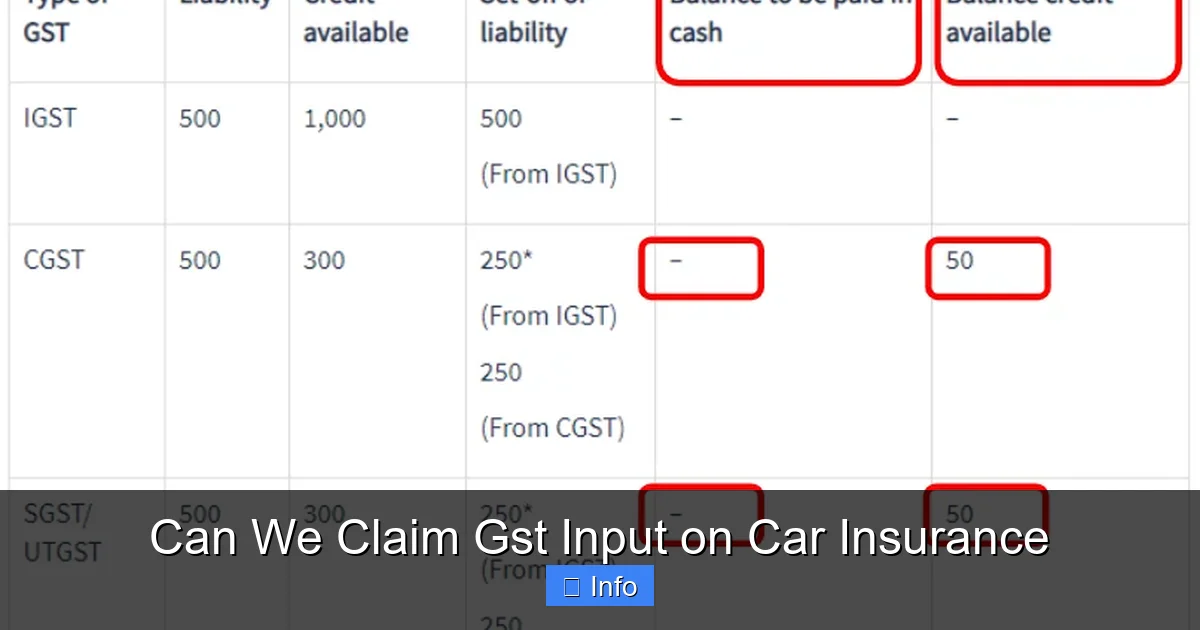
Visual guide about Can We Claim Gst Input on Car Insurance
Image source: assets1.cleartax-cdn.com
For example, if you drive 15,000 kilometres in a year and 10,500 of those are for business, your business use percentage is 70%. This percentage will be applied to the total GST paid on the insurance premium when you calculate the credit.
Documentation Needed for Claim
To support your claim, gather the following documents:
- Insurance certificate showing the business as the insured party.
- Invoice or receipt from the insurer with the GST amount clearly listed.
- Logbook or mileage record proving business use.
- Bank statement or credit card slip showing payment of the premium.
- Any correspondence with the insurer regarding coverage.
Keeping these files organized will speed up the process and reduce the chance of rejection.
For a detailed checklist, see our guide on documents required for car insurance claim.
Digital copies are acceptable, but ensure they are clear and include all relevant details. Store them in a secure cloud folder for easy access during an audit.
Step‑by‑Step Claim Process
- Collect all required documents and verify the ABN on the invoice.
- Log in to your myGov or ATO portal and select “Input Tax Credit.”
- Enter the invoice number, date, and GST amount.
- Upload a scanned copy of the invoice and any supporting evidence.
- Review the details and submit the claim.
- Monitor the status and respond to any requests for additional information.
Typical processing time is 5‑10 business days, but it can vary depending on the volume of claims.
To compare claim settlement performance, read about SBI car insurance claim settlement ratio.
Make sure to submit your claim before the BAS deadline to avoid late filing penalties. The ATO usually requires claims to be reported on the BAS for the period in which the expense was incurred.
Common Mistakes to Avoid
- Claiming for a vehicle used mostly for personal trips.
- Missing the correct ABN or GST registration number on the invoice.
- Not maintaining an up‑to‑date logbook.
- Submitting the claim after the deadline.
- Ignoring ATO requests for further documentation.
These errors can lead to a rejected claim or a request for additional information, which can delay your refund. Double‑check all details before submission.
Tips to Maximize Your Credit
- Review your policy annually to ensure it still meets business use criteria.
- Consider bundling multiple vehicles under a single commercial policy.
- Use accounting software that automatically tracks GST credits.
- Consult a tax professional if you are unsure about eligibility.
Implementing a regular review process helps you stay compliant and take full advantage of available credits.
Real‑World Example
Sarah runs a small delivery business and uses her van 70% of the time for work. She purchases a car insurance policy for $1,200, which includes $120 GST. Because her business is GST‑registered and the invoice shows her ABN, she can claim the $120 as an input tax credit. This reduces her tax payable by $120 for that period.
Another example is a freelance graphic designer who uses a car for client meetings 40% of the time. With a $900 premium and $90 GST, she can claim $36 (40% of $90) as a credit, lowering her tax bill accordingly.
Tax Implications and Record Keeping
Claiming input tax credits affects your Business Activity Statement (BAS). You must report the credit in the appropriate section, and keep supporting documents for at least five years. The ATO may audit your records, so accuracy is essential.
Use a dedicated folder in your accounting system to store invoices, logbooks, and correspondence. This makes it easy to retrieve documents if requested and ensures compliance with record‑keeping requirements.
When you file your BAS, enter the credit in the “Input Tax Credit” field. The ATO will then reconcile the amount with the GST you have collected from sales.
Digital Record Keeping
Storing your insurance documents digitally not only saves space but also makes it easier to retrieve them when needed. Use a consistent naming convention, such as “Insurance_2024_ABC.pdf,” and keep files in a secure cloud service. Many accounting packages allow you to attach invoices directly to transactions, creating an audit trail. By adopting digital records, you reduce the risk of losing paperwork and streamline the claim process.
Choosing the Right Insurance Provider
When selecting a policy, consider not only the premium cost but also the insurer’s reputation for claim settlement. You might also find our article on best car insurance claim settlement ratio useful when comparing options.
A provider with a high settlement ratio can give you confidence that your claims will be processed smoothly, which is especially important when you are relying on the input tax credit to offset your expenses.
Common Scenarios
Here are a few typical situations and how they affect your ability to claim GST input:
- Full‑time business use: If the vehicle is used exclusively for business, you can claim 100% of the GST on the insurance premium.
- Mixed use: When the car is used for both business and personal purposes, claim only the business percentage. Keep a logbook to support your calculation.
- Leased vehicle: If you lease a car for business, the GST on the lease payments and insurance can be claimed, provided the lease agreement is in the business name.
- Employee use: If an employee uses their personal car for work, the business can reimburse the insurance premium and claim the GST, but the invoice must be in the business’s name.
Each scenario requires careful documentation. The ATO may ask for proof of business use, so maintain accurate records.
ATO Tools and Resources
The ATO provides several online tools that can help you determine business use and calculate input tax credits. The “Logbook” app allows you to record trips on your mobile device and generate a report. The “GST Calculator” lets you input your expenses and instantly see the potential credit. Additionally, the ATO website hosts rulings, fact sheets, and video tutorials that explain the rules in plain language. Using these resources can reduce the risk of errors and ensure you claim the correct amount.
When to Seek Professional Advice
If you are unsure about any aspect of GST input claims, it is wise to consult a qualified tax agent or accountant. They can review your records, confirm your business use percentage, and ensure you are complying with ATO guidelines. Professional advice can also help you identify additional credits you may have missed, such as GST on car maintenance or fuel expenses. The cost of a consultation is often outweighed by the potential tax savings and peace of mind.
Final Checklist
Before you submit your claim, verify the following:
- Business is GST‑registered.
- Invoice shows ABN and GST amount.
- Vehicle is used predominantly for business.
- Logbook or mileage record is up‑to‑date.
- All supporting documents are attached.
- Claim is filed before the BAS deadline.
Following this checklist will help you avoid common errors and ensure a smooth claim process.
Related Reading
For more information on related topics, see our articles on how to check no claim bonus for car insurance and engine protection cover in car insurance. These guides provide additional insights that can help you manage your car insurance costs effectively.
Conclusion
In summary, you can claim GST input on car insurance if the vehicle is used for business, your business is GST‑registered, and you have proper invoices. By following the steps above and keeping accurate records, you can recover the tax and stay compliant with ATO requirements.
Take the time to review your current policies, calculate your business use percentage, and gather the necessary documentation. Doing so will position your business to maximize credits and reduce overall tax liabilities.
By staying organized, you can ensure you never miss a credit. This approach saves time and money.
Frequently Asked Questions
Can I claim GST input on car insurance if I use the car partly for personal use?
Yes, you can claim a proportion of the GST based on the business use percentage. Keep a logbook to support your calculation.
What documents do I need to claim GST input on car insurance?
You need the insurance certificate, invoice with GST amount, logbook or mileage record, bank statement, and any correspondence.
How do I submit a GST input claim for car insurance?
Log in to the ATO portal, select Input Tax Credit, enter invoice details, upload documents, and submit before the BAS deadline.
Is there a deadline for claiming GST input on car insurance?
Claims must be reported on the BAS for the period in which the expense was incurred. Late claims may incur penalties.
Can I claim GST input on car insurance for a leased vehicle?
Yes, if the lease is in the business name and the vehicle is used for business, you can claim the GST on the insurance premium.
What if my business is not GST registered?
You cannot claim input tax credits if your business is not registered for GST. You would need to register first.