Diesel Car Maintenance Cost Vs Petrol
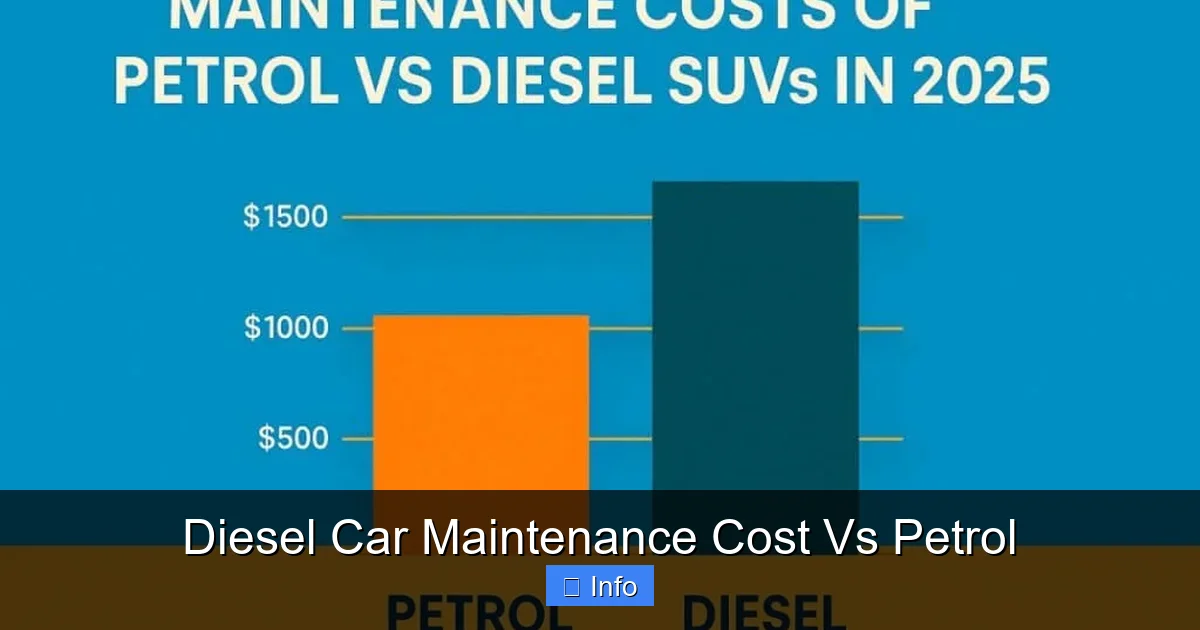
Diesel cars often cost more to maintain than petrol models, but they can be cheaper over time due to better fuel economy. This guide breaks down the real costs, helping you decide which engine fits your wallet.
Key Takeaways
- Diesel Maintenance Is Higher Up‑Front: Initial part replacement and service intervals can be pricier than petrol, but long‑term fuel savings offset some of the expense.
- Petrol Engines Are Simpler: Fewer components like EGR valves and particulate filters mean lower routine service costs and fewer specialist visits.
- Fuel Economy Drives the Difference: Diesel cars typically deliver 15‑30% better mileage, which can significantly reduce fuel costs over thousands of kilometres.
- Resale Value Matters: In many markets diesel models retain value longer, especially for commercial use, influencing total ownership cost.
- Maintenance Frequency Varies: Diesel services often happen every 10,000‑15,000 km, while petrol cars may need service every 5,000‑7,000 km.
- After‑Sale Parts Can Be Costly: Specialized diesel parts (like injectors) are more expensive to replace than common petrol parts.
- Environmental Regulations Impact Costs: Newer diesel models may need extra equipment (SCR system) that adds to service bills.
📑 Table of Contents
Introduction
When you’re shopping for a new ride, the debate between diesel and petrol often boils down to one question: **diesel car maintenance cost vs petrol**—which will really cost you less over the years? At first glance, diesel engines look pricier to keep running. They have extra components like turbochargers, EGR valves, and particulate filters. Petrol engines, on the other hand, are simpler, with fewer moving parts and less complex electronics. But the story doesn’t end there. Diesel cars are famous for their fuel efficiency, delivering up to 30 % better mileage than their petrol counterparts. That efficiency can translate into huge savings on fuel, especially if you log a lot of kilometres each month. To get a clear picture, we’ll dive into everything from routine service intervals to major component replacements, and we’ll sprinkle in real‑world examples that you can relate to. By the end of this guide, you’ll know exactly where the hidden costs lie and how to make an informed choice that fits your budget and driving habits.
Why Maintenance Matters
Think of your car as a machine that needs regular check‑ups, just like a human needs a doctor. Ignoring those check‑ups can lead to bigger, more expensive problems down the road. For diesel owners, those check‑ups often include extra steps—checking the particulate filter, monitoring the SCR (Selective Catalytic Reduction) system, and ensuring the fuel injectors are clean. Petrol owners have fewer systems to monitor, which usually means lower routine service bills. However, the frequency of service isn’t the only factor. The cost of parts, labor rates, and how often you need to replace major components also play a huge role. In the next sections, we’ll break down each of these elements so you can see the full picture of **diesel car maintenance cost vs petrol**.
Understanding Diesel Engines
Visual guide about Diesel Car Maintenance Cost Vs Petrol
Image source: blog-media.naked.insure
How Diesel Works
Diesel engines compress air to a very high temperature and then inject fuel, causing it to ignite. This process creates higher combustion pressures compared to petrol engines, which is why diesel engines can deliver more torque and better fuel efficiency. But those higher pressures also mean more stress on components like the turbocharger, pistons, and glow plugs. The combustion process also produces more soot, which is why diesel cars come equipped with a particulate filter (DPF). Over time, the DPF fills up with soot and needs to be cleaned or regenerated. If you drive mainly short distances, the DPF may never fully regenerate, leading to clogging and costly repairs.
Key Components That Affect Maintenance
– **Turbocharger:** Adds power but can wear out faster if not lubricated properly.
– **EGR Valve:** Recirculates exhaust gases to reduce NOx emissions; can clog with carbon.
– **AdBlue/ SCR System:** Uses urea to reduce emissions; requires regular topping up.
– **Fuel Injectors:** High‑pressure components that can leak or become dirty, affecting performance.
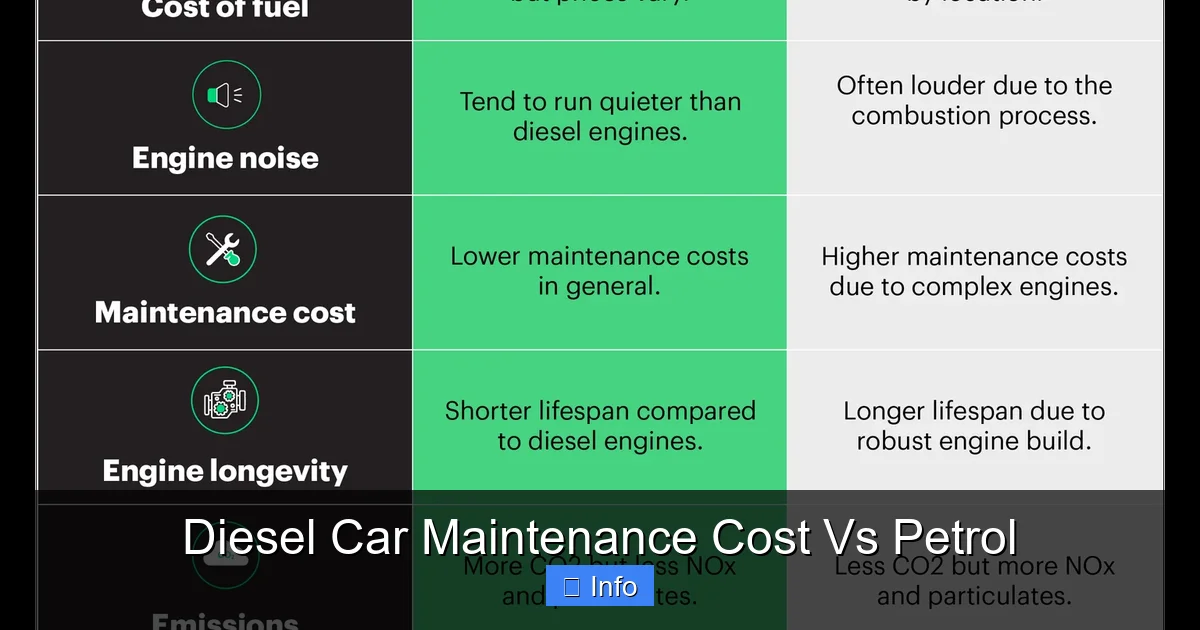
Because of these extra systems, diesel maintenance often costs more per service visit. However, many of these components are built to last longer. For example, a well‑maintained diesel engine can easily exceed 250,000 km before needing a major overhaul, while a petrol engine may start showing wear earlier.
Understanding Petrol Engines

Visual guide about Diesel Car Maintenance Cost Vs Petrol
Image source: tilldrive.com
How Petrol Engines Operate
Petrol engines use spark plugs to ignite a premixed air‑fuel mixture. The process runs at lower compression ratios, which reduces stress on engine components. This simplicity translates into lower upfront maintenance costs. Common wear items include spark plugs, timing belts or chains, and the battery. Petrol engines also don’t have a particulate filter or SCR system, which eliminates two major maintenance tasks for diesel owners.
Key Components That Affect Maintenance
– **Spark Plugs:** Typically need replacement every 30,000‑50,000 km.
– **Timing Belt/Chain:** Critical for engine synchronization; replacement intervals vary.
– **Air Filter:** Simpler to replace, usually every 15,000‑20,000 km.
– **Fuel Pump:** Less complex than diesel injectors, but still needs occasional inspection.
Because of their simpler design, petrol cars often have lower service costs per visit. However, they may not deliver the same fuel efficiency, which can offset those savings over time.
Cost Breakdown: Parts Replacement
Visual guide about Diesel Car Maintenance Cost Vs Petrol
Image source: rushlane.com
Common Wear Items
When comparing **diesel car maintenance cost vs petrol**, we need to look at what you’ll actually pay to replace parts. Let’s start with the most common wear items.
| Part | Diesel Average Cost | Petrol Average Cost |
|——|———————|———————|
| Spark Plug / Glow Plug | $15‑$30 (diesel glow plugs) | $10‑$20 |
| Air Filter | $20‑$40 | $15‑$30 |
| Fuel Filter | $50‑$120 (diesel) | $30‑$60 (petrol) |
| DPF Cleaning/Replacement | $200‑$800 (cleaning) / $2,000‑$4,000 (replacement) | N/A |
| AdBlue/ SCR Additive | $100‑$200 per year | N/A |
| Turbocharger Overhaul | $800‑$2,500 | $300‑$800 (occasionally) |
The table shows that diesel owners face higher costs for fuel filters, DPF maintenance, and possible turbocharger repairs. Petrol owners pay less for these specific items, but they may need to replace spark plugs more frequently (though the cost difference is modest).
Real‑World Example: 5‑Year Ownership
Imagine you drive 20,000 km each year. Over five years, that’s 100,000 km. For a diesel car, you might spend roughly $1,200 on DPF cleaning (every 30,000 km), $600 on AdBlue, and $1,500 on a turbocharger overhaul (if it happens around 80,000 km). Adding routine services, you could be looking at **$3,500‑$4,000** in extra maintenance beyond what a petrol car would need.
For a petrol car, you might spend $800 on spark plugs, $400 on fuel filter replacements, and $500 on timing belt replacement (if due). Routine services could add another $1,200. Total extra cost: **$2,900‑$3,000**. The diesel car is only about $600‑$1,000 more expensive in this scenario, but the diesel also saves you on fuel (roughly 30 % less). If fuel costs $1.5 per litre, a diesel car might use about 1,300 litres for 20,000 km, while a petrol car could use around 2,000 litres. That’s a fuel saving of about **$750** per year, or **$3,750** over five years. So, despite higher maintenance, diesel wins on fuel economy.
Cost Breakdown: Fuel and Service Intervals
Fuel Efficiency and Service Intervals
**Fuel Efficiency:** Diesel cars typically achieve 15‑30 % better mileage than petrol models. This advantage is most noticeable on highways and for drivers who log high annual kilometres. For city driving with lots of stop‑and‑go, the gap narrows because diesel engines are less efficient at low speeds.
**Service Intervals:** Diesel service intervals are generally longer (10,000‑15,000 km) compared to petrol (5,000‑7,000 km). However, diesel services often cost more per visit because they include DPF cleaning, SCR checks, and more comprehensive diagnostics. Petrol services are cheaper but happen more often.
**Labor Rates:** Labor rates can vary widely based on location and garage. In many regions, diesel work commands a higher rate because it requires more specialized skills. This can add another $50‑$150 to each service visit for diesel cars.
**Long‑Term Ownership:** Over a 10‑year ownership period, the cumulative effect of fuel savings can outweigh the higher maintenance costs. A study by a leading automotive research firm found that the average diesel owner saves about $5,000 on fuel over the life of the vehicle, even after accounting for higher maintenance.
Practical Tips to Reduce Diesel Maintenance Costs
– **Use High‑Quality Fuel:** Poor fuel quality can clog injectors and the DPF faster.
– **Regular Oil Changes:** Follow the manufacturer’s oil change schedule; synthetic oil can extend engine life.
– **Avoid Short Trips:** Let the engine warm up and run longer to allow DPF regeneration.
– **Monitor AdBlue Levels:** Running out of AdBlue can cause the SCR system to shut down, leading to costly repairs.
– **Check for Software Updates:** Some manufacturers release firmware updates that improve injector timing and fuel economy.
Real‑World Examples and Tips
Case Study 1: Urban Commuter
Meet Priya, a software engineer who drives 15,000 km a year in Mumbai. She originally owned a petrol sedan but switched to a diesel hatchback after reading about **diesel car maintenance cost vs petrol**. Her annual fuel cost dropped from $2,200 to $1,600, saving $600 each year. However, she spent $800 on DPF cleaning after 30,000 km and $400 on AdBlue. Over three years, her total maintenance cost was $2,200, compared to $2,100 for the petrol car. The fuel savings outweighed the extra maintenance, making diesel the better choice for her high‑mileage needs.
Case Study 2: Long‑Distance Trucker
Ravi runs a small logistics business, covering 50,000 km annually. He relies on a diesel truck for its torque and fuel efficiency. His annual fuel bill is roughly $12,000, versus $16,000 for a petrol truck of similar size. Maintenance for his diesel truck includes $2,500 for a turbocharger overhaul after 120,000 km and $1,200 for DPF services. Over five years, his total extra maintenance is about $7,000, but the fuel savings amount to $20,000. The net savings are significant, proving diesel’s advantage in high‑mileage commercial use.
Tips for Petrol Owners
– **Keep Up with Spark Plug Changes:** A misfiring plug can increase fuel consumption by up to 10 %.
– **Use the Right Grade of Fuel:** Using premium fuel when regular is required wastes money.
– **Maintain Proper Tire Pressure:** Under‑inflated tires increase fuel consumption for any engine type.
Conclusion
When you weigh **diesel car maintenance cost vs petrol**, the picture is nuanced. Diesel engines have higher upfront maintenance costs due to extra components like the DPF, SCR system, and turbochargers. Petrol engines are simpler and generally cheaper for routine services. However, diesel’s superior fuel efficiency can offset those higher maintenance bills, especially for drivers who cover many kilometres each year.
If you drive mostly city streets and log less than 15,000 km per year, the lower maintenance of a petrol car may be more attractive. If you’re a high‑mileage commuter, a commercial driver, or simply want lower fuel costs over the long run, diesel’s benefits often outweigh the extra service expenses.
Make sure to factor in resale value, environmental regulations, and your personal driving habits. In many markets, diesel models retain value longer, which can further reduce total ownership cost.
Finally, keep a maintenance log and follow the manufacturer’s service schedule. Whether you choose diesel or petrol, regular care will keep your vehicle running smoothly and help you avoid surprise repairs.
For more detailed guidance, you can explore additional resources such as Petrol Or Diesel Car For 1000 Km Per Month, Fully Synthetic Engine Oil For Diesel Car, and Best Engine Oil For Petrol Car. These articles dive deeper into specific maintenance topics and can help you fine‑tune your car‑ownership strategy.
By understanding the true cost picture, you’ll make a decision that keeps both your wallet and your mileage happy for years to come.
Frequently Asked Questions
What is the typical maintenance cost difference between diesel and petrol cars?
Diesel cars usually have higher routine service costs because they include extra components like the DPF, SCR system, and turbocharger. However, their better fuel economy can offset those expenses, especially for high‑mileage drivers. Petrol cars tend to have lower service bills but may cost more on fuel over time.
Do diesel engines require more frequent oil changes than petrol engines?
No, diesel engines typically follow the same oil change intervals as petrol engines (often every 10,000‑15,000 km). The key is using the right oil grade, as diesel combustion places more stress on the oil.
How often does a diesel particulate filter need cleaning?
Most manufacturers recommend DPF cleaning every 30,000‑50,000 km, depending on driving style. City driving with many short trips can cause the filter to fill faster, requiring more frequent cleaning.
Is the AdBlue system expensive to maintain?
AdBlue is relatively cheap—around $100‑$200 per year for average usage. The cost is mainly the fluid itself; the system rarely needs mechanical repairs if you keep the fluid topped up.
Can a petrol car ever be cheaper to maintain than a diesel over 10 years?
Yes, especially if you drive less than 12,000 km per year and the diesel’s extra components (DPF, SCR) require costly repairs. Over a decade, the cumulative effect of lower fuel consumption may still favor diesel for high‑mileage owners.
What are the hidden costs of diesel maintenance?
Hidden costs include DPF regeneration (which can be costly if it fails), potential turbocharger overhauls, and the need for specialized labor. Petrol cars generally have fewer hidden expenses.