Highest Selling Car Company in India

Maruti Suzuki has maintained its position as the highest selling car company in India for decades, commanding a market share exceeding 40%. Its success stems from an extensive service network, fuel-efficient models, and aggressive pricing across segments. The company’s ability to adapt to changing consumer preferences, including a strong push into SUVs and CNG variants, ensures its continued leadership in the competitive Indian automotive landscape.
When you think of cars in India, one name inevitably dominates the conversation. For over three decades, Maruti Suzuki has not just participated in the market; it has defined it. Being the highest selling car company in India isn’t just about volume numbers—it’s about understanding the pulse of a diverse nation. From the bustling streets of Mumbai to the winding roads of the Northeast, their vehicles are a ubiquitous sight. But how did a joint venture between the Government of India and Suzuki Motor Corporation become an automotive titan? Let’s take a deep dive into the journey, the strategy, and the future of India’s car king.
The story begins in 1981, but the real turning point came with the launch of the Maruti 800 in 1983. It wasn’t merely a car; it was a revolution on wheels. It brought personal mobility within reach of the middle class, a segment previously reliant on scooters or aging Ambassadors and Fiats. That legacy of democratizing mobility continues today. While competitors have come and gone, and global giants have struggled to crack the Indian code, Maruti Suzuki has only strengthened its grip. Their secret? A relentless focus on what the Indian buyer actually values: low running costs, high resale value, and a service center around every corner.
Key Takeaways
- Market Leadership: Maruti Suzuki holds over 40% market share, making it the undisputed highest selling car company in India.
- Diverse Portfolio: From entry-level hatchbacks to premium SUVs, the brand covers every major segment with models like Alto, Swift, Baleno, and Brezza.
- Service Network Advantage: With 3,500+ service touchpoints, Maruti offers unmatched after-sales support, a critical factor for Indian buyers.
- Fuel Efficiency Focus: Strong emphasis on CNG, hybrid, and petrol powertrains aligns with India’s cost-conscious consumers.
- Export Hub: India serves as a global manufacturing base for Maruti Suzuki, exporting to over 100 countries.
- EV Strategy: The company plans multiple electric vehicle launches by 2030, starting with the eVX concept-based SUV.
- Resale Value: Maruti cars consistently command high resale prices, reinforcing buyer confidence and brand loyalty.
📑 Table of Contents
- The Numbers Behind the Dominance
- Why Indian Buyers Choose Maruti Suzuki
- Product Strategy: Covering Every Base
- Manufacturing Might and Export Powerhouse
- Challenges and the Road Ahead
- The Competitive Landscape: Who’s Chasing?
- Buying Tips: Choosing the Right Maruti for You
- Future Outlook: Can the Crown Be Held?
The Numbers Behind the Dominance
Statistics tell a compelling story. In the financial year 2023-24, Maruti Suzuki dispatched over 2.1 million units to dealers, capturing a passenger vehicle market share hovering around 42%. To put that in perspective, the next three largest competitors combined barely match that volume. This isn’t a recent spike; it’s a consistent trend spanning years. Even during industry downturns—demonetization, BS6 transition, the pandemic, semiconductor shortages—Maruti’s share remained remarkably resilient.
Monthly Sales Consistency
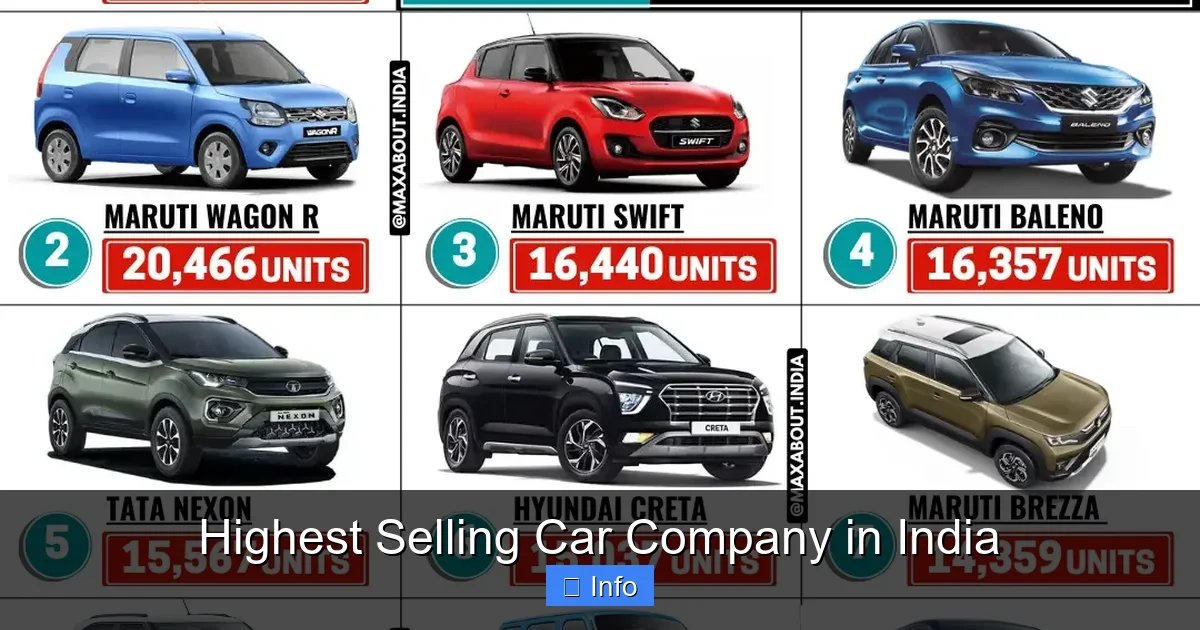
Unlike some rivals who rely on festive season spikes, Maruti delivers steady monthly volumes. Models like the WagonR, Swift, and Baleno regularly feature in the top-10 bestseller lists month after month. The WagonR alone often clocks 15,000-18,000 units monthly. This consistency allows for better production planning, inventory management, and dealer profitability. It creates a virtuous cycle: high volumes lower per-unit costs, enabling competitive pricing, which drives further volume.
Segment-Wise Leadership
The company doesn’t just lead overall; it dominates specific segments. In the entry hatchback space (Alto, S-Presso), they have a near-monopoly. In the premium hatchback segment, the Baleno often outsells the next two competitors combined. The Brezza has dethroned long-standing leaders in the compact SUV space. Even in the mid-size SUV segment, the Grand Vitara has quickly become a volume leader. This breadth means they capture buyers at every life stage—first car, upgrade, family hauler—keeping them within the ecosystem.
Why Indian Buyers Choose Maruti Suzuki
Ask any Indian car owner why they bought a Maruti, and the answers are remarkably consistent. It boils down to a “peace of mind” package that competitors struggle to replicate fully. Let’s break down the pillars of this trust.
Visual guide about Highest Selling Car Company in India
Image source: ic.maxabout.us
The Service Network Moat
This is Maruti’s single biggest competitive advantage. With over 3,500 service workshops across 1,900+ cities, you are rarely far from authorized support. In a country where road conditions vary wildly and spare parts availability can make or break ownership, this network is gold. A breakdown in a tier-3 town? A Maruti technician is likely nearby. Competitors with 300-500 outlets simply cannot match this reach. It also means used car buyers in smaller towns prefer Maruti, boosting resale values.
Cost of Ownership Engineering
Indian buyers calculate cost per kilometer religiously. Maruti engineers for this. Lightweight platforms (HEARTECT), high thermal efficiency engines (K-series, Z-series), and extensive CNG factory-fitted options keep running costs minimal. The company pioneered the “CNG from factory” approach, offering warranty coverage that aftermarket kits void. With fuel prices high, a car delivering 25-30 km/kg (CNG) or 22+ km/l (petrol) isn’t a feature—it’s a necessity. This focus extends to maintenance; service costs are transparent, parts are affordable, and intervals are practical.
Resale Value Confidence
A car is often the second-largest purchase for an Indian family. Knowing it will retain 55-65% value after 5 years makes the decision easier. Maruti models consistently top resale value charts. This is driven by the service network, parts availability, and sheer demand in the used market. High resale value lowers the effective cost of ownership, enabling easier upgrades. It’s a self-reinforcing loop: high resale attracts new buyers, increasing volume, which sustains the used market demand. If you are researching which car has good resale value in India, Maruti models almost always top the list.
Product Strategy: Covering Every Base
Maruti’s portfolio strategy is a masterclass in segmentation. They don’t just make cars; they fill price gaps. Let’s look at how they structure their lineup to capture maximum wallet share.
The Arena vs. Nexa Channel Split
In 2015, Maruti launched Nexa, a premium retail channel for higher-spec models (Baleno, Ciaz, XL6, Grand Vitara, Fronx, Jimny). Arena handles the mass-market volume drivers (Alto, WagonR, Swift, Dzire, Brezza, Ertiga). This dual-channel strategy serves two purposes: it elevates the brand perception for premium buyers who want a differentiated buying experience, while keeping the high-volume, price-sensitive Arena channel lean and efficient. It prevents brand dilution—something that plagued them when the Kizashi failed in a standard showroom.
SUV Offensive: Catching the Wave
Recognizing the SUV boom, Maruti launched a blitzkrieg. The Brezza (compact SUV) became an instant hit. The Grand Vitara (mid-size SUV) brought strong hybrid tech and AWD options. The Fronx (coupe SUV) targets urban youth. The Jimny (lifestyle off-roader) builds brand halo. This offensive arrested share loss to Hyundai (Creta, Venue) and Tata (Nexon, Punch). Today, SUVs contribute over 35% of their sales, up from single digits five years ago. They achieved this without neglecting their hatchback/sedan core.
Powertrain Diversification: Betting on Multiple Horses
Unlike some global OEMs going all-in on EVs, Maruti adopts a pragmatic multi-powertrain approach: strong hybrids (Grand Vitara, Invicto), CNG (across 13+ models), ethanol-flex ready engines, and upcoming EVs. This hedges against infrastructure uncertainty. India’s charging network is nascent; CNG pumps are expanding rapidly; hybrid needs no plug. This flexibility lets them sell “green” cars today without waiting for tomorrow’s grid. The strong hybrid system (e-CVT) sourced from Toyota delivers 27+ km/l real-world—crucial for fleet and high-mileage users.
Manufacturing Might and Export Powerhouse
Being the highest selling car company in India requires industrial scale. Maruti operates three plants: Gurugram (Haryana), Manesar (Haryana), and Hansalpur (Gujarat – Suzuki Motor Gujarat). Combined installed capacity exceeds 2.25 million units annually. A fourth plant in Kharkhoda (Haryana) with 1 million capacity is under construction, targeting 2025 commissioning. This vertical integration—engine, transmission, stamping, casting in-house—controls costs and quality.
Visual guide about Highest Selling Car Company in India
Image source: cardekho24.com
Global Export Hub
India is Suzuki’s largest production base outside Japan. Maruti exports to 100+ countries across Africa, Latin America, ASEAN, and the Middle East. Models like Baleno, Swift, Dzire, S-Presso, and Jimny are shipped in significant volumes. Exports crossed 2.5 lakh units in FY24. This de-risks domestic cycle dependence and improves plant utilization. It also brings global quality benchmarks to domestic cars—export models often have stricter NVH and safety specs that trickle down.
Localization and Supplier Ecosystem
Over 95% localization is achieved for high-volume models. A dense supplier cluster around Manesar/Gurugram enables just-in-time delivery. Maruti hand-holds vendors—tech transfer, quality systems, financial support—creating a loyal, capable base. This ecosystem is a massive entry barrier. A new entrant cannot replicate this supply chain depth quickly. It also allows rapid model iterations and cost reductions.
Challenges and the Road Ahead
Dominance breeds complacency risks. Maruti faces headwinds that could erode share if not addressed decisively.
Safety Perception Gap
Historically, Maruti cars scored poorly on Global NCAP crash tests (0-2 stars for older models). While new HEARTECT-based models (Baleno, Brezza, Grand Vitara, Fronx) now achieve 4-5 stars, the legacy perception lingers. Competitors like Tata and Mahindra have made “safety first” their marketing cornerstone, forcing Maruti to play catch-up in narrative. They are addressing this structurally—all new launches target 5 stars—but changing consumer perception takes time.
EV Transition Execution
Maruti’s first EV (eVX-based SUV) arrives around 2025-26, later than Tata (Nexon.ev, Tiago.ev, Punch.ev) and Mahindra (XUV400, BE.05). Tata already commands 70%+ EV market share. Maruti argues the market isn’t ready for mass EV adoption (high cost, low infra) and their hybrid/CNG bridge is smarter. But they must scale EV production fast post-launch. The Kharkhoda plant has dedicated EV lines. Partnership with Toyota for EV tech helps. Success here is non-negotiable for 2030 relevance.
Premiumization and Margin Pressure
As buyers upgrade, average selling prices rise. Maruti’s strength has been high-volume, lower-margin entry cars. The shift to SUVs, Nexa models, and hybrids improves margins but reduces volumes per model. Managing this portfolio mix—keeping entry volume for market share while pushing premium for profit—is a delicate balancing act. The discontinuation of the Alto 800 (entry icon) signals intent, but risks ceding the absolute entry buyer to used cars or two-wheelers.
The Competitive Landscape: Who’s Chasing?
No monopoly lasts forever. Understanding the challengers highlights what Maruti must defend.
Hyundai Motor India: The Perennial #2
Hyundai holds ~15% share. Strengths: strong brand premiumness, feature-loaded cars (ADAS, panoramic sunroofs), successful SUV lineup (Creta, Venue, Exter), and growing EV presence (Ioniq 5, Creta EV coming). Weakness: service network half of Maruti’s, higher maintenance costs, no CNG factory range breadth. They dominate the premium hatchback (i20) and mid-SUV (Creta) segments where Maruti is weaker.
Tata Motors: The Disruptor
Tata has surged to ~13-14% share, driven by “New Forever” philosophy: safety (5-star GNCAP across range), design, and EVs. The Nexon (ICE + EV) and Punch are blockbusters. They own the EV narrative. Weakness: service experience inconsistency, longer wait times, resale value still catching up. Their aggressive model pipeline (Curvv, Sierra, Harrier EV) keeps pressure on.
Mahindra & Mahindra: The SUV Specialist
Mahindra (~9-10% share) owns the “authentic SUV” space (Thar, Scorpio-N, XUV700, Bolero). High loyalty, strong brand community. New BE/born electric platform targets premium EVs. Weakness: limited presence in high-volume hatchback/sedan segments, production bottlenecks (long waits), urban dealership density lower.
Toyota Kirloskar Motor: The Silent Partner
Toyota (~5-6% share) shares tech (hybrid, platforms) with Maruti via Suzuki-Toyota alliance. Models like Hyryder (Grand Vitara twin), Rumion (Ertiga twin), Invicto (Innova Hycross twin) are badge-engineered Marutis. This expands Maruti’s reach without R&D cost. But Toyota’s own strong hybrid push (Innova Hycross, Camry) and upcoming EVs make them a collaborator-competitor.
Buying Tips: Choosing the Right Maruti for You
With 15+ models, picking the right one can be overwhelming. Here’s a quick framework based on typical buyer profiles.
First-Time Buyer / Budget Conscious
- Alto K10 / S-Presso: Lowest entry price, easy city maneuverability, best mileage (24+ km/l petrol, 32+ km/kg CNG). Ideal for tight parking, short commutes.
- WagonR: Tall-boy stance = more headroom, better visibility. 1.0L and 1.2L options. CNG available. Best practical family hatchback under ₹7 lakh.
Urban Professional / Small Family
- Swift / Baleno: Sporty styling, peppy 1.2L K-series. Baleno offers more space, features (HUD, 360-cam), premium feel (Nexa). Swift is more fun to drive. Both have strong resale.
- Dzire (sedan): Boot space for luggage, rear AC vents, corporate fleet favorite. CNG makes it a running cost champion.
Growing Family / Weekend Traveler
- Ertiga / XL6: Only 3-row MPVs in segment. Ertiga (Arena) = value. XL6 (Nexa) = captain seats, premium trim. 1.5L mild-hybrid petrol/CNG. Best people movers under ₹15 lakh.
- Brezza / Fronx: Compact SUVs. Brezza = boxy, practical, CNG option. Fronx = coupe styling, turbo-petrol (1.0L Boosterjet) for performance. Both feature-rich (sunroof, HUD, 360-cam).
Enthusiast / Highway Tourer
- Grand Vitara: Mid-size SUV. Strong hybrid (27.97 km/l claimed) = lowest running cost in class. AWD (AllGrip Select) on manual variants. Premium interior, panoramic sunroof, ventilated seats. Best for high monthly mileage (2000+ km).
- Jimny: True 4×4 with low-range transfer case. Lifestyle off-roader. 5-door practicality. Niche but capable.
Pro Tip: Timing Your Purchase
Best discounts usually arrive: year-end (Dec), financial year-end (Mar), and during festive season (Oct-Nov). However, high-demand models (Grand Vitara hybrid, Brezza CNG, Jimny) rarely see heavy discounts. For these, book early to lock price and queue position. Always negotiate accessories (mats, mudflaps, coating) as freebies rather than cash discount on high-demand cars.
Future Outlook: Can the Crown Be Held?
The automotive landscape is shifting faster than ever—electrification, connectivity, shared mobility, stricter emissions (CAFE norms). Maruti’s FY24 annual report outlines a clear roadmap: 6 new SUVs by 2030, first EV in FY26, 6 EV models by 2031, targeting 40% EV mix by 2030-31. They aim for 4 million annual capacity (domestic + export) by 2030-31.
Their pragmatic “multi-pathway” tech strategy (hybrid, CNG, flex-fuel, EV) is uniquely suited for India’s uneven infrastructure rollout. The Suzuki-Toyota alliance provides access to world-class hybrid and EV architectures without solo R&D burden. The financial muscle (zero debt, huge cash reserves) funds aggressive capacity expansion.
However, the biggest threat isn’t a rival OEM—it’s disruption. If EV adoption accelerates non-linearly (battery cost crash, charging ubiquity, policy mandate), the hybrid/CNG bridge could become a stranded asset. Maruti’s late EV entry is a calculated risk. If they execute the eVX launch flawlessly—right price (₹15-20 lakh), right range (400+ km real), right charging support—they can leverage their distribution to scale faster than anyone.
Another wildcard: the entry segment. As two-wheelers get expensive (BS7 norms) and used car market organizes, the “first new car” buyer may shrink. Maruti must keep an ultra-affordable EV/hybrid in pipeline to defend the bottom. The rumored “e-Spresso” or small EV based on Suzuki’s global compact EV platform could be that answer.
Ultimately, the title of highest selling car company in India is Maruti Suzuki’s to lose. They have the network, the product breadth, the cost structure, and the trust. The next decade will test if they can translate ICE dominance into EV leadership. For now, if you want a car that starts every morning, sips fuel, gets fixed anywhere, and sells well later—a Maruti is still the default rational choice for millions. And that habit is the strongest moat of all.
Frequently Asked Questions
Which is the highest selling car company in India currently?
Maruti Suzuki India Limited is the highest selling car company in India, consistently holding a market share above 40% in the passenger vehicle segment for several decades.
What are the top 3 best-selling Maruti Suzuki models in India?
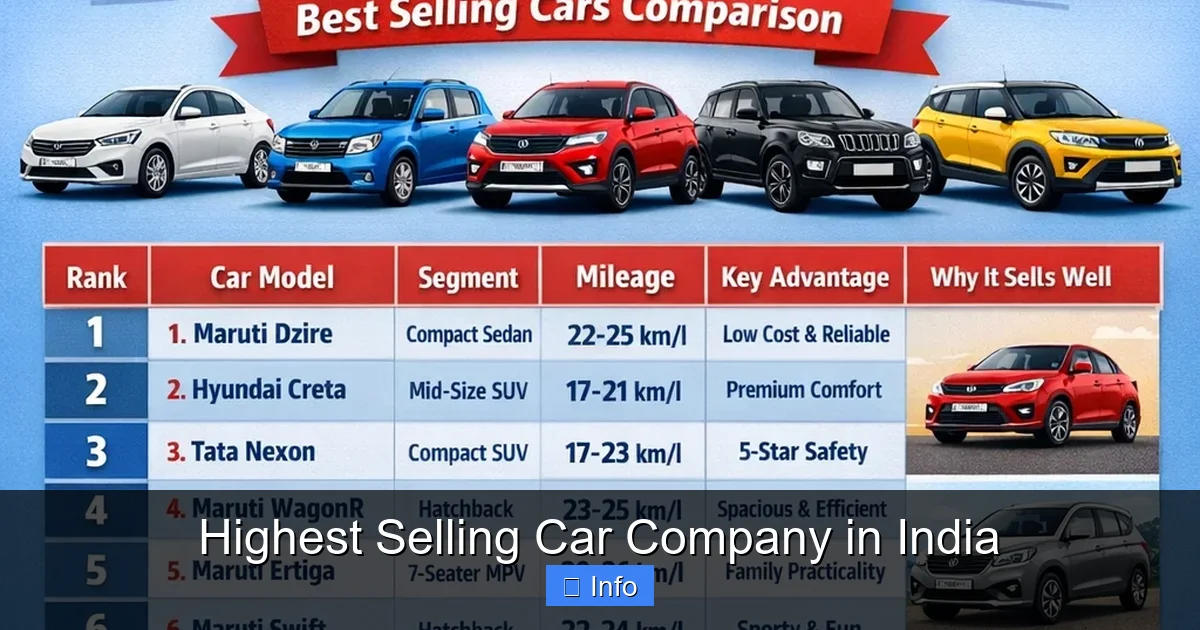
The consistent top sellers are the WagonR, Swift, and Baleno. The Brezza and Dzire also regularly feature in the top 5, depending on the month.
Why does Maruti Suzuki have such a high market share in India?
Key reasons include an unmatched service network (3,500+ outlets), low cost of ownership (fuel efficiency, affordable maintenance), high resale value, and a diverse product portfolio covering almost every price bracket.
Is Maruti Suzuki planning to launch electric cars in India?
Yes, Maruti Suzuki plans to launch its first electric vehicle (based on the eVX concept) around 2025-2026, with a target of 6 EV models by 2030-31.
Which Maruti car offers the best mileage in India?
The CNG variants offer the best running costs. The WagonR CNG, Alto K10 CNG, and S-Presso CNG deliver over 32 km/kg. Among strong hybrids, the Grand Vitara Hybrid claims 27.97 km/l.
How does Maruti Suzuki’s service network compare to competitors?
Maruti Suzuki has the largest service network in India with over 3,500 workshops across 1,900+ cities. This is roughly 3-4 times larger than the nearest competitors like Hyundai or Tata Motors.