Maruti Suzuki Car Emi and Downpayment
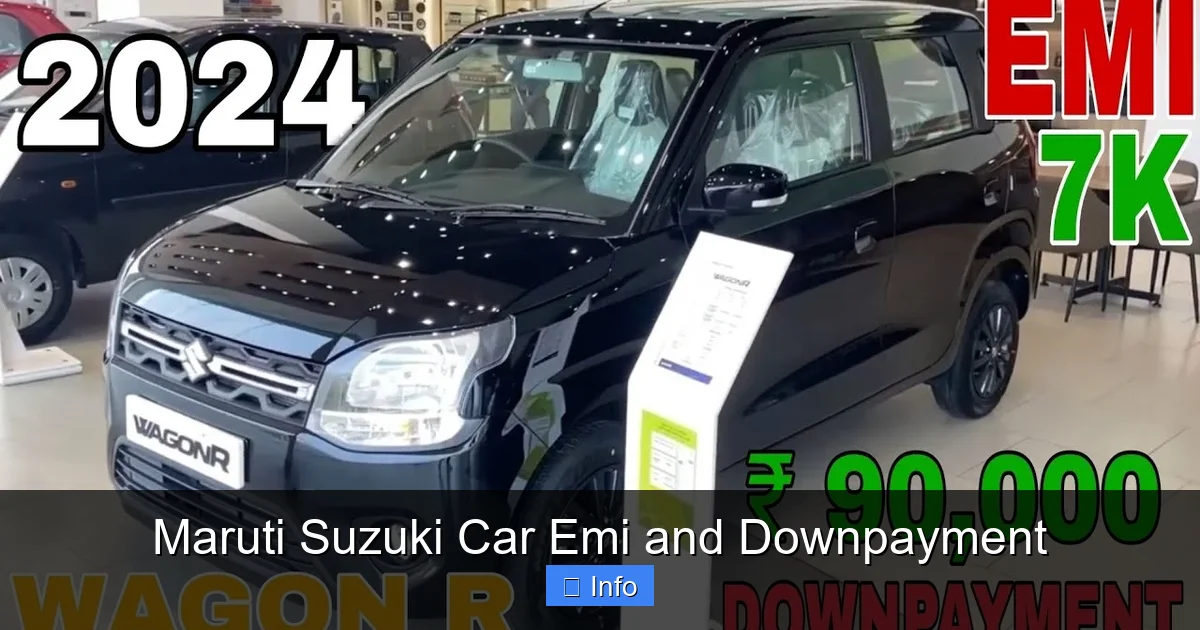
Planning to buy a Maruti Suzuki? Understanding the EMI and downpayment structure is crucial for budgeting. This guide breaks down costs for popular models, explains how interest rates and loan tenure affect monthly payments, and shares tips to lower your financial burden.
Buying a car is a major financial milestone. For millions of Indians, a Maruti Suzuki is the default choice thanks to its reliability, service network, and resale value. But before you visit the showroom, you need to crack the numbers. Understanding the Maruti Suzuki car EMI and downpayment structure helps you avoid surprises and pick a plan that fits your monthly budget comfortably.
Most buyers focus only on the ex-showroom price. The real cost includes RTO charges, insurance, handling fees, and accessories. This on-road price is the actual base for your loan calculation. Whether you are eyeing a compact Alto K10 or a feature-packed Brezza, the logic remains the same. Let us walk through every detail so you can negotiate confidently and drive home stress-free.
Key Takeaways
- Downpayment Range: Typically 10% to 20% of the on-road price, but zero downpayment schemes exist for eligible buyers.
- EMI Determinants: Loan amount, interest rate, and tenure are the three pillars that decide your monthly installment.
- Model Variance: Entry-level cars like Alto have EMIs starting near ₹10,000, while premium models like Grand Vitara can exceed ₹30,000.
- Interest Rates Matter: A 0.5% rate difference on a 7-year loan changes the total interest payable by thousands of rupees.
- Prepayment Helps: Making part-prepayments annually can significantly reduce the loan tenure and total interest outgo.
- Check On-Road Price: Always calculate EMI on the on-road price (including RTO, insurance), not the ex-showroom price.
- Used Car Option: Certified pre-owned vehicles from Maruti Suzuki True Value offer lower loan amounts and EMIs.
📑 Table of Contents
- Understanding Maruti Suzuki Car EMI and Downpayment Basics
- Factors That Influence Your EMI and Downpayment
- Popular Maruti Suzuki Models and Their Estimated EMI
- How to Calculate Your EMI and Downpayment
- Tips to Reduce Your EMI Burden
- Financing Options: Bank Loans vs. Dealer Financing
- Documents Required and Process Flow
- Common Mistakes to Avoid
- Conclusion
Understanding Maruti Suzuki Car EMI and Downpayment Basics
What Is a Downpayment?
The downpayment is the upfront amount you pay from your pocket. The bank or NBFC finances the remaining amount. For a new Maruti Suzuki, lenders usually fund 80% to 90% of the on-road price. This means you need to arrange 10% to 20% upfront. Some festive offers or tie-ups with specific banks may offer 100% on-road funding, but these often come with slightly higher interest rates or processing fees.
What Is an EMI?
EMI stands for Equated Monthly Installment. It is the fixed amount you pay every month until the loan is cleared. It has two components: principal repayment and interest payment. In the initial years, the interest portion is high. As you progress, the principal portion increases. The formula uses the reducing balance method, meaning interest is calculated on the outstanding principal every month.
On-Road Price vs. Ex-Showroom Price
Never calculate your loan on the ex-showroom price. Always ask the dealer for the on-road price. This includes:
– Ex-showroom price
– RTO registration charges
– Mandatory insurance (1st year comprehensive + 3rd year third-party for new cars)
– Dealer handling/logistic charges
– Optional accessories and extended warranty
For accurate planning, check the Maruti Suzuki all car price in Bhubaneswar or your respective city to get a realistic on-road estimate before applying for a loan.
Factors That Influence Your EMI and Downpayment
Loan Tenure: The Balancing Act
Tenure typically ranges from 1 to 7 years. A longer tenure lowers the EMI but increases total interest paid. A shorter tenure raises the EMI but saves massive interest. For example, a ₹6 lakh loan at 9% for 5 years costs ~₹12,500 EMI with ~₹1.5 lakh total interest. The same loan for 7 years drops EMI to ~₹9,600 but interest jumps to ~₹2.1 lakh. Choose the shortest tenure you can afford.
Visual guide about Maruti Suzuki Car Emi and Downpayment
Image source: i.ytimg.com
Interest Rate: Fixed vs. Floating
Most car loans are floating, linked to the bank’s MCLR or repo rate. Fixed rates are rare and usually higher. Your credit score (CIBIL) is the biggest lever. A score above 750 gets you the best rates. Compare offers from multiple banks. Even a 0.25% difference matters over 5-7 years. You can check current benchmarks like the Punjab and Sind Bank car loan interest rate to negotiate better with your preferred lender.
Loan-to-Value (LTV) Ratio
LTV is the percentage of the on-road price the bank funds. RBI guidelines cap LTV for cars at 90% for loans up to ₹10 lakh and 80% above that. However, individual banks set internal caps. Maruti’s financing partners (like Maruti Suzuki Smart Finance) often offer higher LTV for select models or customer profiles (salaried, existing customers).
Processing Fees and Hidden Charges
Banks charge a processing fee (0.5% to 1% of loan amount, capped usually at ₹5,000-₹10,000). There may be documentation charges, foreclosure charges (if you close early), and part-prepayment penalties. Read the sanction letter carefully. Some banks waive foreclosure charges after a certain period (e.g., 6-12 months).
Popular Maruti Suzuki Models and Their Estimated EMI
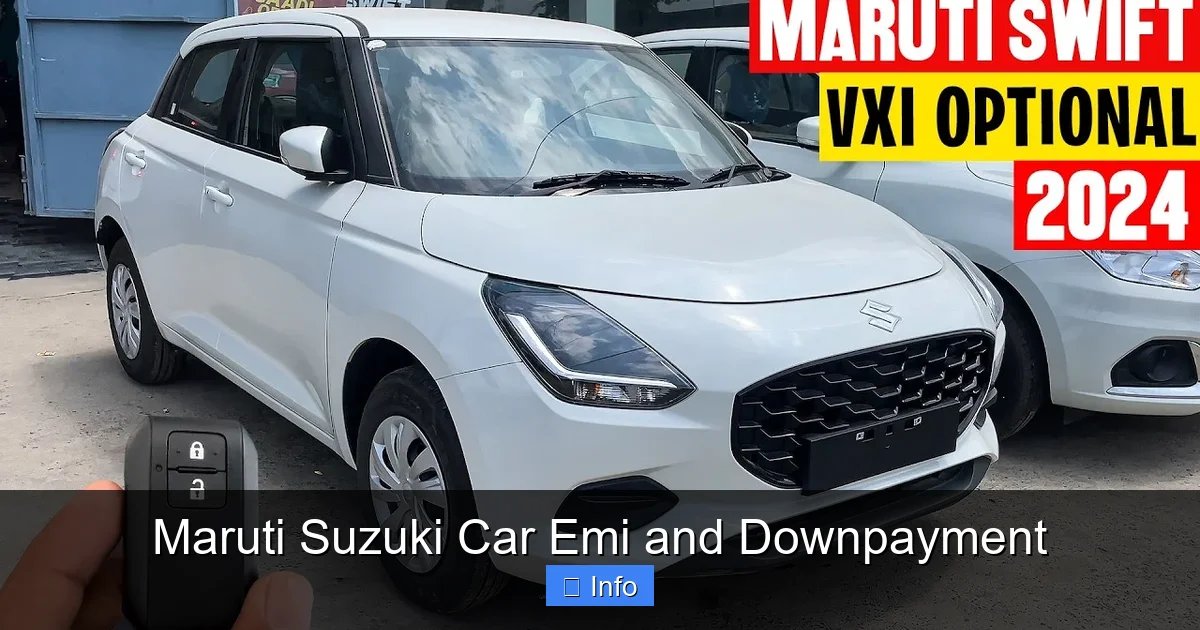
Below are indicative calculations for base variants in a metro city. Assumptions: 20% downpayment, 9% interest rate, 5-year tenure. On-road prices vary by city; these are estimates.
Visual guide about Maruti Suzuki Car Emi and Downpayment
Image source: i.ytimg.com
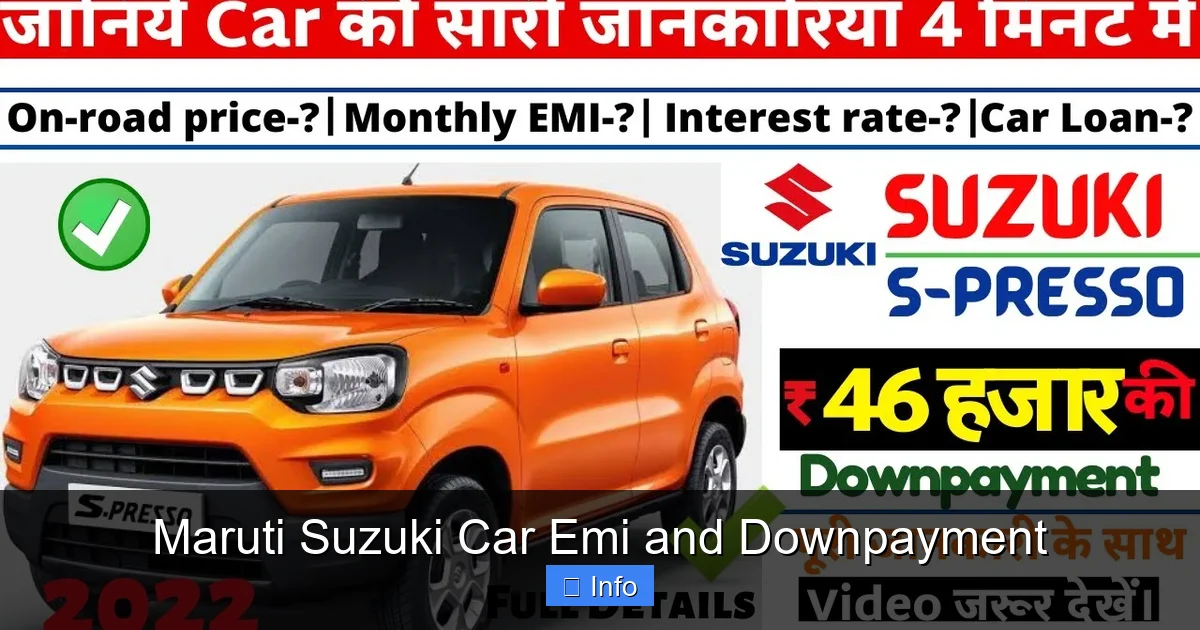
Entry-Level Segment (Alto K10, S-Presso)
On-road price: ~₹4.5 – 5.2 Lakh
Loan Amount (80%): ~₹3.6 – 4.16 Lakh
Estimated EMI: ₹7,500 – ₹8,600
These are the most affordable entries. The downpayment is manageable (~₹90k – ₹1.04 Lakh). Ideal for first-time buyers with tight monthly budgets.
Compact Hatchbacks (WagonR, Swift, Celerio, Ignis)
On-road price: ~₹6.0 – 8.5 Lakh
Loan Amount (80%): ~₹4.8 – 6.8 Lakh
Estimated EMI: ₹10,000 – ₹14,100
The Swift and WagonR are volume leaders. The WagonR CNG variant is popular for low running costs. Downpayment ranges ₹1.2 – ₹1.7 Lakh.
Premium Hatchbacks (Baleno, Swift Sport)
On-road price: ~₹8.0 – 10.5 Lakh
Loan Amount (80%): ~₹6.4 – 8.4 Lakh
Estimated EMI: ₹13,300 – ₹17,400
Baleno commands a premium. The downpayment crosses ₹1.6 Lakh. Buyers often stretch to 6-7 years here to keep EMI near ₹12k-₹13k.
Compact SUVs (Brezza, Fronx)
On-road price: ~₹9.5 – 13.5 Lakh
Loan Amount (80%): ~₹7.6 – 10.8 Lakh
Estimated EMI: ₹15,800 – ₹22,400
High demand segment. The Brezza CNG and Fronx Turbo attract buyers wanting SUV stance with manageable running costs. Downpayment: ₹1.9 – ₹2.7 Lakh.
Mid-Size SUVs (Grand Vitara)
On-road price: ~₹13.0 – 20.0 Lakh (Strong Hybrid top-end)
Loan Amount (80%): ~₹10.4 – 16.0 Lakh
Estimated EMI: ₹21,600 – ₹33,200
The flagship. Strong Hybrid variants qualify for lower GST in some states, slightly reducing on-road price. Downpayment is substantial: ₹2.6 – ₹4.0 Lakh.
MPVs (Ertiga, XL6, Invicto)
On-road price: ~₹10.5 – 25.0 Lakh (Invicto Hybrid)
Loan Amount (80%): ~₹8.4 – 20.0 Lakh
Estimated EMI: ₹17,400 – ₹41,500
Ertiga is the volume king. XL6 is the premium 6-seater. Invicto is the flagship hybrid MPV. Downpayment for Ertiga starts ~₹2.1 Lakh.
How to Calculate Your EMI and Downpayment
The Manual Formula
EMI = [P x R x (1+R)^N] / [(1+R)^N – 1]
Where:
P = Principal Loan Amount
R = Monthly Interest Rate (Annual Rate / 12 / 100)
N = Number of Monthly Installments (Tenure in years x 12)
Visual guide about Maruti Suzuki Car Emi and Downpayment
Image source: images.news18.com
Example: Loan ₹6,00,000, Rate 9% p.a., Tenure 5 years (60 months).
R = 9/(12×100) = 0.0075
EMI = [600000 x 0.0075 x (1.0075)^60] / [(1.0075)^60 – 1] = ₹12,456 (approx).
Using Online EMI Calculators
Don’t do math manually. Use the Maruti Suzuki Smart Finance portal or any bank website. Input on-road price, downpayment %, interest rate, tenure. It instantly shows EMI, total interest, and amortization schedule. Play with sliders to see how changing downpayment or tenure affects EMI.
Amortization Schedule: Your Repayment Map
Ask the lender for the amortization table. It shows every month’s split: Principal Paid, Interest Paid, Outstanding Balance. This helps you plan part-prepayments. You see exactly how much principal remains after year 2 or year 3.
Real-World Example: Buying a Swift VXi
On-road price (Delhi): ₹7,50,000.
Downpayment (20%): ₹1,50,000.
Loan Amount: ₹6,00,000.
Interest: 8.85% (good credit score, bank tie-up).
Tenure: 5 Years.
EMI: ₹12,395.
Total Interest Paid: ₹1,43,700.
Total Cost of Car: ₹7,50,000 + ₹1,43,700 = ₹8,93,700.
If you increase downpayment to ₹2,50,000 (Loan ₹5,00,000), EMI drops to ₹10,329. You save ₹24,000 in interest over 5 years.
Tips to Reduce Your EMI Burden
Maximize Your Downpayment
This is the single most effective lever. Use savings, matured FDs, or bonus. Every extra lakh paid upfront reduces EMI by ~₹2,000 (for 5 years @ 9%) and saves ~₹20,000 in interest. Avoid zero downpayment schemes unless you have zero savings; the higher rate usually costs more long-term.
Opt for a Shorter Tenure
If your cash flow allows, choose 3 or 4 years over 5 or 7. The EMI is higher, but you own the car faster and pay drastically less interest. A 3-year tenure on the same ₹6 lakh loan @ 9% has EMI ~₹19,000 but total interest only ~₹86,000. You save ~₹57,000 vs 5 years.
Make Part-Payments Annually
Most loans allow part-prepayment (e.g., one EMI extra per year) without penalty after 6-12 months. Use your annual bonus, tax refund, or gift money. Paying one extra EMI per year on a 5-year loan can close it 8-10 months early. Paying 5% of outstanding principal annually can cut a 7-year loan to ~5 years.
Negotiate the Interest Rate
Don’t accept the first quote. Get offers from 3-4 banks (HDFC, ICICI, SBI, Axis, Kotak, plus Maruti Finance). Show them competing offers. Ask for a rate match. If you have a salary account or existing relationship, leverage it. A 0.5% concession on ₹8 lakh for 5 years saves ~₹11,000 interest.
Consider a Used Car from True Value
If the new car EMI stretches your budget, look at Maruti Suzuki True Value certified cars. They come with warranty, verified history, and easier financing. The loan amount is lower, so EMI and downpayment drop significantly. You can explore options like the Maruti Suzuki True Value Thriveni Car Salem Mamangam to see available inventory and pricing in your region.
Step-Up EMI Plans (For Young Professionals)
Some lenders offer step-up EMIs. You pay lower EMI for first 1-2 years (only interest or partial principal), then higher EMIs later. This matches career growth. Use cautiously; total interest is higher. Only opt if you are certain of income growth.
Financing Options: Bank Loans vs. Dealer Financing
Direct Bank Loan
You approach the bank yourself. Pros: Transparent rates, no dealer commission markup, you control the process. Cons: You handle paperwork, may need to visit branch, approval can take 2-3 days.
Dealer Arranged Financing (Maruti Suzuki Smart Finance)
The dealer has tie-ups with 10+ lenders. They submit your application to multiple banks instantly. Pros: One-stop shop, faster approval (often same day), exclusive schemes (low rate, zero processing fee, accessories funding). Cons: Dealer may push a specific lender for higher commission; rate might be marginally higher than direct best offer.
Maruti Suzuki Subscribe / Lease
This is not a loan. You pay a monthly fee (all-inclusive: maintenance, insurance, roadside assistance) for 24-48 months. No downpayment, no loan on your credit report, no resale hassle. Good for short-term stays (2-3 years) or if you want to change cars frequently. Cost per km is higher than ownership over 5+ years.
Loan Against Car (Top-Up)
If you already own a car (clear title), you can pledge it for a top-up loan at car loan rates (lower than personal loan). Use this for downpayment on the new car if liquidity is tight. But you risk losing the old car if you default.
Documents Required and Process Flow
Standard KYC Documents
- Identity Proof: PAN Card (mandatory), Aadhaar Card, Passport, Voter ID, Driving License.
- Address Proof: Aadhaar, Passport, Utility Bill (not older than 3 months), Rent Agreement.
- Signature Proof: PAN Card, Passport, Banker’s Verification.
Income Proof (Salaried)
- Last 3 months salary slips.
- Last 6 months bank statement (salary credit visible).
- Form 16 or Last 2 years ITR.
- Employment continuity proof (Appointment letter / ID card).
Income Proof (Self-Employed)
- Last 2 years ITR with computation of income.
- Last 2 years Audited Financials (Balance Sheet, P&L).
- Last 6-12 months Bank Statements (Business & Personal).
- Business Proof: GST Registration, Shop Act License, Partnership Deed / MOA-AOA.
The Process
- Select model, variant, color at dealership.
- Get on-road price quote.
- Decide downpayment amount.
- Submit application via dealer (Smart Finance) or directly to bank.
- Bank verifies documents, checks credit score, evaluates repayment capacity.
- Sanction letter issued (mentions loan amount, rate, tenure, EMI, charges).
- You sign loan agreement, ECS/NACH mandate, hypothecation papers.
- Bank disburses funds to dealer (usually RTGS/NEFT).
- Dealer registers car (RTO), hypothecation endorsed on RC.
- Delivery!
Common Mistakes to Avoid
Ignoring the Total Cost of Ownership
EMI is not the only monthly cost. Add fuel, insurance renewal (yearly), maintenance (periodic service), parking, tolls, and depreciation. A car costing ₹15,000 EMI may cost ₹25,000/month to run. Budget for the full picture.
Rolling Over Negative Equity
If you exchange an old car with an outstanding loan higher than its trade-in value, the deficit gets added to the new loan. This increases your new EMI and LTV. Clear the old loan first or pay the difference from pocket.
Skipping Insurance Add-Ons
Dealers push add-ons (Zero Dep, Engine Protect, Consumables, Return to Invoice). Some are valuable (Zero Dep for new car, Engine Protect for flood-prone areas). Buy them standalone online later if dealer price is high. But don’t skip essential covers to save ₹2,000 now and risk ₹50,000 claim rejection later.
Not Checking Prepayment Terms
Assume you will prepay. Confirm: Is part-prepayment allowed? Frequency? Minimum amount? Charges? Foreclosure charges? Lock-in period? Get it in writing. A loan with “no foreclosure charges after 12 months” is far better than one with “3% charge anytime”.
Overborrowing for Accessories
Dealers love financing accessories (music system, mats, body graphics, coating) into the loan. You pay interest on a ₹30,000 music system for 5 years. Buy accessories separately or negotiate freebies. Keep the loan strictly for the vehicle.
Conclusion
Navigating the Maruti Suzuki car EMI and downpayment landscape is simpler when you break it down. Start with the on-road price of your chosen variant. Decide a downpayment that doesn’t empty your emergency fund. Pick the shortest tenure your salary comfortably supports. Shop for the lowest interest rate using your credit score as leverage. Read the fine print on prepayment and foreclosure. And always, always factor in the total cost of ownership — fuel, insurance, maintenance — not just the EMI.
Whether you choose a peppy Swift, a spacious Ertiga, or a tech-laden Grand Vitara, the math works the same way. Use online calculators, compare at least three lenders, and don’t hesitate to negotiate. A well-structured loan turns a liability into a managed asset. Drive safe, pay smart, and enjoy the journey in your new Maruti Suzuki.
Frequently Asked Questions
What is the minimum downpayment for a Maruti Suzuki car?
Most lenders require a minimum downpayment of 10% to 20% of the on-road price. Some promotional schemes offer zero downpayment, but these usually come with higher interest rates or stricter eligibility criteria.
Can I get 100% on-road funding for a Maruti Suzuki car?
Yes, 100% on-road financing is available during special festivals or through specific bank tie-ups like Maruti Suzuki Smart Finance. Eligibility depends on your credit score, income stability, and the specific model chosen.
How is the EMI calculated for a Maruti Suzuki car loan?
EMI is calculated using the reducing balance method: EMI = [P x R x (1+R)^N] / [(1+R)^N – 1], where P is principal, R is monthly interest rate, and N is tenure in months. Online calculators on bank or Maruti websites do this instantly.
Which is better: a longer tenure with lower EMI or shorter tenure with higher EMI?
A shorter tenure saves significant total interest and makes you debt-free faster. Choose the shortest tenure where the EMI fits comfortably within 30-40% of your net monthly income.
Can I prepay my Maruti Suzuki car loan without penalty?
Most banks allow part-prepayment and foreclosure after a lock-in period (usually 6-12 months) with zero or nominal charges. Always check the specific loan agreement terms before signing.
Does Maruti Suzuki offer special finance schemes for government employees or farmers?
Yes, Maruti Suzuki and its banking partners frequently offer special schemes with lower interest rates, reduced processing fees, or higher LTV for government employees, PSU staff, farmers, and select corporate segments. Ask your dealer for current offers.