Punjab and Sind Bank Car Loan Interest Rate
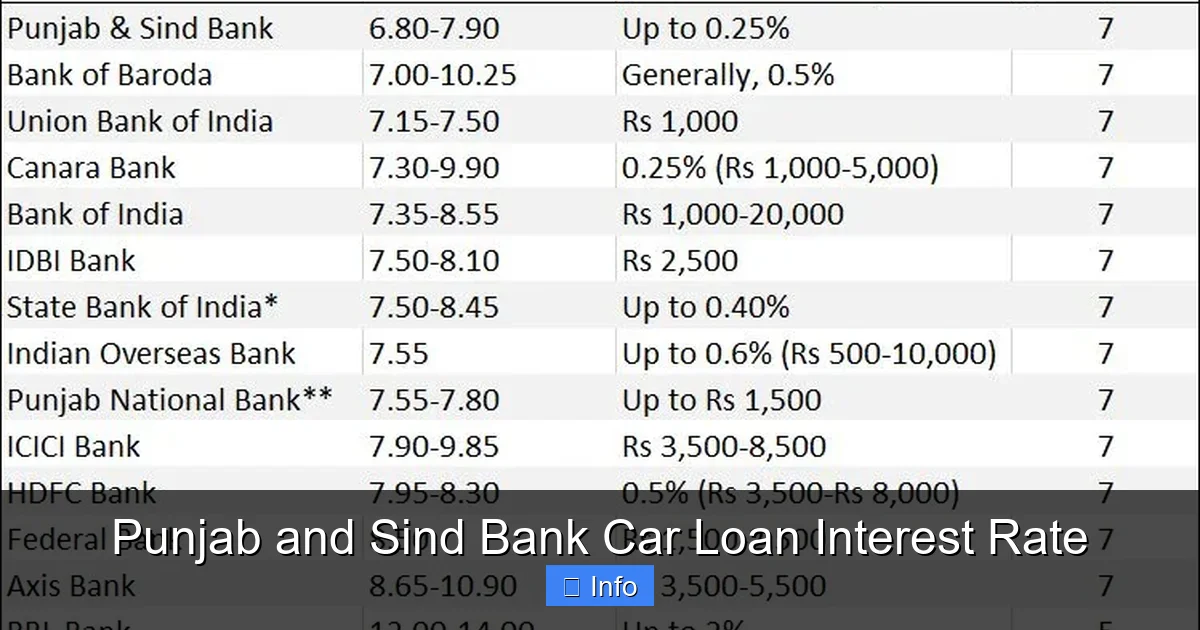
Punjab and Sind Bank car loan interest rate starts at competitive rates for new and used cars. This guide covers current rates, eligibility, required documents, and expert tips to lower your EMI. Learn how to apply online or offline and compare offers to save money.
Buying a car is a major milestone. For many of us, a car loan makes that dream affordable. If you are eyeing a Punjab and Sind Bank car loan, you are in the right place. This guide breaks down everything you need to know about the Punjab and Sind Bank car loan interest rate, eligibility, fees, and smart strategies to get the best deal. We keep it simple, so you can decide with confidence.
Interest rates change often. Banks adjust them based on RBI policies, internal cost of funds, and your creditworthiness. Knowing the current range and the factors that influence your final rate puts you in a stronger negotiating position. Let’s dive in.
Key Takeaways
- Competitive Rates: Interest rates start from around 8.75% per annum for new cars, varying by credit profile and loan tenure.
- Flexible Tenure: Repayment periods range from 1 to 7 years, letting you choose an EMI that fits your budget.
- Minimal Paperwork: Salaried and self-employed applicants need basic KYC, income proof, and vehicle documents.
- Special Schemes: Women borrowers and existing customers may get rate concessions of 0.05% to 0.25%.
- Prepayment Options: Part-prepayment and foreclosure are allowed, often with zero charges after a specific period.
- Quick Processing: Digital applications and doorstep document pickup speed up approval to 24-48 hours.
- Compare Before You Sign: Always check processing fees, prepayment penalties, and total cost across lenders.
📑 Table of Contents
- Understanding Punjab and Sind Bank Car Loan Interest Rate
- Factors That Affect Your Interest Rate
- Current Interest Rate Offers and Special Schemes
- Eligibility Criteria and Required Documents
- How to Apply for a Punjab and Sind Bank Car Loan
- Tips to Get the Best Punjab and Sind Bank Car Loan Interest Rate
- Understanding Fees and Charges Beyond Interest Rate
- Comparing Punjab and Sind Bank with Other Lenders
- After Getting Your Car Loan: Essential Accessories
- Conclusion
Understanding Punjab and Sind Bank Car Loan Interest Rate
The Punjab and Sind Bank car loan interest rate is typically linked to the bank’s Marginal Cost of Funds based Lending Rate (MCLR) or an external benchmark like the Repo Rate. This means your rate can move up or down when the benchmark changes. As of now, the bank offers floating rates for most car loans. Fixed-rate options may be available for specific tenures or schemes, but they are less common.
New Car vs. Used Car Rates
New cars usually attract lower interest rates because the asset value is clear and depreciation is predictable. Used cars carry higher risk for the lender, so rates are often 0.5% to 1.5% higher. The age and condition of the used car also matter. Cars older than 5 years may not be financed at all, or the rate could be significantly higher.
Floating vs. Fixed Rate
A floating rate moves with the market. If the RBI cuts rates, your EMI or tenure may reduce. A fixed rate stays constant for the agreed period, giving you certainty. However, fixed rates are usually 0.5% to 1% higher than the prevailing floating rate at the time of sanction. Choose based on your risk appetite and view on future rate movements.
Rate Range Snapshot
While exact numbers change, the typical range for the Punjab and Sind Bank car loan interest rate looks like this:
- New Car: 8.75% – 10.50% p.a.
- Used Car: 9.50% – 11.50% p.a.
- Top-up Loan on Existing Car: 10.00% – 12.00% p.a.
These are indicative. Your final rate depends on your credit score, income, relationship with the bank, and the car model.
Factors That Affect Your Interest Rate
Not everyone gets the advertised rate. The bank assesses your profile to decide the risk premium. Here are the key factors:
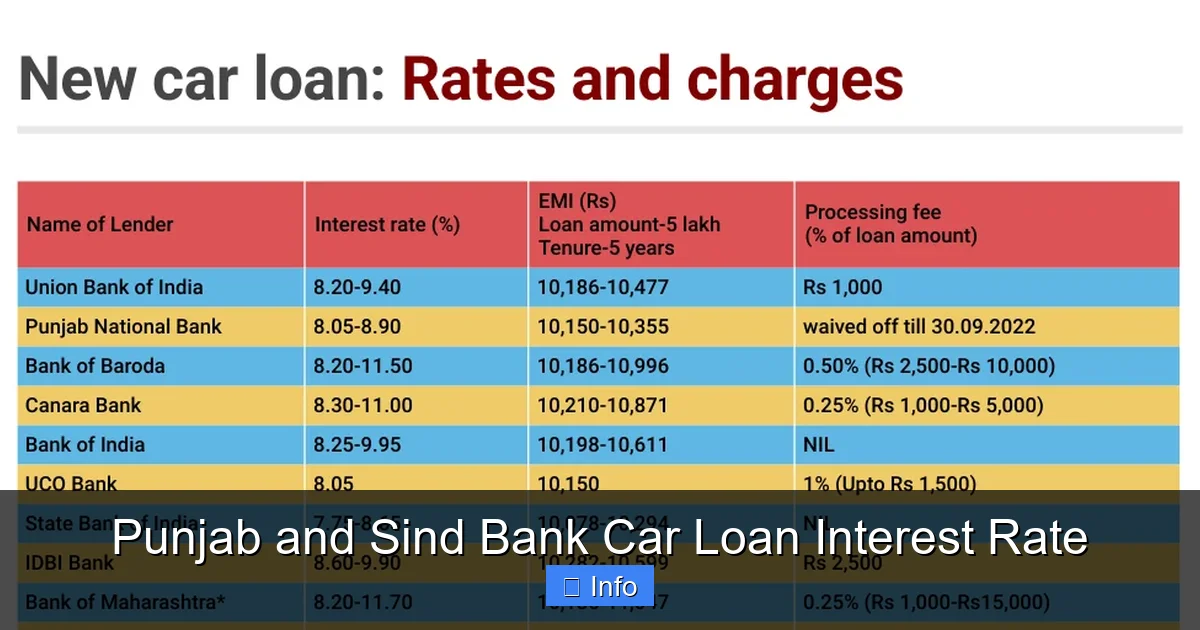
Visual guide about Punjab and Sind Bank Car Loan Interest Rate
Image source: infogram-thumbs-1024.s3-eu-west-1.amazonaws.com
Credit Score (CIBIL Score)
This is the single biggest factor. A score above 750 usually qualifies you for the lowest rate. Scores between 700-750 may get a slightly higher rate. Below 700, the bank may either reject the application or charge a steep premium. Check your score before applying and correct any errors.
Income Stability and Employer Category
Salaried employees of government, PSUs, or reputed private companies (Category A) get the best rates. Self-employed professionals with steady income tax returns also fare well. Frequent job changes or inconsistent income can lead to a higher rate or rejection.
Loan-to-Value (LTV) Ratio
LTV is the loan amount as a percentage of the car’s on-road price. A lower LTV (higher down payment) reduces the bank’s risk. If you fund 80% of the car, the rate may be higher than if you fund 60%. Aim for at least 20-25% down payment to secure a better rate.
Relationship with the Bank
Existing customers with a salary account, fixed deposits, or a clean repayment history on previous loans often get a loyalty discount of 0.05% to 0.25%. It pays to ask your relationship manager.
Car Model and Segment
Popular models with high resale value (like Maruti Suzuki, Hyundai, Tata) are preferred. Luxury or niche models may attract higher rates due to volatile resale prices. Electric vehicles sometimes get special green loan rates.
Current Interest Rate Offers and Special Schemes
Banks run promotional campaigns during festivals, year-end, or model launches. Punjab and Sind Bank often ties up with manufacturers for special rates. Keep an eye on:
Visual guide about Punjab and Sind Bank Car Loan Interest Rate
Image source: eadn-wc01-5773915.nxedge.io
Festival Offers
During Diwali, New Year, or regional festivals, the bank may offer a 0.25% to 0.50% rate cut, waived processing fees, or free accessories. These are time-bound. Ask the dealer or branch for ongoing promotions.
Women Borrower Concession
Many banks, including Punjab and Sind Bank, offer a 0.05% rate concession to women applicants. If a woman is the primary borrower or co-borrower, ensure this benefit is applied.
Green Car Loan for EVs
Electric vehicles may qualify for a “Green Car Loan” with a rate 0.20% to 0.50% lower than regular cars. This supports the government’s push for EVs. Check if your model is on the approved list.
Corporate Tie-ups
If your employer has a corporate salary account relationship with the bank, you might get preferential rates, zero processing fees, and relaxed documentation. Check with your HR or the bank’s corporate banking team.
Eligibility Criteria and Required Documents
Before you apply, make sure you meet the basic criteria. This saves time and avoids rejection marks on your credit report.
Visual guide about Punjab and Sind Bank Car Loan Interest Rate
Image source: i.ytimg.com
Basic Eligibility
- Age: 21 to 65 years (at loan maturity).
- Minimum Annual Income: ₹3 lakh for salaried; ₹4 lakh for self-employed (varies by location).
- Employment/Business Stability: 1 year in current job or 2 years in current business.
- Credit Score: 700+ preferred.
Documents for Salaried Applicants
- Identity Proof: Aadhaar, PAN, Passport, or Voter ID.
- Address Proof: Aadhaar, Utility Bill, Rent Agreement.
- Income Proof: Last 3 months salary slips, Form 16, or 6 months bank statement showing salary credit.
- Employment Proof: Appointment letter or ID card.
Documents for Self-Employed Applicants
- Business Proof: Registration certificate, GST certificate, or Shop Act license.
- Income Proof: Last 2 years ITR with computation, audited balance sheet, P&L account.
- Bank Statement: Last 12 months current account statement.
- Office Address Proof: Utility bill or property tax receipt.
Vehicle Documents (Post-Sanction)
- Proforma Invoice from dealer.
- Registration Certificate (RC) for used cars.
- Insurance copy.
- Road tax receipt.
How to Apply for a Punjab and Sind Bank Car Loan
You can apply online, at a branch, or through the dealer. Each channel has pros and cons.
Online Application
Visit the bank’s official website. Fill the car loan application form with personal, income, and vehicle details. Upload scanned documents. A bank representative will call for verification. This is fast and you can track status online. The Punjab and Sind Bank car loan interest rate offered online is usually the same as branch, but sometimes exclusive digital offers exist.
Branch Application
Walk into your nearest branch. Meet the loan officer. They guide you through the form and document checklist. This is good if you prefer face-to-face interaction or have a complex income profile. You can negotiate fees and rate directly.
Dealer-Assisted Application
Most dealers have tie-ups with multiple banks. They submit your application to Punjab and Sind Bank along with others. This is convenient but the dealer may push the bank that gives them the highest commission, not necessarily the lowest rate for you. Always compare the final quote.
Step-by-Step Process
- Check eligibility and calculate EMI using the bank’s online calculator.
- Gather documents.
- Submit application (online/branch/dealer).
- Bank verifies documents and credit score.
- Field investigation (for high-value loans).
- Sanction letter issued with rate, tenure, EMI, and conditions.
- You accept and sign loan agreement.
- Bank disburses amount directly to dealer.
- You take delivery of the car.
Tips to Get the Best Punjab and Sind Bank Car Loan Interest Rate
A small rate difference saves lakhs over the loan tenure. Use these tips:
Improve Your Credit Score Before Applying
Pay off outstanding credit card dues. Keep credit utilization below 30%. Don’t apply for multiple loans or cards in the 6 months before your car loan application. Each inquiry hurts your score slightly.
Increase Your Down Payment
Put down 30% or more if possible. Lower LTV = lower risk = lower rate. It also reduces your EMI and total interest outgo.
Choose a Shorter Tenure If Affordable
Shorter tenure (3-4 years) often comes with a lower rate than 7 years. You pay less interest overall. Use an EMI calculator to find the sweet spot for your cash flow.
Leverage Existing Relationship
If you have a salary account, FD, or home loan with the bank, mention it. Ask for a “relationship discount.” Even 0.10% matters on a ₹10 lakh loan over 5 years.
Negotiate Processing Fees and Other Charges
Processing fee is typically 0.5% of loan amount (min ₹2,500, max ₹10,000). Ask for a waiver or reduction, especially during promotions. Also check documentation charges, stamp duty, and foreclosure charges.
Compare with Other Banks
Don’t settle for the first offer. Get quotes from SBI, HDFC, ICICI, Bank of Baroda, etc. Use the lowest quote to negotiate with Punjab and Sind Bank. They may match or beat it to retain you.
Opt for Auto-Debit from Salary Account
Some banks offer a 0.05% rate concession if you set up auto-debit from your salary account with them. It also ensures you never miss an EMI.
Understanding Fees and Charges Beyond Interest Rate
The Punjab and Sind Bank car loan interest rate is not the only cost. Read the Most Important Terms and Conditions (MITC) document carefully.
Processing Fee
Usually 0.50% of loan amount + GST. Minimum ₹2,500, Maximum ₹10,000. Sometimes waived for salary account holders or during offers.
Documentation Charges
Flat fee of ₹500 – ₹2,000 + GST for legal verification and stamping.
Prepayment / Foreclosure Charges
Floating rate loans: Nil after a certain period (often 6-12 months) as per RBI guidelines. Fixed rate loans: 2-4% of outstanding principal if prepaid before tenure. Check your sanction letter.
Late Payment Penalty
Typically 2% per month on the overdue EMI amount. Avoid this by setting up auto-debit.
Cheque Bounce / ECS Return Charges
₹500 – ₹750 per instance + GST. Ensure sufficient balance on EMI date.
Duplicate NOC / Statement Charges
₹100 – ₹500 per request. Keep digital copies of all documents to avoid these.
Comparing Punjab and Sind Bank with Other Lenders
It’s smart to compare. Here’s a quick mental framework:
Public Sector Banks (SBI, PNB, Bank of Baroda, Punjab and Sind Bank)
Pros: Lower rates for high credit scores, transparent fees, wide branch network, government-backed stability. Cons: Slower processing, stricter documentation, less flexible on negotiation.
Private Sector Banks (HDFC, ICICI, Axis, Kotak)
Pros: Faster digital processing, doorstep service, pre-approved offers for existing customers, flexible tenure. Cons: Slightly higher base rates, higher prepayment charges on fixed rates, aggressive cross-selling.
NBFCs and Captive Finance (Mahindra Finance, Tata Capital, Maruti Suzuki Finance)
Pros: Easier eligibility for lower scores, financing for older used cars, on-the-spot approval at dealerships. Cons: Significantly higher interest rates (11-15%+), higher fees, less regulatory oversight.
If you have a strong profile (score 750+, stable job), a public sector bank like Punjab and Sind Bank often gives the lowest total cost. If you need speed or have a weaker profile, a private bank or NBFC might be the only option.
After Getting Your Car Loan: Essential Accessories
Once your loan is approved and you take delivery, you’ll want to protect your new asset. A good car cover shields the paint from sun and rain. Check out our guide on the best car cover for rain and sun to find a durable fit. If you travel with family, a reliable car seat is non-negotiable. We’ve reviewed the best car seat and stroller for travel to make your trips safe and easy. And for peace of mind on the road, a portable jump starter can save you from a dead battery. See our pick for the best car battery jump starter and charger.
Conclusion
Securing a car loan is a significant financial commitment. The Punjab and Sind Bank car loan interest rate is competitive, especially if you have a strong credit profile and an existing relationship with the bank. Do your homework: check your credit score, save for a healthy down payment, compare offers, and negotiate fees. Read the fine print on prepayment and late payment charges. A well-chosen loan keeps your EMI comfortable and your total cost low. Drive home your dream car with confidence, knowing you made a smart financial decision.
Frequently Asked Questions
What is the current Punjab and Sind Bank car loan interest rate for new cars?
The interest rate for new cars typically starts from 8.75% per annum and can go up to 10.50% depending on your credit score, income, and loan tenure. Always confirm the latest rate with the bank before applying.
Can I get a Punjab and Sind Bank car loan for a used car?
Yes, the bank finances used cars usually up to 5-7 years old. The interest rate is higher than for new cars, generally ranging from 9.50% to 11.50% p.a. The loan-to-value ratio is also lower, often capped at 70-80% of the car’s valuation.
What is the maximum tenure for a Punjab and Sind Bank car loan?
The maximum repayment tenure is usually 7 years (84 months) for new cars and 5 years (60 months) for used cars. A longer tenure reduces EMI but increases total interest paid.
Are there any prepayment charges on Punjab and Sind Bank car loan?
For floating rate loans, RBI guidelines prohibit prepayment charges after a certain period (often 6-12 months). For fixed rate loans, a foreclosure fee of 2-4% on the outstanding principal may apply. Check your specific sanction letter for exact terms.
How can I check my Punjab and Sind Bank car loan application status?
You can track your application online through the bank’s website using your application reference number. Alternatively, call the customer care helpline or visit the branch where you applied.
Do women borrowers get any interest rate concession?
Yes, Punjab and Sind Bank typically offers a concession of 0.05% on the interest rate for women borrowers, either as primary or co-applicant. Ensure you request this benefit during application.