Side Mirror of Car Is Concave or Convex

Car side mirrors are convex to provide a wider field of view, significantly reducing blind spots and enhancing safety. Unlike flat rear-view mirrors, their curved design ensures drivers see more of the road, though objects appear smaller and farther away. This critical design choice prioritizes visibility over perfect image accuracy, making it indispensable for modern driving.
Key Takeaways
- Convex Design: Side mirrors use convex curves to widen the field of vision, crucial for detecting vehicles in blind spots.
- Safety Priority: The wider view reduces accidents caused by unseen vehicles, especially during lane changes.
- Visual Distortion: Convex mirrors make objects appear smaller and farther away, requiring drivers to adjust their perception.
- Legal Standards: Most regions mandate convex mirrors on vehicles to meet safety regulations.
- Comparison with Rear Mirrors: Unlike flat rear-view mirrors, side mirrors prioritize coverage over image accuracy.
- Maintenance Matters: Regularly cleaning and adjusting side mirrors ensures optimal visibility and safety.
- Modern Alternatives: Advanced systems like cameras and sensors are replacing traditional mirrors in some vehicles.
📑 Table of Contents
Understanding Mirror Shapes: Convex vs Concave
When you glance at your car’s side mirrors, you’re interacting with a carefully engineered optical tool. The question of whether these mirrors are concave or convex hinges on their purpose: maximizing visibility. Unlike the flat surface of a rear-view mirror, side mirrors are intentionally curved to serve a specific safety function. Let’s break down the basics of mirror shapes first.
What Defines Concave and Convex Mirrors?
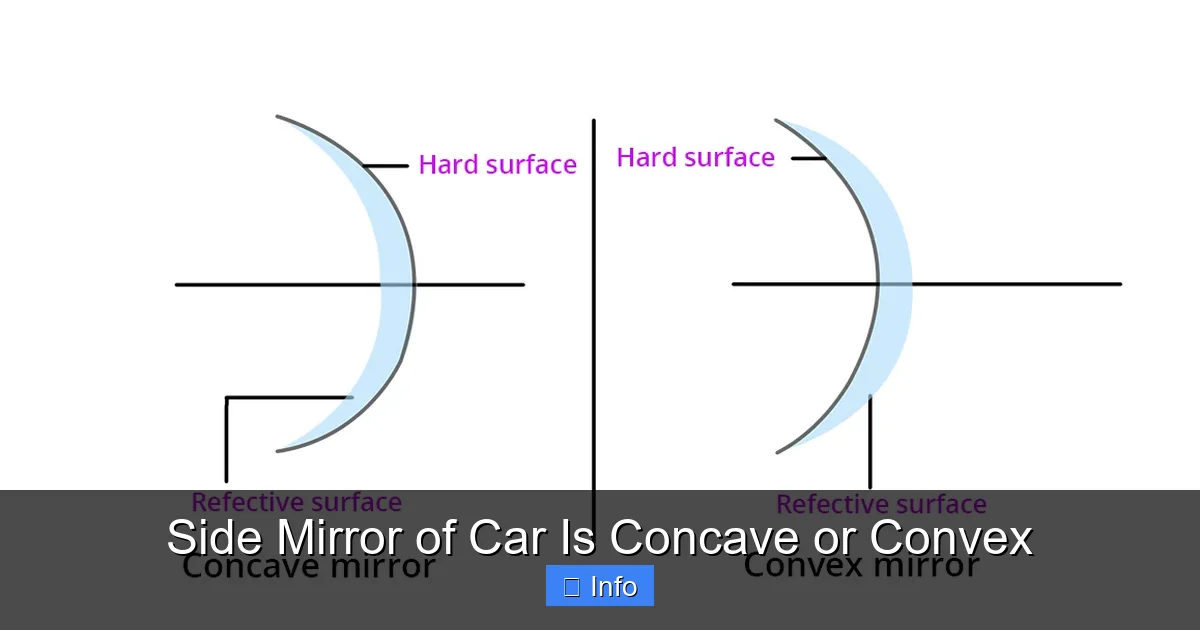
A concave mirror curves inward, like the inside of a spoon. It focuses light to a single point, creating magnified images of objects placed close to it. On the other hand, a convex mirror curves outward, resembling the exterior of a dome. This shape spreads light rays outward, producing smaller, wider-angle images. For driving purposes, the convex design is critical.
Why Convex Wins for Side Mirrors
Convex mirrors are chosen for side mirrors because their outward curve provides a broader field of view. Imagine standing in a narrow hallway with a convex mirror at one end—you can see further down the corridor than with a flat mirror. Similarly, a convex side mirror allows drivers to see more of the lane beside them, which is vital for detecting vehicles in blind spots. However, this comes at the cost of image size; objects appear smaller and farther away than they actually are.
The Science Behind Convex Side Mirrors
To understand why convex mirrors dominate in automotive design, we need to explore their optical properties. When light hits a convex mirror, it reflects outward, creating a virtual image that is upright and diminished in size. This principle is why the familiar warning “Objects in mirror are closer than they appear” is etched into the glass—a reminder that the mirror’s design intentionally distorts perception to prioritize coverage.
Wide-Angle Vision: A Safety Necessity
During lane changes or merging, drivers must account for vehicles in adjacent lanes. A flat mirror would only show a narrow strip of the road, creating dangerous blind spots. Convex mirrors eliminate these gaps by capturing a panoramic view. For example, if you’re driving on a highway and check your right-side mirror, the convex design ensures you can see the side of the car beside you, even if it’s partially out of your peripheral vision.
Image Distortion: An Acceptable Trade-Off
The distortion caused by convex mirrors isn’t a flaw—it’s a calculated compromise. While the image is smaller, the trade-off is worth it. Drivers learn to compensate for this distortion through experience, much like how we adjust to the curvature of a funhouse mirror. Over time, the brain adapts, making it easier to judge distances and movements despite the altered appearance.
Legal Requirements and Global Standards
Car manufacturers worldwide adhere to strict safety regulations when designing mirrors. In the United States, the National Highway Traffic Safety Administration (NHTSA) mandates that side mirrors must be convex to ensure drivers have a clear view of their surroundings. Similarly, the European Union’s ECE Regulation 46 specifies that mirrors must provide a minimum field of vision, which is achieved through convex curvature. These standards exist because studies consistently show that convex mirrors reduce accidents caused by blind-spot collisions.

Visual guide about Side Mirror of Car Is Concave or Convex
Image source: cdn.teachoo.com
Country-Specific Variations
While most regions require convex side mirrors, some differences exist. For instance, in countries with left-hand driving (like the UK), the convex mirror is still used on the right side of the vehicle. Additionally, newer vehicles may feature automatic dimming or heated mirrors, but the fundamental convex shape remains unchanged to comply with safety laws.
Maintenance and Modern Alternatives
Even the best-designed mirror is useless if it’s dirty or misaligned. Regular cleaning with glass-safe products and checking for cracks or scratches is essential. Proper adjustment is equally important: side mirrors should be angled so you see just a sliver of the car beside you when checking from the driver’s seat.
Visual guide about Side Mirror of Car Is Concave or Convex
Image source: dcx0p3on5z8dw.cloudfront.net
Emerging Technologies: Cameras and Sensors
While traditional convex mirrors remain standard, some high-end vehicles now use cameras and sensors to supplement or replace them. For example, rearview cameras and blind-spot monitoring systems provide real-time video feeds or alerts, reducing reliance on mirror distortion. However, these technologies are still supplementary—convex mirrors are unlikely to disappear entirely due to their simplicity, reliability, and universal applicability.
Common Misconceptions About Side Mirrors
Many drivers misunderstand how convex mirrors function. Let’s debunk a few myths:
Myth 1: Concave Mirrors Are Better for Distance Judgment
While concave mirrors do magnify objects, they offer a narrower field of view, making them impractical for side mirrors. Their use in makeup or solar collectors highlights their magnification power, but in driving, this narrow vision creates more blind spots than it solves.
Myth 2: Convex Mirrors Are Less Reliable
On the contrary, convex mirrors are highly durable and resistant to distortion. Their curved glass is less prone to cracking compared to flat mirrors, and they maintain functionality even with minor scratches.
Myth 3: All Mirrors Are the Same Shape
As discussed, rear-view mirrors are typically flat, while side mirrors are convex. Even rear-facing cameras in modern cars often use flat lenses to mimic the undistorted view of a traditional mirror. Understanding these differences is key to safe driving.
Conclusion: Why Convex Side Mirrors Are a Safety Essential
The convex design of car side mirrors is no accident—it’s a deliberate engineering choice to enhance safety. By providing a wider field of view, these mirrors help drivers avoid collisions in blind spots, a common cause of accidents on roads worldwide. While the distortion of objects is a notable feature, it’s a small price to pay for the peace of mind that comes with seeing more of the road. As automotive technology evolves, the humble convex mirror will likely remain a cornerstone of vehicle safety design, proving that sometimes, simple solutions are the most effective.
Frequently Asked Questions
Why are side mirrors convex instead of flat?
Convex mirrors provide a wider field of view, which is critical for detecting vehicles in blind spots. A flat mirror would leave dangerous gaps in visibility, especially during lane changes or merging.
Are concave mirrors ever used in cars?
No, concave mirrors are not used for side or rear-view mirrors in standard vehicles. Their narrow field of view and magnification make them unsuitable for safety-focused applications like driving.
Do all countries require convex side mirrors?
Most countries mandate convex side mirrors through safety regulations. Standards like the U.S. NHTSA and EU’s ECE Regulation 46 ensure that mirrors meet minimum field-of-view requirements, typically achieved through convex design.
How do convex mirrors affect my perception of distance?
Convex mirrors make objects appear smaller and farther away than they actually are. Drivers must learn to compensate for this distortion over time, which is why the “closer than they appear” warning is etched into the glass.
Can I replace my side mirror with a flat one?
Replacing a convex mirror with a flat one is unsafe and likely illegal. Flat mirrors would significantly reduce visibility, increasing the risk of accidents in blind spots. Always adhere to manufacturer specifications.
What’s the difference between side mirrors and rear-view mirrors?
Rear-view mirrors are typically flat to provide an undistorted view of the area directly behind the car. Side mirrors are convex to widen their field of view, addressing the unique challenges of lateral visibility.