Small Automatic Car Price in India
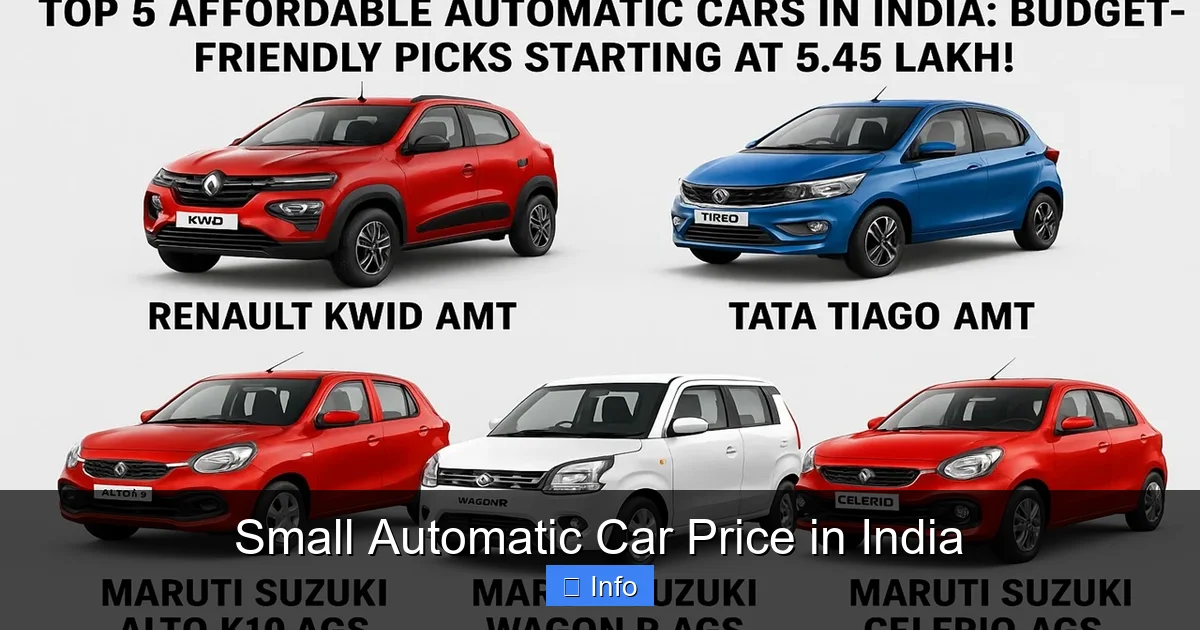
Small automatic cars in India offer the perfect blend of convenience and affordability for city driving. Prices typically range from ₹5.5 lakh to ₹12 lakh (ex-showroom), with popular models from Maruti Suzuki, Tata, and Hyundai leading the segment.
Key Takeaways
- Price Range: Small automatic cars in India start around ₹5.5 lakh and go up to ₹12 lakh (ex-showroom) for premium hatchbacks.
- Transmission Types: AMT is the most common in budget models, while CVT and torque converters appear in higher trims.
- Top Contenders: Maruti Suzuki Alto K10, S-Presso, Celerio, Tata Tiago, and Hyundai Grand i10 Nios dominate sales.
- Fuel Efficiency: Automatic variants now offer mileage nearly identical to manuals, typically 20-25 kmpl for petrol.
- On-Road Costs: Add 10-15% for registration, insurance, and taxes to get the final on-road price.
- Best Value: The Maruti Celerio AMT and Tata Tiago AMT offer the best balance of price, space, and features.
- Buying Tip: Test drive in heavy traffic to assess creep function and low-speed smoothness before deciding.
📑 Table of Contents
- Introduction: The Rise of Small Automatic Cars in India
- Why Choose a Small Automatic Car for Indian Roads?
- Top Small Automatic Car Models and Price Breakdown (2024)
- Understanding Transmission Types in Budget Automatics
- Factors Influencing the Final On-Road Price
- Ownership Experience: Maintenance, Mileage, and Resale
- Smart Buying Tips for Your First Small Automatic Car
- Conclusion: Making the Right Choice
Introduction: The Rise of Small Automatic Cars in India
Driving in Indian cities has changed dramatically over the last decade. Stop-and-go traffic, narrow lanes, and long commutes have made manual gear shifting a tiring chore. This shift in driving conditions has fueled a massive surge in demand for small automatic cars. Manufacturers have responded by flooding the market with affordable automatic options, primarily using Automated Manual Transmission (AMT) technology. Today, you can buy a brand-new automatic hatchback for barely a lakh more than its manual counterpart. This article breaks down everything you need to know about small automatic car price in India, helping you navigate the options and find the perfect fit for your budget and lifestyle.
The perception that automatic cars are expensive to buy and maintain is fading fast. Modern AMT units are robust, fuel-efficient, and cheap to service. Moreover, the resale value of automatic variants has strengthened considerably as buyer preference shifts. Whether you are a first-time buyer, a daily office commuter, or looking for a second family car, the current market offers compelling choices. We will explore the top models, dissect their pricing structures, explain the different transmission technologies, and share practical tips to make your purchase decision easier.
Why Choose a Small Automatic Car for Indian Roads?
Effortless City Commuting
The biggest advantage is fatigue-free driving. In bumper-to-bumper traffic, you only need to manage the brake and accelerator. There is no clutch pedal to modulate constantly. This reduces physical strain significantly, making your daily commute less stressful. For new drivers, it removes the anxiety of stalling on inclines or in heavy traffic.
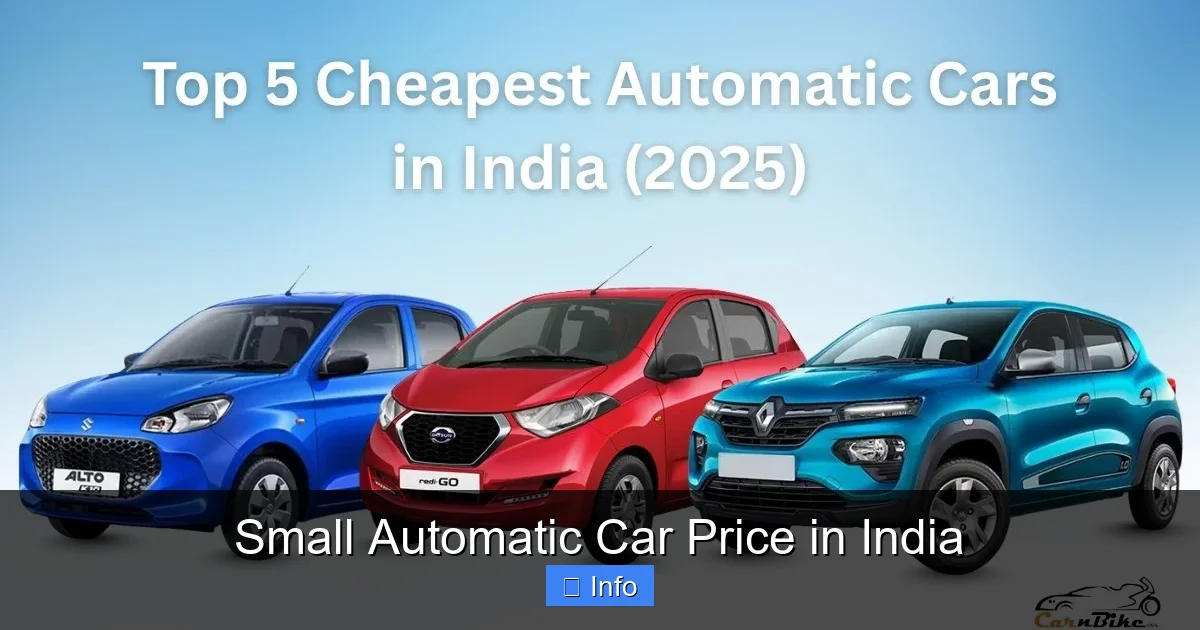
Visual guide about Small Automatic Car Price in India
Image source: carnbikecafe.com
Improved Fuel Efficiency Technologies
Gone are the days when automatics guzzled fuel. Modern AMT and CVT transmissions are engineered for efficiency. Many small automatic cars now deliver mileage figures within 1-2 kmpl of their manual siblings. The engine management systems optimize gear shifts for economy, often outperforming human drivers in consistent mileage delivery.
Better Resale Value
As the used car market matures, automatic variants command a premium. The demand for pre-owned automatic hatchbacks is high, especially in metros. This means when you decide to upgrade after 4-5 years, you recover a higher percentage of your initial investment compared to a manual variant.
Top Small Automatic Car Models and Price Breakdown (2024)
Below is a curated list of the most popular small automatic cars currently on sale. Prices are ex-showroom Delhi and represent the starting price for the automatic variant. On-road prices will be higher.
Maruti Suzuki Alto K10 AMT
Price Range: ₹5.50 Lakh – ₹6.50 Lakh (Ex-showroom)
The Alto K10 is the most affordable automatic car in India. It uses a 1.0L K-Series petrol engine paired with a 5-speed AMT. It is light, peppy, and incredibly easy to park. The cabin is basic but functional. It is ideal for strict city use and first-time buyers. The AMT unit is calibrated for smooth low-speed maneuvers.
Maruti Suzuki S-Presso AMT
Price Range: ₹5.90 Lakh – ₹6.80 Lakh (Ex-showroom)
The S-Presso offers an SUV-stanced design with high ground clearance. It shares the Alto K10’s powertrain but offers a taller seating position and better visibility. The interior gets a center-mounted instrument cluster and a SmartPlay infotainment system in higher trims. It is a strong value proposition for those wanting a mini-SUV feel.
Maruti Suzuki Celerio AMT
Price Range: ₹6.50 Lakh – ₹7.80 Lakh (Ex-showroom)
The second-gen Celerio is spacious, modern, and efficient. It uses the new K10C DualJet engine with idle start-stop, delivering class-leading mileage (claimed 26 kmpl). The cabin is roomy for four adults, and the boot space is generous. The AMT shifts are among the smoothest in the segment. It is widely considered the best value small automatic car right now.
Tata Tiago AMT
Price Range: ₹6.80 Lakh – ₹8.20 Lakh (Ex-showroom)
The Tiago brings a 4-star Global NCAP safety rating, a rarity in this segment. Its 1.2L Revotron engine with AMT offers strong low-end torque, making it fun to drive. The ride quality is supple, absorbing bad roads well. Features include a Harman audio system, projector headlamps, and a digital instrument cluster. It feels more premium than its price suggests.
Hyundai Grand i10 Nios AMT
Price Range: ₹7.20 Lakh – ₹8.50 Lakh (Ex-showroom)
The Grand i10 Nios is feature-packed. It gets a 1.2L Kappa engine with a smooth AMT. The highlight is the feature list: wireless charging, Arkamys sound, TPMS, and a clean dashboard design. It offers a mature driving experience with light controls. It sits at a slight premium but justifies it with equipment levels.
Tata Punch AMT
Price Range: ₹7.50 Lakh – ₹9.50 Lakh (Ex-showroom)
Technically a micro-SUV, the Punch is a top seller. It shares the Tiago’s platform and engine but offers SUV ground clearance (187mm) and a commanding view. The AMT includes a ‘Traction Pro’ mode for loose surfaces. It is the safest car here (5-star GNCAP) and offers unmatched versatility for the price.
Understanding Transmission Types in Budget Automatics
AMT (Automated Manual Transmission)
This is the dominant technology in small cars. It is essentially a manual gearbox where a hydraulic actuator operates the clutch and shifts gears. Pros: Low cost, high fuel efficiency, simple maintenance. Cons: Slight head-nod during shifts, slower shifts compared to CVT/DCT, no paddle shifters usually. Best for: Budget buyers, pure city use.
CVT (Continuously Variable Transmission)
Found in cars like the Honda Amaze (sedan) or higher variants of some hatchbacks. It uses a belt and pulley system for infinite gear ratios. Pros: Seamless acceleration, very smooth, good efficiency. Cons: Rubber-band effect under hard acceleration, higher cost, expensive repairs if failed. Best for: Smoothness priority, highway cruising.
Torque Converter Automatic
Rare in small cars due to cost. Uses fluid coupling. Pros: Smooth, durable, good creep function. Cons: Lower fuel efficiency, heavier, expensive. Usually found in premium hatchbacks like the Hyundai i20 or Maruti Baleno (though those are slightly larger).
Factors Influencing the Final On-Road Price
Ex-Showroom vs. On-Road Price
The ex-showroom price is the base. To drive the car home, you add: RTO charges (road tax + registration), Insurance (mandatory 3rd party + own damage), Handling/Logistics charges, and optional accessories/extended warranty. Typically, on-road price is 10-15% higher than ex-showroom. For a ₹7 lakh car, expect to pay ₹7.7 – ₹8 lakh on-road.
State-Wise Road Tax Variations
Road tax varies significantly by state. For example, Delhi has lower tax for private cars compared to Karnataka or Maharashtra. Electric vehicles enjoy tax exemptions in many states, but for petrol automatics, you pay the standard slab. Always ask the dealer for a detailed on-road breakup for your specific RTO zone.
Insurance Costs for Automatic Variants
Insurance premium (Own Damage component) is slightly higher for automatic variants because the transmission replacement cost is higher than a manual gearbox. However, the difference is marginal (a few hundred rupees annually). Opt for a Zero Depreciation add-on and Engine Protect cover for peace of mind.
Dealer Discounts and Offers
Manufacturers and dealers often run exchange bonuses, corporate discounts, or loyalty benefits. These can reduce the effective price by ₹20,000 – ₹50,000. Timing your purchase during year-end (December) or festival seasons (Diwali) usually yields the best deals. Negotiate on accessories (mats, mud flaps, coating) which have high margins.
Ownership Experience: Maintenance, Mileage, and Resale
Service Intervals and Costs
AMT cars follow similar service schedules as manuals (every 10,000 km or 1 year). The clutch actuator fluid may need replacement at longer intervals (40k-60k km). Clutch wear is managed by software, so clutch life is often longer than manual cars driven poorly in traffic. Periodic maintenance costs are nearly identical to manual variants.
Real-World Fuel Economy
Expect 18-22 kmpl in heavy city traffic and 22-25 kmpl on highways for petrol AMTs. The Celerio and Alto K10 lead the efficiency charts. Driving gently, using the ‘Manual’ mode on inclines, and avoiding aggressive acceleration helps maximize mileage. AC usage drops mileage by 10-15% in stop-go traffic.
Resale Value Trends
Automatic variants depreciate slower. A 3-year-old Tiago AMT or Celerio AMT fetches 60-65% of its original invoice price in the used market. The demand from learner drivers and second-car buyers keeps prices firm. Keep service records complete and avoid major accidents to maximize resale.
Smart Buying Tips for Your First Small Automatic Car
Test Drive Checklist
Drive in conditions mimicking your daily route. Check: Creep function strength (does it hold on a slope?), shift smoothness at 20-40 km/h, cabin noise at 60 km/h, visibility of all corners, and ease of parking. Try the ‘Manual’ mode (if available) to see if you like the control. Spend at least 15 minutes behind the wheel.
Variant Selection Strategy
Base automatic variants often miss features like touchscreen, rear camera, or alloy wheels. The mid-spec (VXi/ZXi/Z+ equivalent) usually offers the best value-to-feature ratio. Top variants add safety (6 airbags, ESC) and comfort (auto AC, push start) but cost significantly more. Assess which features you truly need.
Financing and Insurance Planning
Compare loan interest rates from 3-4 banks/NBFCs before accepting the dealer’s offer. A 0.5% difference saves thousands over 5 years. For insurance, compare online aggregators vs. dealer quotes. Dealer insurance is convenient but often pricier. You can buy insurance independently and submit the policy to the dealer for registration.
Consider the “Smallest Car” Factor
If your parking space is extremely tight or you navigate very narrow lanes daily, the physical dimensions matter immensely. The Alto K10 and S-Presso are the most compact. You can read more about which is the smallest car in India to compare dimensions precisely before visiting the showroom.
Conclusion: Making the Right Choice
The market for small automatic cars in India has never been more exciting or accessible. You no longer need to stretch your budget to enjoy two-pedal convenience. From the ultra-affordable Alto K10 to the feature-rich Grand i10 Nios and the rugged Tata Punch, there is an automatic hatchback for every need and wallet size. The key is to define your priorities: is it the absolute lowest price, maximum safety, best mileage, or a premium feel?
Remember to calculate the total on-road cost, not just the ex-showroom sticker price. Factor in insurance, warranty extensions, and accessories. A well-chosen small automatic car will serve you reliably for years, turning stressful commutes into relaxed journeys. Take your time, test drive at least three shortlisted models back-to-back, and negotiate confidently. Your perfect city companion is waiting in the showroom.
If you are exploring options slightly above the hatchback segment or need a diesel automatic for high mileage runs, you might want to check the cheapest diesel automatic car in India for a different perspective. For those with a strict budget ceiling, our guide on the best car under 8 lakhs in India 2023 remains a fantastic resource for comparing overall value packages.
Frequently Asked Questions
What is the cheapest automatic car in India right now?
The Maruti Suzuki Alto K10 AMT is currently the cheapest automatic car in India, with a starting ex-showroom price of approximately ₹5.50 lakh. The Maruti S-Presso AMT follows closely.
Is AMT reliable for long-term ownership?
Yes, modern AMT units from Maruti Suzuki, Tata, and Hyundai are highly reliable. They have fewer complex parts than traditional torque converters or CVTs. With regular servicing, they easily last the vehicle’s lifetime (15+ years) without major issues.
Do automatic cars give less mileage than manual cars?
Not anymore. The gap has narrowed to 1-2 kmpl. In city traffic, an AMT can actually return better mileage than a manual driven inefficiently. The Celerio AMT claims 26 kmpl, which is class-leading.
Which small automatic car has the best safety rating?
The Tata Punch (5-star GNCAP) and Tata Tiago (4-star GNCAP) are the safest small automatic cars. Among non-Tata models, the Hyundai Grand i10 Nios offers 6 airbags and ESC as standard on higher trims.
Can I get a sunroof in a small automatic car under ₹10 lakh?
Yes, the Tata Punch Creative AMT variant (approx ₹9.5 lakh ex-showroom) offers a voice-assisted electric sunroof. The Hyundai Grand i10 Nios Asta AMT also gets a sunroof near the top of the budget.
What is the difference between on-road price and ex-showroom price?
Ex-showroom price is the manufacturer’s price before taxes. On-road price includes RTO registration tax, road tax, mandatory insurance, dealer handling charges, and optional accessories. It is typically 10-15% higher than the ex-showroom price.