
T56 Vs Tr6060
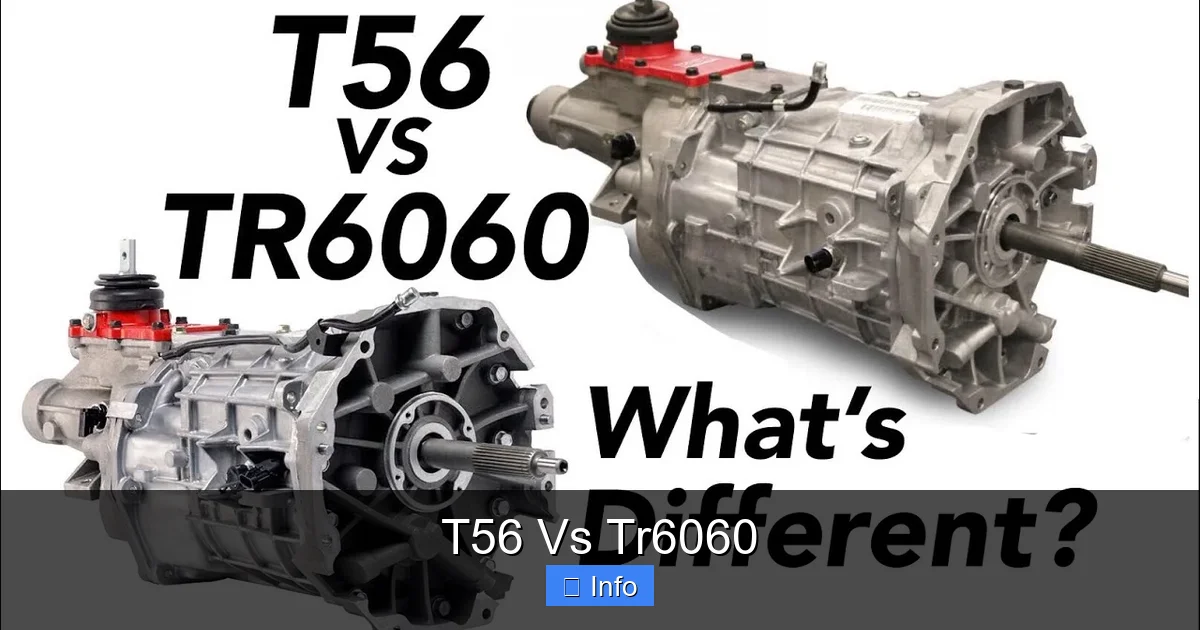
In the T56 vs TR-6060 debate, the T56 is the proven, budget-friendly choice for many stock and moderate builds. The TR-6060 is newer, generally stronger, and easier to live with under high torque or track use. Match the unit to your engine, ratios, car, and budget before buying.
T56 Vs Tr6060
Choosing between a T56 and a TR-6060 can make or break a manual swap. Both are strong Tremec six-speeds. Both can handle more abuse than many older five-speeds. Yet they are not the same part, and one is not always a direct upgrade.
The T56 has a long record in Vipers, Camaros, Firebirds, and Cobras. The TR-6060 came later and brought stronger parts, better synchros, and a more modern feel. That makes the T56 vs TR-6060 choice more than a simple year-game.
This guide explains the real differences. It also covers ratios, fitment, fluid, cost, and common swap traps. By the end, you should know which gearbox fits your car and your driving style.
Power is only one part of the choice. A gearbox must match the engine’s torque curve, rear axle, tires, and launch style. A smooth street car has different needs from a car that leaves at high rpm each weekend.
Key Takeaways
- T56: A proven Tremec six-speed that suits many stock, classic, and moderate street builds.
- TR-6060: A newer design with stronger internals and better shift capacity for hard use.
- Strength varies: Torque ratings depend on the exact tag code, gears, case, and build history.
- Ratios matter: The right gear set affects launches, shift spacing, cruising rpm, and drivability.
- Fitment is critical: Bellhousing, shafts, yokes, mounts, sensors, and driveline parts may all change.
- Fluid matters: Always follow the transmission tag, VIN information, or builder’s specification.
- Condition counts: A healthy T56 can be better than a worn TR-6060.
📑 Table of Contents
1. What Are the T56 and TR-6060?
Both transmissions use an aluminum case, six forward gears, and a rear-wheel-drive layout. Their shared family tree is why they look similar in photos. The details under the cover are where they part ways.
The T56
The T56 arrived in the early 1990s. It became popular in high-performance cars because it offered a wide first gear, a true overdrive sixth, and a compact package. Many versions were built for specific engines, so spline counts, shaft lengths, and ratio sets changed over time. That is why a T56 from one car may not share parts with a T56 from another.
The TR-6060
The TR-6060 arrived in the mid-2000s as the newer evolution. It was designed for higher input torque and heavier use. You will find it in cars such as the Corvette Z06, modern Camaro, Mustang GT, Dodge SRT models, and later Vipers. It kept the six-speed layout but improved the internal parts and shift hardware.
There is no single T56 or TR-6060 recipe. GM, Ford, and Dodge used different cases, shafts, sensors, and ratio sets. Even two transmissions with the same model name can require different parts. Always use the ID tag as the starting point.
For a T56 vs TR-6060 decision, the date matters less than the exact build code. A well-chosen T56 can be the right answer. A mismatched TR-6060 can be an expensive problem.
2. T56 vs TR-6060 Strength and Shift Quality
The biggest practical difference is how much load each unit can take. This matters most when the engine is modified or the car sees hard launches.
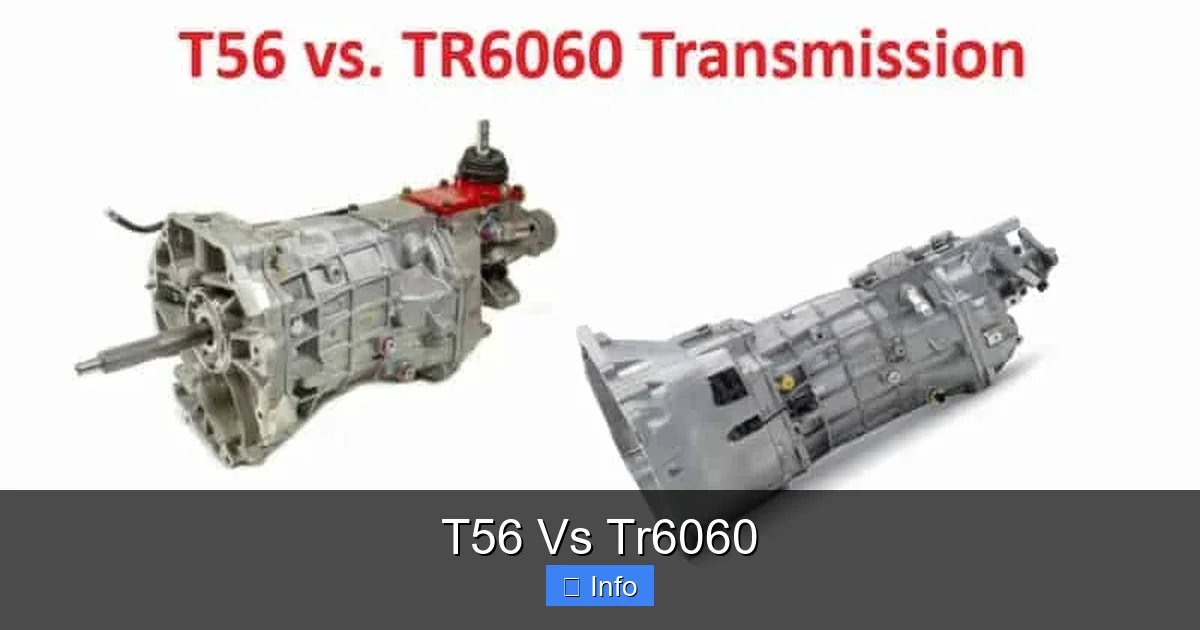
Visual guide about T56 Vs Tr6060
Image source: rxmechanic.com
Gear strength and torque
Common summaries rate many T56 versions near 450 lb-ft and many TR-6060 versions near 600 lb-ft. Those are broad figures, not universal limits. The tag code, gear set, case, and prior abuse all matter.
High torque is not only about peak numbers. A turbo car can hit the gearbox with a sudden load. A drag car can shock it at launch. A track car can heat it during long, hard shifts. The TR-6060 has more margin in those cases.
This extra margin is useful, but it is not a license to abuse any setup. The clutch, flywheel, mounts, and rear tires affect shock loads. A stiff clutch and poor launch technique can still damage a TR-6060.
Synchronizers and shift feel
Many T56 units use double-cone synchronizers in the lower gears. They work well when warm and healthy, but cold fluid can make shifts feel stiff or notchy. Worn synchros may grind during fast downshifts.
The TR-6060 commonly uses triple-cone synchronizers in first and second. This gives better shift capacity and a smoother feel under load. It does not fix a bad clutch, weak hydraulic system, or poor shifter setup. Condition still matters.
An upgraded T56 with fresh fluid, a good shifter, and new synchros can feel excellent. A tired TR-6060 can feel worse than a cared-for T56. Do not judge only by the badge. Weight and noise can also differ by version, but fitment and strength matter more.
3. Gear Ratios in the T56 vs TR-6060 Choice
A stronger gearbox does not automatically make a car faster. Ratios decide how engine torque reaches the tires. They also affect launch feel, shift spacing, and highway engine speed.
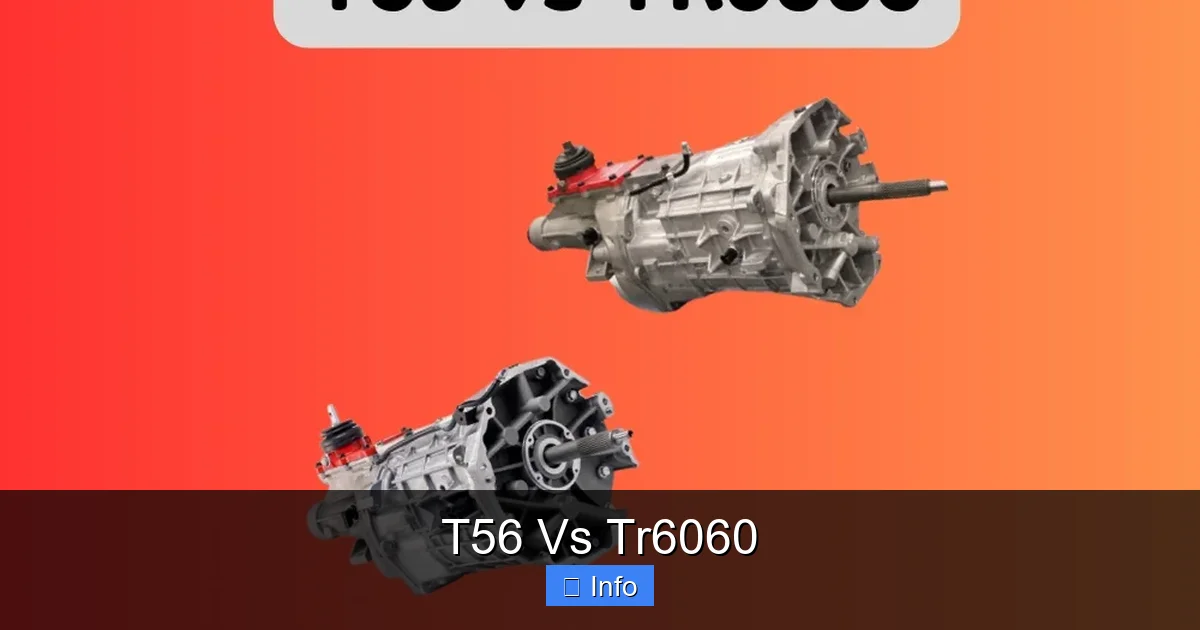
Visual guide about T56 Vs Tr6060
Image source: carpartsfaq.com
Do not buy by model name alone
T56 and TR-6060 ratio sets changed by car maker and year. One T56 may use a 2.66 first and .50 sixth. Another may use 2.97 and .56. A Mustang TR-6060 can have different steps from a Corvette unit.
- Street driving: A moderate first gear and relaxed sixth make daily use easier.
- Drag racing: A deeper first gear can help launch, but gaps must suit the engine.
- Road course use: Close steps keep the engine in its power band after each shift.
- Highway cruising: A tall sixth lowers rpm, noise, and fuel use.
Write down the rpm drop between gears. If the engine falls out of its useful range after every shift, the ratio set may be too wide. If the driver shifts constantly in traffic, first and second may be too deep.
A simple match tip
Think of the rear axle and tires as part of the gear set. A 2.66 first with a 3.27 axle can feel soft off the line. A 2.97 first with a 4.10 axle will pull harder. Sixth gear also matters: .50 is taller than .67 and lowers cruise rpm.
For example, a tall sixth can be pleasant on the highway, but it may lug a large engine on a steep grade. A shorter sixth improves response and engine braking, at the cost of more rpm. There is no perfect set for every car. For a T56 vs TR-6060 pick, match the ratios to the engine’s torque curve and check the actual tag before you buy.
4. T56 vs TR-6060 Fitment and Swap Compatibility
This is where many builds go wrong. A transmission may be strong enough and still fail to fit. The T56 vs TR-6060 swap needs more than a matching bellhousing.
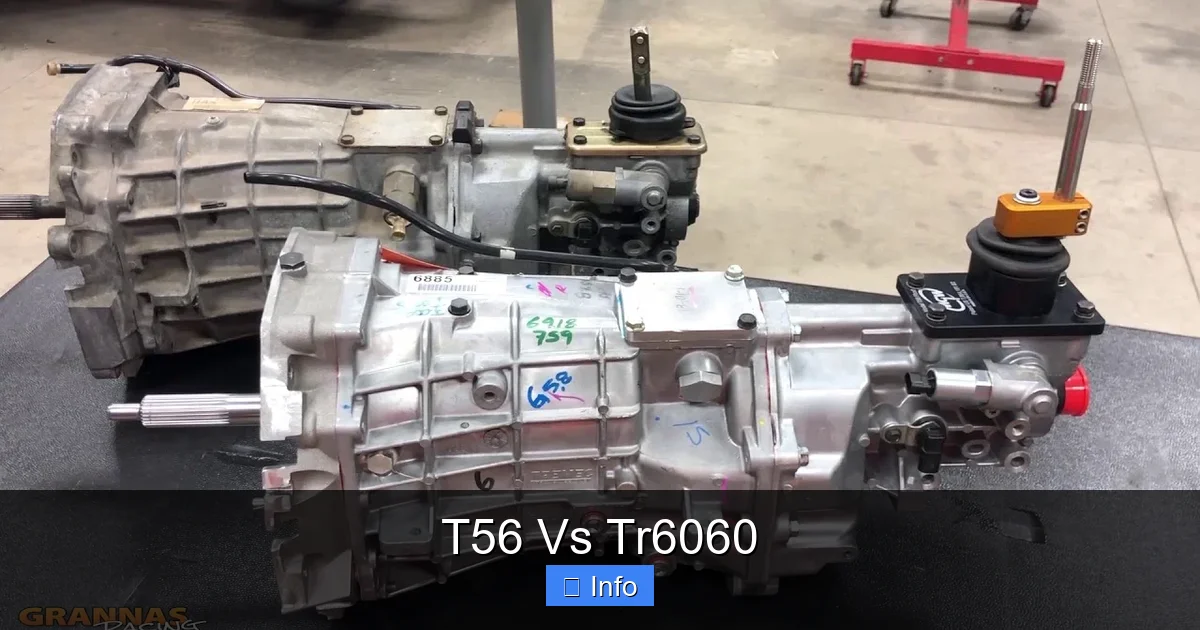
Visual guide about T56 Vs Tr6060
Image source: i.ytimg.com
Parts that often change
- Bellhousing: The bolt pattern must match the engine.
- Input shaft: Spline count, length, and diameter must suit the clutch.
- Output shaft: The yoke or flange must match the driveshaft.
- Mount: The case may need a different crossmember or mount.
- Shifter: Lever position can change by several inches.
- Electronics: Sensors, speed signals, and reverse lockout may need work.
Clutch hydraulics also matter. A cable, hydraulic slave, or external release system may not transfer parts between cars. The torque arm or K-member can create another fit issue.
A common mistake is buying a transmission because it came from a powerful car. Power does not guarantee fit. A Corvette, Mustang, Camaro, and Viper unit can differ in almost every external connection.
Plan the whole package
Before buying, compare the donor car with your car. Write down the engine, axle ratio, tire size, and intended power. Then price every adapter and labor job. Measure before you order parts, because a small shaft or yoke difference can cause a big problem.
- Confirm the bellhousing and input shaft.
- Check the output yoke and speed sensor.
- Measure driveshaft length and mount height.
- Plan the shifter, clutch, and hydraulic parts.
- Check PCM, wiring, and reverse-light needs.
If you want a simpler aftermarket route, a Magnum may solve some T56-to-TR-6060 fitment issues. It is related, but it is not the same as a used OEM unit. Price it as a full package.
5. T56 vs TR-6060 Fluid, Maintenance, and Cost
Use the correct lubricant
Fluid is the easiest way to ruin a good gearbox. Some factory T56 tags call for an ATF specification. Some TR-6060 builds call for ATF, while others call for a manual-transmission fluid. The tag, VIN, and builder’s instructions win.
Fluid names can be confusing. The Toyota ATF Type T-IV vs Dexron III guide shows why a Dexron reference does not mean any ATF will do. Broad guides such as Mobil Delvac 1 ATF vs Transynd also show that ATF products serve different systems. The Honda ATF DW-1 vs Z1 comparison makes the same point: factory approval and use matter.
Never choose by brand or thickness alone. Avoid GL-5 gear oil unless the maker approves it, because some synchronizers do not like certain additives. Check the side plug level, watch for leaks, and change fluid sooner after track use or a rebuild.
Change the fluid at the maker’s interval, and sooner if you see metal, a burnt smell, or poor shifts. Track cars often need shorter intervals. After a rebuild, follow the builder’s break-in advice. A leak may be cheap to fix, but low fluid can wear bearings and synchros fast.
Cost beyond the purchase price
A used T56 often costs less because there are more units on the market. A used TR-6060 usually costs more, and a rebuilt or aftermarket unit costs more still. The low purchase price is not the full bill.
Budget for the clutch, flywheel, yoke, driveshaft, mount, sensors, and labor. A rebuild makes sense when the case and main parts are sound. A damaged rare unit may be better replaced. Also compare warranty and return terms, since a cheap untested core can become costly after freight and labor.
6. Which T56 vs TR-6060 Should You Choose?
For most buyers, the right answer comes from use, not the badge. Ask what the car does now, what you plan to change, and how often you will drive it.
Choose the T56 when
- You want a stock-style car: The original T56 keeps the build correct and can support resale.
- Your power level is moderate: A healthy T56 is often enough for a street car with bolt-ons. An upgraded synchro or shifter setup can extend its useful life.
- Budget matters: Lower purchase and parts costs leave room for clutch work or tuning.
- You enjoy rebuilding: Good cores and aftermarket parts make a T56 project practical.
Choose the TR-6060 when
- Torque is high: The stronger design gives more margin for boosted or large-displacement engines.
- You launch hard: Better synchros and gear strength suit drag and autocross use.
- You track the car: The unit handles heat and repeated shifts better in many builds.
- You want a newer feel: A good TR-6060 often shifts more smoothly than an old T56.
Practical examples
Stock-style F-body: A healthy original T56 with the right fluid and shifter may be the smartest choice. Spend money on service, mounts, and clutch setup before swapping. If the car stays near its original power, a rebuild is often better value.
Supercharged Mustang: A TR-6060 with a matched ratio set gives more strength and a better shift under load. Make sure the bellhousing, input, and electronics are planned. A strong transmission cannot rescue a weak clutch or bad mount.
Classic LS swap: A Magnum can be easier than hunting donor parts, but compare the full price. A used T56 may win if the car stays mild and the fit is already solved. A TR-6060 makes more sense when the engine will grow beyond the T56’s comfort zone.
Used-unit checks
- Read the ID tag and confirm the ratio code.
- Check for leaks, bearing noise, and shaft play.
- Test every gear, including reverse and neutral.
- Look for grind during slow and fast shifts.
- Ask what fluid was used and when it changed.
A good test drive is worth more than a clean photo. Shift when cold, then again when warm. Listen for whine and feel for pulled shifts. If the seller cannot explain the unit’s history, lower your offer or walk away.
Bottom line
The T56 is the value pick for many classic, stock, and moderate builds. The TR-6060 is the stronger, more refined pick for high torque and hard use. In any T56 vs TR-6060 decision, fitment and ratios matter as much as strength. Buy the complete package, not just the badge.
Frequently Asked Questions
Is the TR-6060 stronger than the T56?
Generally, yes. Many TR-6060 versions are built for higher input torque and harder launches, but ratings vary by tag code and gear set. Do not use a round torque number without checking the exact unit.
Will a TR-6060 bolt directly into a car that had a T56?
Not usually. Bellhousing, input shaft, output yoke, mount, shifter position, sensors, and driveshaft length can all differ. Treat it as a full swap and price the supporting parts first.
Which transmission shifts better?
A healthy TR-6060 usually has the advantage because of its synchronizer design. A fresh T56 with the right fluid and shifter can still shift well, while a worn TR-6060 can feel poor.
How much power can a T56 handle?
There is no safe horsepower number for every T56. Torque, tire grip, launch style, cooling, and the condition of the gears matter more. A mild street build is often fine, but a hard-launch high-torque build may need upgrades or a TR-6060.
What fluid goes in a T56 or TR-6060?
Use the specification on the tag, in the owner’s manual, or from the transmission builder. Some versions call for ATF, while others call for manual-transmission fluid. Do not guess based on brand or viscosity alone.
Is upgrading from a T56 to a TR-6060 worth it?
It can be worth it for high torque, track use, or repeated hard launches. For a stock or mild street car, a rebuilt T56 may deliver better value. Compare the full installed cost, not just the price of the gearbox.


