Understanding the Differences Drag Link Vs Tie Rod in Car Suspension Systems
Drag links and tie rods are both critical steering components but serve different roles. A drag link connects the steering box to the wheel assembly in recirculating ball systems, while tie rods connect the steering rack to the wheels in rack-and-pinion setups. Knowing the difference helps you diagnose steering issues accurately and choose the right replacement parts.
If you have ever felt a mysterious clunk when turning your steering wheel or noticed your car drifting to one side, you might have a steering linkage problem. Two parts often get confused in this system: the drag link and the tie rod. They look somewhat similar. They both connect things. They both wear out. But they do very different jobs. Understanding the drag link vs tie rod distinction is essential for any car owner who wants to maintain their vehicle properly or talk confidently with a mechanic.
Think of your steering system as a team passing a message. The steering wheel says “turn left.” That message travels down the column. Then it hits a translation point. In older trucks and SUVs, that translator is the steering box. It needs a strong arm to push the wheels. That arm is the drag link. In most modern cars, the translator is the steering rack. It uses tie rods to push and pull the wheels. Both systems achieve the same goal. They just use different hardware to get there.
This guide will break down the anatomy, function, and failure signs of each part. We will explore how they fit into different steering geometries. You will learn how to spot trouble early. You will also get practical tips on maintenance and replacement. By the end, you will know exactly which part does what and why it matters for your safety and your wallet.
Key Takeaways
- Different Systems: Drag links are found in older recirculating ball steering; tie rods are used in modern rack-and-pinion systems.
- Connection Points: A drag link connects the pitman arm to the steering knuckle; tie rods connect the steering rack to the knuckle.
- Force Direction: Drag links handle primarily lateral forces; tie rods manage both lateral and rotational forces.
- Wear Symptoms: Both cause loose steering, but drag link wear often shows as wandering; tie rod wear causes uneven tire wear.
- Replacement Difficulty: Tie rod replacement is more common and often DIY-friendly; drag link work may require specialized tools.
- Alignment Impact: Replacing either component almost always requires a professional wheel alignment afterward.
- Quality Matters: Investing in quality boots and greaseable fittings extends the life of both components significantly.
📑 Table of Contents
What Is a Drag Link?
The drag link is a heavy-duty steering linkage component. You will typically find it on vehicles that use a recirculating ball steering gearbox. This includes many older domestic cars, full-size trucks, vans, and SUVs. It is also common on many solid-axle four-wheel-drive vehicles like the Jeep Wrangler or older Ford Broncos.
Function of the Drag Link
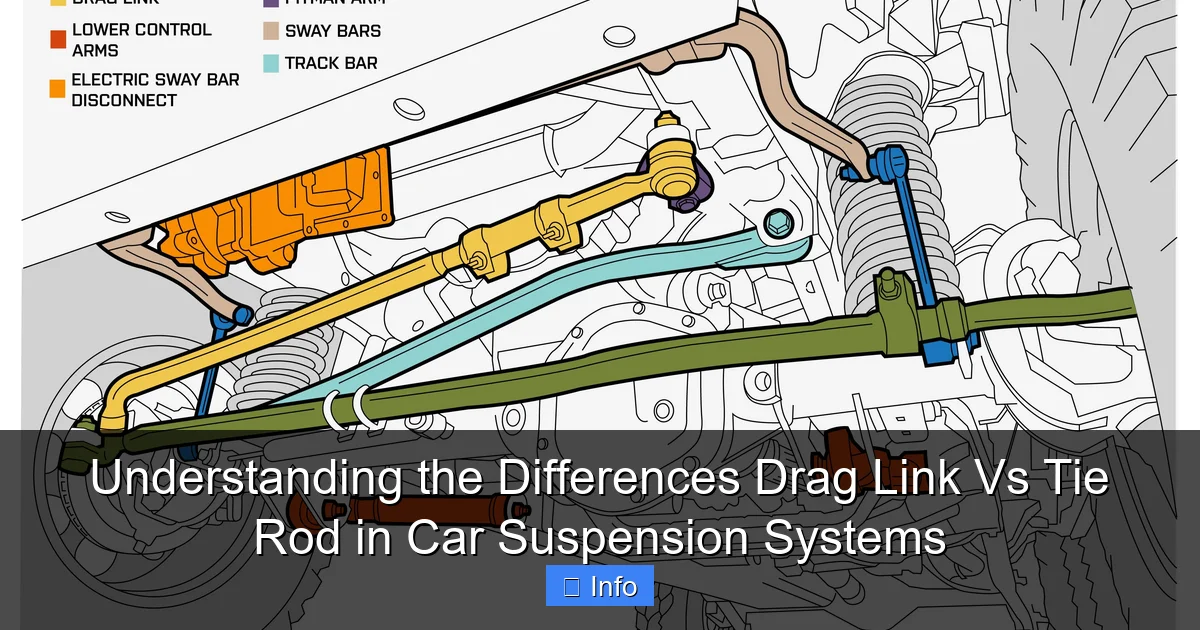
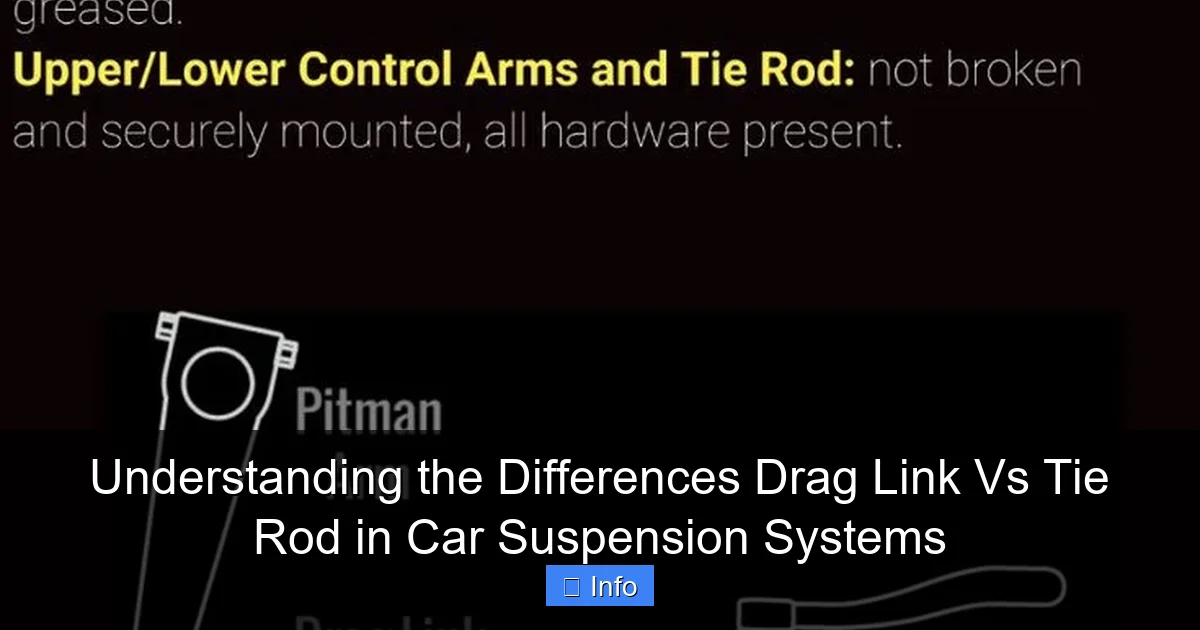
The drag link acts as the primary bridge between the steering gearbox and the steering knuckle. When you turn the steering wheel, the gearbox rotates an output shaft. Attached to that shaft is the pitman arm. The drag link connects to the pitman arm on one end. On the other end, it connects to the steering arm on the knuckle (or sometimes to a tie rod assembly). As the pitman arm swings in an arc, the drag link pushes or pulls the steering knuckle. This turns the front wheels.
It is called a “drag” link because it literally drags the steering knuckle into the turn. It operates under high stress. It must withstand the full force of the steering gearbox output. It also absorbs road shock from potholes and bumps. Because of this, it is usually a thick, solid steel bar or a heavy-walled tube with robust ball sockets on each end.
Common Applications
You will see a drag link in a few specific steering layouts. The most common is the “parallelogram” linkage. Here, the drag link connects the pitman arm to one steering knuckle. A separate center link (or relay rod) connects the other knuckle via an idler arm. The tie rods then connect the center link to the knuckles. In a “cross-steer” setup (common on Jeeps), the drag link runs directly from the pitman arm to the passenger-side knuckle. A tie rod then connects the two knuckles together. In both cases, the drag link is the driver-side input link.
What Is a Tie Rod?
The tie rod is the most common steering link on the road today. Virtually every modern passenger car, crossover, and light truck uses a rack-and-pinion steering system. In this system, the tie rod is the final link. It connects the steering rack directly to the steering knuckle.
Visual guide about Understanding the Differences Drag Link Vs Tie Rod in Car Suspension Systems
Image source: i.pinimg.com
Inner and Outer Tie Rods
A tie rod assembly actually comes in two pieces: the inner tie rod and the outer tie rod end. The inner tie rod threads directly onto the steering rack. It usually has a ball socket that allows it to pivot. It is protected by a rubber bellows boot that keeps dirt out and grease in. The outer tie rod end threads onto the inner tie rod. This threaded connection is the adjustment point for toe alignment. The outer end has a tapered stud with a ball joint that bolts into the steering knuckle.
This two-piece design serves a crucial purpose. It allows for length adjustment. When a mechanic performs an alignment, they loosen the jam nut between the inner and outer rods. They then spin the inner rod to change the overall length. This sets the “toe” angle of the wheel. The drag link, by contrast, is usually a fixed-length component (though some heavy-duty versions are adjustable).
Role in Steering
In a rack-and-pinion system, the steering rack moves linearly side-to-side. The inner tie rod pushes or pulls the outer tie rod. The outer tie rod pushes or pulls the steering knuckle. This turns the wheel. The tie rod must transmit steering force while allowing the suspension to move up and down. The ball joints at both ends provide this articulation. They handle a complex mix of tension, compression, and bending forces.
Key Differences Between Drag Link and Tie Rod
While both are steering links, the drag link vs tie rod comparison reveals fundamental engineering differences. These differences dictate how you diagnose, repair, and maintain them.
Visual guide about Understanding the Differences Drag Link Vs Tie Rod in Car Suspension Systems
Image source: i.ytimg.com
Location and Connection Points
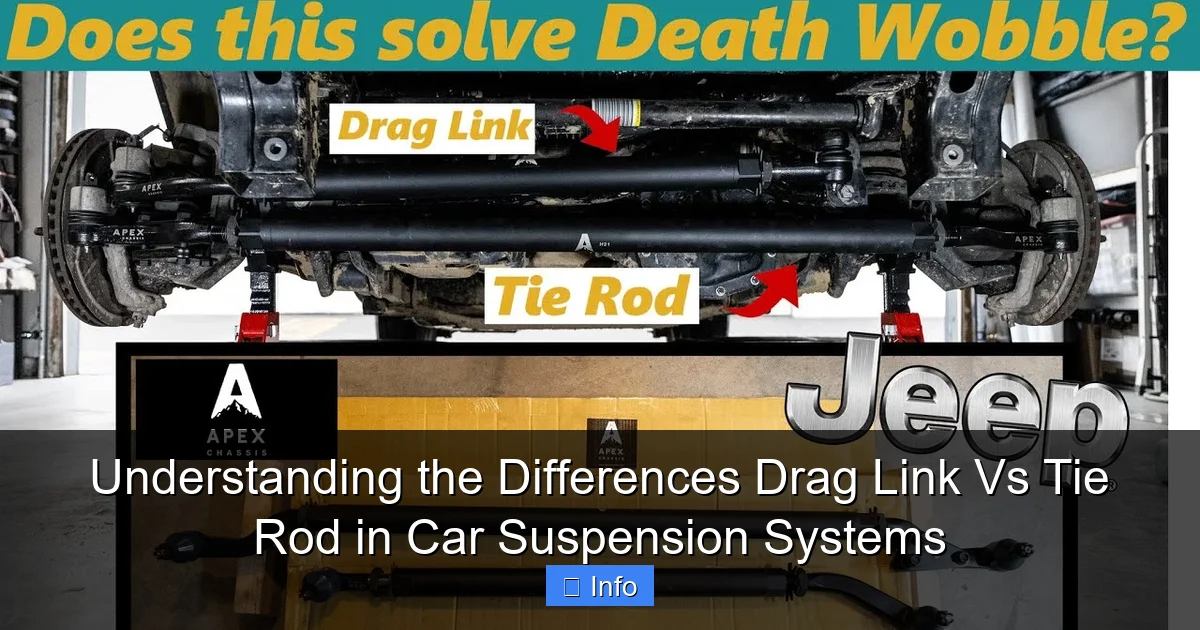
The most obvious difference is where they live. The drag link connects the steering box output (pitman arm) to the steering knuckle (or center link). It is part of a “linkage” system. The tie rod connects the steering rack to the steering knuckle. It is part of a “rack” system. You generally will not find both on the same axle in the same role. A vehicle has either a steering box with a drag link, or a steering rack with tie rods.
Movement and Force Handling
The drag link moves in an arc. The pitman arm swings through a radius. The drag link must accommodate this sweeping motion while pushing the knuckle laterally. It sees mostly compressive and tensile loads along its axis. The tie rod moves mostly linearly. The rack slides sideways. The tie rod pushes and pulls in a straighter line. However, because the outer tie rod end attaches to the knuckle which moves up and down with the suspension, the tie rod end must articulate through a wider range of angles than a typical drag link end.
Wear Patterns and Failure Symptoms
Both parts use ball-and-socket joints. Both wear out when the socket loses its preload or the ball develops play. But the symptoms differ slightly. A worn drag link often causes a “dead spot” or wander in the steering wheel center. You turn the wheel slightly, and nothing happens. Then the wheels suddenly catch up. You may hear a single loud clunk when reversing direction. A worn tie rod end typically causes a shimmy or vibration at speed. It causes rapid, uneven tire wear (feathering) on the affected wheel. You might hear a knocking noise over small bumps.
If the inner tie rod fails, the steering feels vague and loose. The boot often tears first, letting water in and grease out. This accelerates wear drastically. A drag link end failure can be more dangerous. If the socket separates, you lose steering control on that side completely. This is why drag link ends often have a safety castle nut and cotter pin, while many tie rod ends use a prevailing torque nut (nylock).
How They Work Together in Steering Systems
It is rare to see a drag link and a tie rod working the same axle in parallel. However, they often work in series on solid-axle vehicles. Understanding the system architecture helps you visualize the force flow.
Visual guide about Understanding the Differences Drag Link Vs Tie Rod in Car Suspension Systems
Image source: i.pinimg.com
Parallelogram Steering Linkage
This is the classic setup on rear-wheel-drive cars and trucks from the 60s through the 90s. The steering box turns the pitman arm. The drag link connects the pitman arm to the passenger-side knuckle (or to the center link). The center link (idler arm side) connects to the driver-side knuckle. Tie rods connect the center link to both knuckles. In this system, the drag link is the “input” link. The tie rods are the “output” links to each wheel. The drag link determines the steering angle. The tie rods follow and ensure both wheels turn together (Ackermann geometry).
Cross-Steer (Solid Axle) Linkage
This is the standard for solid front axles (Jeeps, heavy-duty trucks). The drag link runs from the pitman arm (driver side) across to the passenger-side knuckle. A single tie rod connects the passenger knuckle to the driver knuckle. Here, the drag link pushes the passenger wheel. That wheel pushes the tie rod. The tie rod drags the driver wheel along. The drag link does the heavy lifting. The tie rod just synchronizes the second wheel. This is why the drag link is beefier.
Rack and Pinion vs. Recirculating Ball
The drag link vs tie rod divide is really a divide between steering gear types. Recirculating ball boxes use a worm gear and ball bearings to turn a sector shaft. They output rotary motion (the pitman arm). This requires a linkage system (drag link, center link, tie rods) to convert rotation to linear wheel movement. Rack-and-pinion uses a pinion gear on the steering shaft meshing with a toothed rack. It outputs linear motion directly. It only needs tie rods to connect the rack to the wheels. Rack-and-pinion is lighter, more precise, and cheaper to manufacture. That is why it dominates modern production.
Maintenance and Replacement Tips
Steering linkage is a safety-critical system. Neglecting it leads to loss of control. The good news is that inspection is easy. Replacement is often within reach of a skilled DIYer.
Inspection Intervals
Check your steering linkage every oil change or at least twice a year. Grab the wheel at 3 and 9 o’clock. Shake it firmly. Feel for any free play (looseness) before the steering rack or box engages. Then check at 12 and 6 o’clock to rule out wheel bearings. Look at the boots. Are they cracked, torn, or leaking grease? A torn boot on a tie rod or drag link end is a ticking clock. Dirt enters. Grease exits. The joint fails fast. If you see a torn boot, replace the joint immediately. Don’t just replace the boot; the joint is likely already contaminated.
Signs You Need Replacement
- Excessive Play: More than 1/8 inch of free movement at the wheel rim.
- Noise: Clunking on turn-in, knocking over bumps, or squeaking when turning at low speed.
- Tire Wear: Feathered edges or uneven wear across the tread face.
- Steering Drift: Car wanders left/right on flat highway; requires constant correction.
- Off-Center Wheel: Steering wheel is crooked when driving straight.
If you need to replace a tie rod end, the process is straightforward on most cars. You break the jam nut loose. You remove the castle nut or nylock from the knuckle. You separate the taper with a pickle fork or puller. You unscrew the old end. You screw the new one in to the same depth (count threads or measure). You reinstall. Crucial: You must get a professional alignment immediately after. If you are tackling this job yourself, having the right tools makes a huge difference. A quality master inner tie rod tool set is essential for removing the inner tie rod from the rack without damaging the housing. For the outer ends, a good tie rod puller saves the threads and the knuckle.
DIY vs. Professional Service
Outer tie rod ends are a classic DIER (Do It Yourself Repair). Inner tie rods require a special socket and often a pipe wrench or crows foot on a torque wrench. Drag link replacement is similar in difficulty to outer tie rods. However, on solid axle vehicles, the drag link is often longer and heavier. The tapers can be seized tight. Heat and a heavy hammer are often needed. If you lack an impact wrench, a big breaker bar, and a torch, leave drag links to the pros. Also, adjusting a drag link (if adjustable) to center the steering wheel requires precision. A shop alignment rack is mandatory after any linkage work.
One common DIY mistake is not torquing the castle nut correctly. Over-tightening crushes the socket. Under-tightening allows the taper to spin and wallow out the knuckle hole. Always use a torque wrench. If the spec says “tighten to 50 ft-lbs then align cotter pin hole,” do exactly that. Never back off to align the hole. Tighten further until the slot aligns.
Choosing Quality Parts for Longevity
Not all steering parts are created equal. The price difference between a budget brand and a premium brand is often $20-$40 per part. The life difference can be years. This is not the place to save pennies.
Materials and Construction
Look for forged steel housings, not cast iron. Forged parts have better grain structure and impact resistance. Check the ball stud. It should be heat-treated and hardened. The socket should be a polymer-lined metal or a high-quality sintered metal. Greaseable fittings (Zerk fittings) are a huge plus. They allow you to flush old contaminated grease and add fresh synthetic grease periodically. This doubles or triples joint life. Sealed “lifetime” joints are convenient but once the grease breaks down, the joint dies. If you do your own maintenance, greaseable is superior.
Trusted Brands and Where to Buy
Stick with known chassis brands: Moog, Mevotech (Supreme/TTX lines), AC Delco Professional, Duralast Gold, Lemförder, TRW, and Beck/Arnley. Avoid no-name “white box” parts. RockAuto, Summit Racing, and local NAPA/CarQuest stores carry the good stuff. When buying, also check the dust boot quality. A thick, multi-lip boot with a metal retention ring beats a thin rubber boot with a zip tie every time. If you live in the rust belt or off-road, consider upgrading to best rubber boots for tie rod ends that offer superior sealing against salt, mud, and water. This small upgrade prevents the number one killer of steering joints: corrosion.
If you are replacing a tie rod end that spins when you try to loosen the jam nut, there is a specific technique to hold the stud. You can read a detailed guide on how to tighten a tie rod end that spins which covers the same holding principles for removal. It saves a lot of frustration.
Conclusion
The difference between a drag link and a tie rod comes down to the steering architecture of your vehicle. The drag link is the muscular input arm of a recirculating ball system. The tie rod is the precise output link of a rack-and-pinion system. Both translate your steering intent into wheel angle. Both rely on ball joints that wear out. Both will make your car unsafe if ignored.
Now that you understand the drag link vs tie rod roles, you can listen to your car better. That clunk over a bump? Check the outer tie rod end. That wandering on the highway? Check the drag link or inner tie rods. That feathered tire wear? Alignment time, likely caused by a loose tie rod. Catch these early. Replace with quality parts. Grease them if you can. And always, always get an alignment after. Your tires, your wallet, and your safety will thank you.
Frequently Asked Questions
Can a vehicle have both a drag link and tie rods?
Yes, many solid-axle vehicles (like Jeeps and heavy-duty trucks) use a drag link to connect the steering box to one knuckle, and a tie rod to connect that knuckle to the other knuckle. They work in series to steer both wheels.
Which fails more often, drag link or tie rod?
Tie rod ends fail more frequently because there are more of them on the road (rack-and-pinion is standard now) and they articulate through greater angles with suspension travel. However, drag link ends fail more catastrophically when they do go.
Do I need an alignment after replacing a drag link?
Absolutely. Any time you disconnect a steering linkage component that affects toe angle, you need a professional alignment. Even if you count threads or measure length, the geometry is too sensitive for guesswork.
Can I replace just the outer tie rod end and not the inner?
Yes, they are separate parts. If the inner joint is tight and the boot is intact, you can replace only the outer end. However, if the inner boot is torn or the joint has play, replace both. The labor overlaps significantly.
What is the difference between a center link and a drag link?
A drag link connects the pitman arm (steering box output) to the steering linkage. A center link (or relay rod) connects the drag link (or pitman arm) to the idler arm on the passenger side frame rail. The tie rods then connect the center link to the knuckles.
Are adjustable drag links worth it for lifted trucks?
Yes. Lifting a solid-axle vehicle changes the drag link angle, causing bump steer and steering wander. An adjustable drag link (or a dropped pitman arm) corrects the geometry. It restores proper steering leverage and reduces stress on the steering box.