How to Calculate Gcwr F150
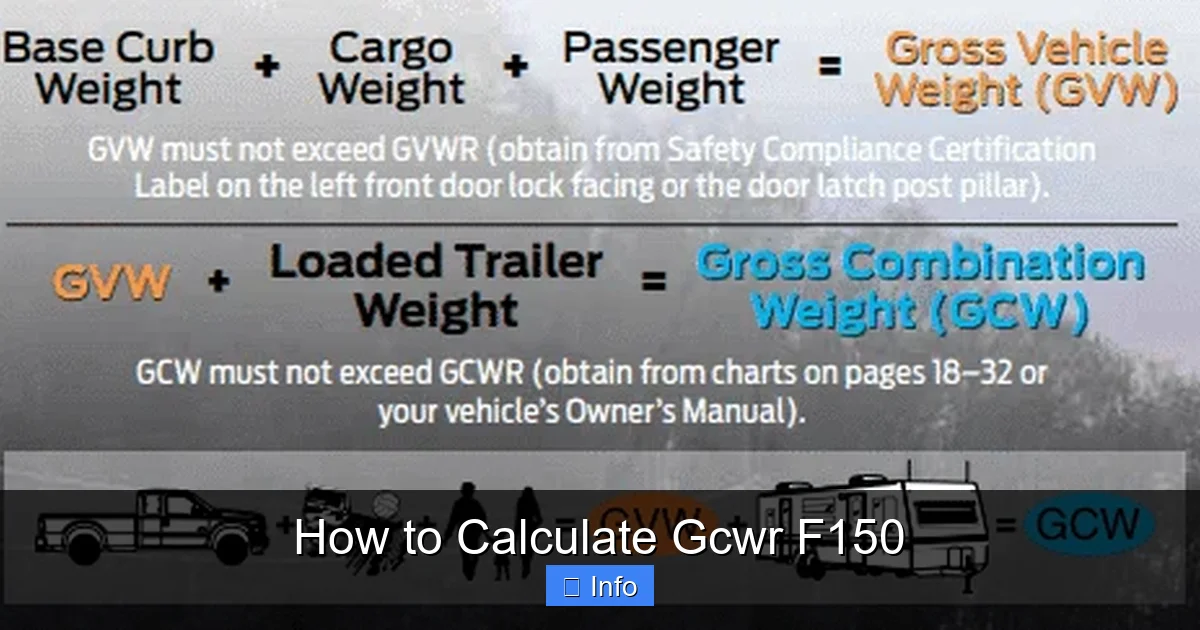
Knowing how to calculate GCWR F150 is essential for safe towing. This guide walks you through the formula, real-world examples, and common mistakes so you can hit the road with confidence and avoid overloading your truck.
Key Takeaways
- GCWR is the total weight of your truck, passengers, cargo, tongue weight, and trailer combined.
- The formula is simple: Curb Weight + Payload + Tongue Weight + Trailer Weight = GCWR.
- Exceeding GCWR can cause brake failure, swaying, and drivetrain damage.
- Your F150’s GCWR varies based on engine type, axle ratio, and configuration.
- Always check your door jamb sticker for the factory GCWR rating.
- Regular maintenance helps your truck handle towing loads more safely.
📑 Table of Contents
- What Is GCWR And Why Does It Matter For Your F150?
- Understanding The Key Terms Before You Calculate
- Step-By-Step: How To Calculate GCWR F150
- GCWR Limits For Different F150 Configurations
- Common Mistakes When Calculating GCWR
- Tips For Staying Within Your GCWR Safely
- What Happens If You Exceed Your GCWR?
- Conclusion
What Is GCWR And Why Does It Matter For Your F150?
If you own a Ford F150, you have probably seen the letters GCWR somewhere. Maybe on a sticker. Maybe in the owner’s manual. But what does it actually mean?
GCWR stands for Gross Combined Weight Rating. It is the maximum total weight your truck can safely handle when towing a trailer. This includes the truck itself, passengers, cargo, the tongue weight of the trailer, and the trailer plus its load.
Why is this so important? Because going over your GCWR can lead to serious problems. Brakes may fail. The trailer may sway. Your drivetrain can take a beating. In the worst case, you could lose control entirely.
That is why learning how to calculate GCWR F150 is not just technical knowledge. It is basic safety. Whether you are hauling a boat, a camper, or a horse trailer, understanding your numbers keeps everyone safe.
Understanding The Key Terms Before You Calculate
Before you plug numbers into a formula, you need to know what each term means. Let us break it down in plain English.
Visual guide about How to Calculate Gcwr F150
Image source: towengine.com
Curb Weight
Curb weight is how much your F150 weighs when it is empty but ready to drive. It includes the fuel tank, fluids, and factory equipment. Think of it as the truck standing on a scale with a full tank and no people or stuff inside.
Payload
Payload is everything you add to the truck. Passengers, gear, tools, cooler, anything in the bed. Payload is measured by subtracting curb weight from the Gross Vehicle Weight Rating, or GVWR. Your payload capacity is listed on the door jamb sticker.
Tongue Weight
This is the downward force the trailer hitch applies to your truck’s rear. It usually makes up about 10 to 15 percent of the total trailer weight. Too little tongue weight causes sway. Too much overloads the rear axle.
Trailer Weight
This is the total weight of the trailer plus everything inside it. Boats, luggage, fuel, animals, tools, all of it counts. Never guess this number. Use a public scale to get an accurate reading.
Gross Vehicle Weight Rating (GVWR)
GVWR is the maximum weight your F150 can carry on its own. It includes curb weight plus payload. Do not confuse GVWR with GCWR. GVWR is just the truck. GCWR includes the trailer too.
Step-By-Step: How To Calculate GCWR F150
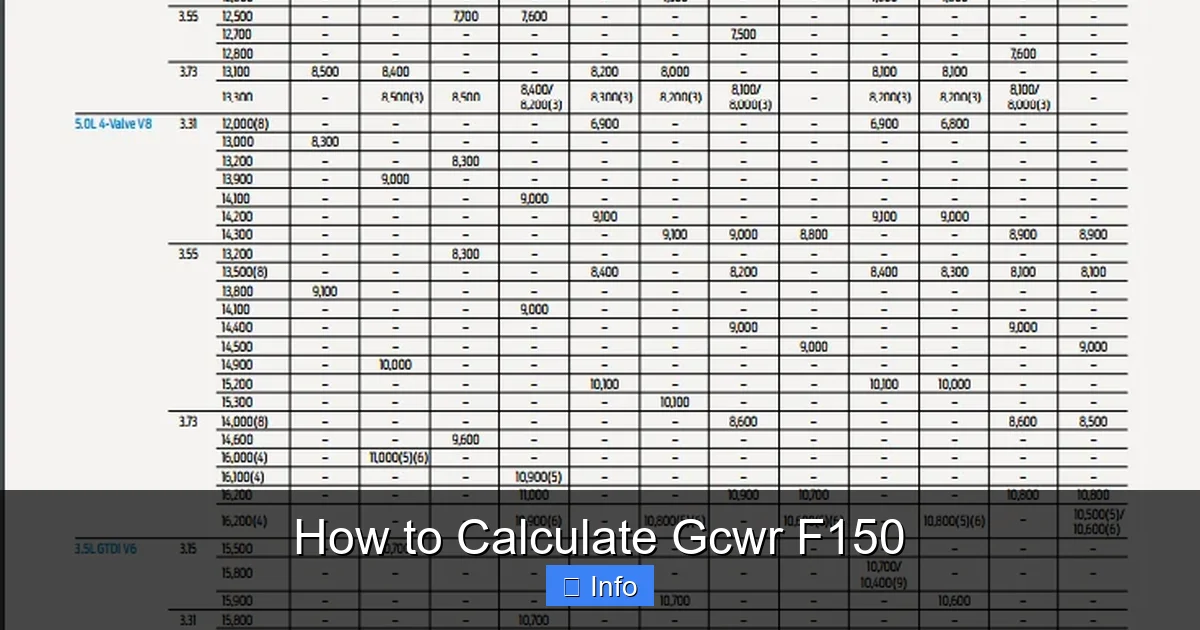
Now let us get to the actual math. The formula is straightforward. But getting the inputs right is where most people slip up.
Visual guide about How to Calculate Gcwr F150
Image source: cimg1.ibsrv.net
The Formula
GCWR = Curb Weight + Payload + Tongue Weight + Trailer Weight (including load)
That is it. Four numbers added together. Let us walk through a real example.
Example: Weekend Boat Trip
Say your F150 has a curb weight of 5,200 pounds. You plan to drive two adults and gear, totaling 600 pounds in payload. Your boat trailer has a tongue weight of 450 pounds. The trailer plus the boat weighs 6,500 pounds.
GCWR = 5,200 + 600 + 450 + 6,500 = 12,750 pounds.
Now compare that number to your F150’s rated GCWR. If your truck is rated for 13,000 pounds, you are within limits. If it is rated for 11,500, you are over and need to lighten the load.
Using The Door Jamb Sticker
Open your driver’s side door. Look at the sticker on the door jamb. That sticker lists your GVWR, payload capacity, and often your GCWR. It is the most accurate source for your specific truck. Do not rely on generic charts alone.
Online Calculators And Resources
Several websites let you input your F150 year, engine, and configuration to find the factory GCWR. Ford’s own website has towing guides. Third-party sites also offer calculators. Just make sure the data is current and matches your truck’s specs.
Checking Your Transmission And Drivetrain
Towing puts extra stress on your transmission. Before heading out, it is smart to have it checked. If you are unsure about your transmission type or condition, you can learn how to identify your transmission and make sure it is ready for the job. A healthy transmission is key to safe towing.
GCWR Limits For Different F150 Configurations
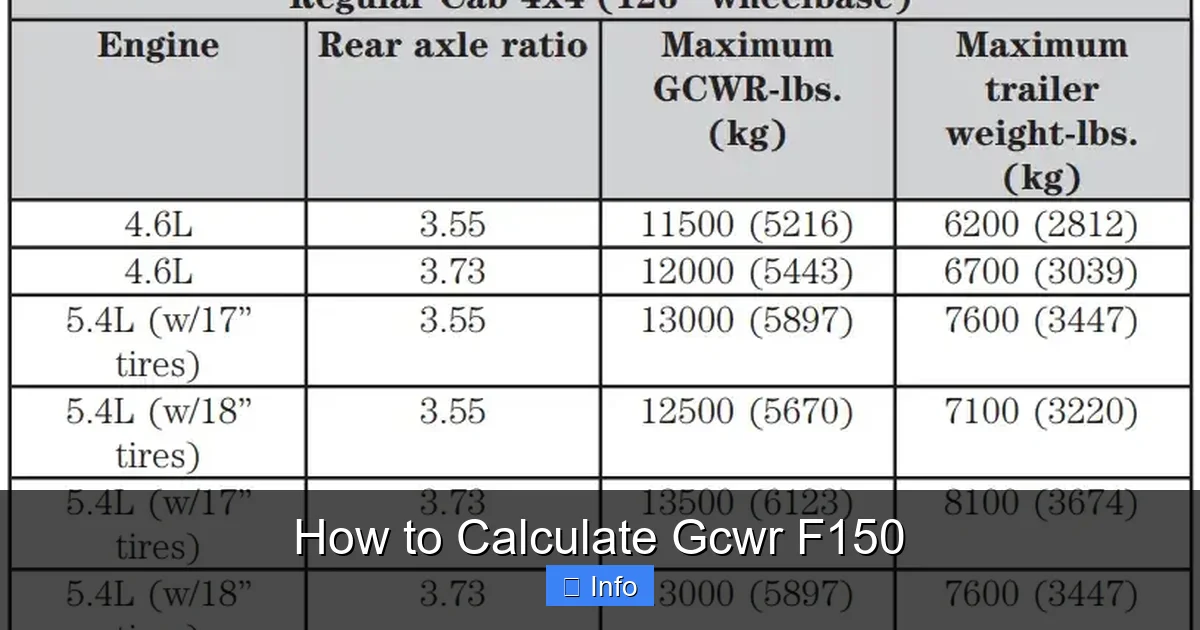
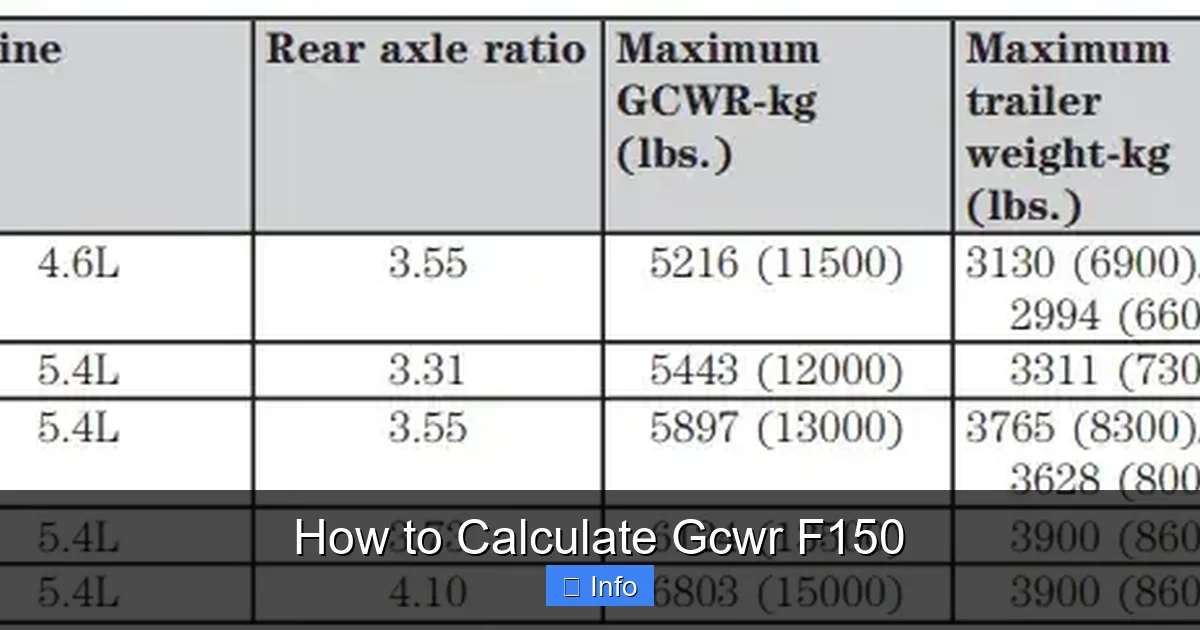
Not all F150s are the same. Your GCWR depends on several factory specs. Here is a quick breakdown.
Visual guide about How to Calculate Gcwr F150
Image source: towengine.com
Engine Type
The 3.3-liter V6 has a lower GCWR than the 5.0-liter V8 or the 3.5-liter EcoBoost. The PowerBoost hybrid also has its own rating. More horsepower and torque generally mean a higher towing capacity.
Axle Ratio
A higher numerical axle ratio, like 4.10 or 4.30, improves towing ability. It gives your truck more pulling power but can affect fuel economy.
Cab And Bed Configuration
SuperCab and SuperCrew cabs have different weight distributions. Short beds and long beds also shift the balance. Always check the GCWR for your exact body style.
Typical GCWR Ranges
For a standard F150, the GCWR usually falls between 11,000 and 14,000 pounds. Heavy-duty configurations with the EcoBoost can reach the top end. Again, your door jamb sticker is the final word.
Maintenance Tips For Towing Readiness
Before every trip, check your tire pressure, brake pads, and suspension. Towing can expose weak spots fast. If you want to boost your truck’s pulling power, learning how to increase torque through proper maintenance and minor upgrades can make a real difference. A well-maintained truck handles weight better and safer.
Common Mistakes When Calculating GCWR
Even careful truck owners make errors. Here are the most common ones to avoid.
Forgetting The Tongue Weight
Many people add the trailer weight but skip the tongue weight. That is a big mistake. The tongue weight pushes down on your truck and counts directly toward your GCWR. Always include it.
Guessing The Trailer Weight
Do not estimate. Trailers vary widely depending on what is inside. A boat trailer with a fully loaded boat can weigh hundreds of pounds more than an empty one. Use a scale.
Ignoring Passengers And Gear
Four adults and a cooler in the cab add up fast. Every pound inside the truck counts as payload. Be honest about what you are carrying.
Using Old Or Generic Numbers
A 2015 F150 does not have the same GCWR as a 2023 model. Engine updates, frame changes, and equipment upgrades all shift the numbers. Always use data for your exact year and model.
Overlooking Cargo In The Trailer
An empty trailer weight is not the same as a loaded trailer. If you are hauling furniture, tools, or fuel, those weights must be added. A trailer loaded with heavy gear can easily exceed its rated weight by hundreds of pounds.
Tips For Staying Within Your GCWR Safely
Once you know how to calculate GCWR F150, the next step is staying within limits. Here are practical tips.
Weigh Your Truck And Trailer
Take your loaded truck and trailer to a public scale. Many truck stops and weigh stations offer this service. This gives you real numbers instead of estimates.
Distribute Weight Evenly
Place heavier items low and centered in the trailer. Uneven loading causes sway and puts stress on one side of the truck. A well-balanced load is a safer load.
Use The Right Hitch
Make sure your hitch is rated for the weight you are towing. A class III hitch may not handle a heavy fifth-wheel trailer. Match the hitch to the load.
Check Brakes And Tires Before Every Trip
Towing demands more from your brakes and tires. Worn brake pads or low tire pressure can cause disaster under load. A quick check before each trip can prevent big problems. Also, keeping your transmission in good shape is critical when towing. Regular fluid changes and inspections help avoid costly failures on the road.
Keep A Logbook
Write down your weights for each trip. Over time, you will develop a feel for what your F150 can handle. This habit also helps you spot trends, like increasing strain on certain components.
What Happens If You Exceed Your GCWR?
Exceeding your GCWR is dangerous and potentially illegal. Here is what can go wrong.
Brake Failure
Your brakes are designed for a specific total weight. Add too much and they may not stop you in time. Brake fade is common on long downgrades with overloaded rigs.
Transmission Damage
Extra weight creates extra heat inside your transmission. Over time, this leads to slipping, rough shifting, or complete failure. If you notice any signs of transmission trouble, address it immediately. Early action can save you from a much larger repair bill.
Suspension And Frame Stress
Your frame and suspension have limits. Overloading causes sag, cracking, and premature wear. These are expensive repairs that are easy to avoid.
Insurance And Legal Issues
If you get into an accident while over your GCWR, your insurance may not cover the damages. You could also face fines or citations. Staying within limits protects you legally and financially.
Conclusion
Learning how to calculate GCWR F150 is one of the most important skills any truck owner can have. It is not just about numbers on a paper. It is about protecting your truck, your passengers, and everyone else on the road.
The formula is simple. Curb weight plus payload plus tongue weight plus trailer weight gives you your GCWR. Check it against your truck’s rated limit. Stay under that number, and you tow with confidence.
Take the time to weigh everything accurately. Do not skip the tongue weight. Keep your truck maintained and your tires in good shape. Small efforts lead to big safety gains.
Now you have the knowledge. Use it on your next trip. Your F150 is built to work hard. Just make sure you give it the right numbers to work with.
Frequently Asked Questions
Where do I find my F150’s GCWR?
Check the door jamb sticker on the driver’s side door. It lists your truck’s specific GCWR based on its factory configuration. You can also find it in your owner’s manual or on Ford’s official website for your exact model year.
Does tongue weight count toward payload?
Yes, tongue weight counts toward your payload capacity and your GCWR. It pushes down on the rear of your truck and adds to the total combined weight. Always include it in your calculations.
Can I increase my F150’s GCWR?
The factory GCWR is set by Ford and should not be modified or exceeded. However, you can improve towing capability through proper maintenance, using the right axle ratio, and ensuring your drivetrain and brakes are in top condition.
What is the difference between GCWR and GVWR?
GVWR is the maximum weight your truck can carry on its own, including passengers and cargo. GCWR includes the GVWR plus the weight of your trailer and its load. GCWR is always higher because it accounts for the combined rig.
How often should I check my GCWR?
Check your GCWR before every towing trip. Weights can change based on cargo, passengers, and trailer load. Getting on a public scale regularly helps you stay accurate and safe.
Is it safe to tow near my GCWR limit?
It is best to stay well below your GCWR limit for safety and longevity of your truck. Operating at or near the limit puts extra stress on brakes, transmission, and suspension. Leave a comfortable margin for changing road conditions.