A Car Moving Along a Straight Highway

A car moving along a straight highway demonstrates fundamental physics principles like constant velocity and acceleration. Understanding the forces at play helps drivers improve safety, fuel efficiency, and overall driving performance on open roads.
Picture this: you’re cruising down a long, open highway. The road stretches straight ahead for miles. Your speedometer holds steady at 65 mph. The engine hums a consistent note. It feels simple, almost effortless. But beneath that calm exterior, a fascinating interplay of physics, engineering, and human skill is happening every second. A car moving along a straight highway is one of the most common yet scientifically rich scenarios in everyday life.
We often take this motion for granted. We press the pedal, the car goes. We turn the wheel slightly, it stays in lane. But understanding what’s actually happening can make you a safer, more efficient driver. It can also satisfy that natural curiosity about how the world works. From the forces pushing against your vehicle to the energy conversions powering your journey, there’s a lot to unpack. Let’s dive into the mechanics, the science, and the practical realities of straight-line highway travel.
Key Takeaways
- Constant velocity means zero acceleration: When speed and direction don’t change, the net force on the car is zero.
- Engine force balances resistance: At steady highway speeds, the forward thrust equals drag plus rolling resistance.
- Inertia keeps you moving: Newton’s first law explains why a car continues straight unless acted upon by an external force.
- Braking converts kinetic energy: Stopping transforms motion energy into heat through friction.
- Aerodynamics matter at high speeds: Air resistance increases with the square of velocity, impacting fuel economy.
- Tire traction enables control: Friction between tires and pavement allows acceleration, braking, and steering.
- Real-world conditions add complexity: Wind, road grade, and traffic require constant driver adjustments.
📑 Table of Contents
The Physics of Straight-Line Motion
At its core, highway driving is a perfect demonstration of Newton’s laws of motion. When a car moving along a straight highway maintains a constant speed, it’s in a state of dynamic equilibrium. This means the net force acting on the vehicle is zero. The forward force from the engine exactly cancels out the backward forces of air resistance and rolling friction.
Newton’s First Law: The Law of Inertia
Newton’s first law states that an object in motion stays in motion with the same speed and in the same direction unless acted upon by an unbalanced force. Your car has mass, so it has inertia. It wants to keep going straight at the same speed forever. In a perfect vacuum with no friction, you could turn off the engine and coast indefinitely. But we live in the real world. Air pushes against the car. Tires deform on the pavement. Internal friction exists in the drivetrain. These forces constantly try to slow you down. The engine must provide a continuous force just to maintain equilibrium.
Reference Frames and Relative Motion
Motion is always relative. To a passenger in your car, the coffee cup in the cup holder is stationary. To a person standing on an overpass, that same cup is moving at 65 mph. To a driver in the opposite lane, you’re approaching at 130 mph. Physics works the same in any inertial reference frame. This concept is crucial for understanding collisions and relative speed. It also explains why highway driving feels calm inside the cabin despite high speeds relative to the ground.
Understanding Velocity and Acceleration
Velocity and acceleration are often confused in casual conversation. In physics, they have precise meanings that are vital for driving dynamics. Velocity is a vector: it has both magnitude (speed) and direction. Acceleration is the rate of change of velocity. This means you accelerate when you speed up, slow down, or change direction.

Visual guide about A Car Moving Along a Straight Highway
Image source: c8.alamy.com
Constant Velocity vs. Constant Acceleration
On a straight highway, constant velocity is the ideal steady state. The speedometer doesn’t move. The heading doesn’t change. Acceleration is zero. But real driving involves frequent small accelerations. You adjust speed for traffic. You change lanes. You accelerate onto the highway from an on-ramp. You decelerate for an exit. Each of these maneuvers requires a net force. The magnitude of acceleration determines how much force is needed, following Newton’s second law: F = ma.
The Role of the Accelerator Pedal
Despite its name, the “accelerator” pedal doesn’t directly control acceleration. It controls engine torque output. The resulting acceleration depends on the net force after subtracting resistances. At high speeds, most engine power fights aerodynamic drag. Only a small fraction is available for actual acceleration. This is why passing power diminishes at highway speeds. Understanding this helps manage expectations during merging or overtaking.
Forces Acting on a Car on a Highway
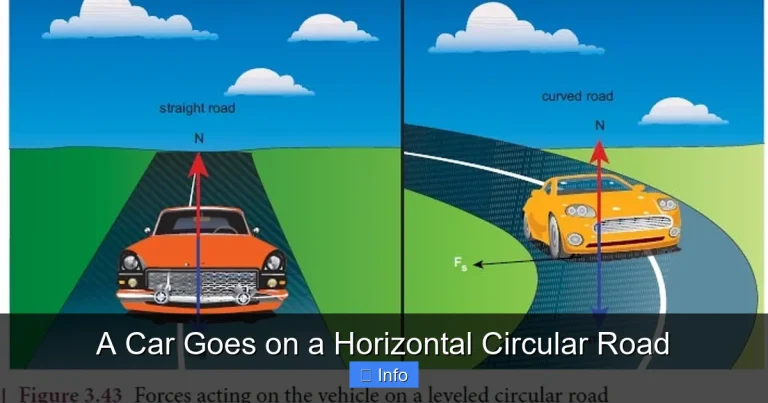
Several distinct forces act on a car moving along a straight highway. Analyzing them reveals why cars behave the way they do at speed. The main forces are: engine thrust (forward), aerodynamic drag (backward), rolling resistance (backward), gravity (downward), and normal force (upward). When driving straight and level, gravity and normal force cancel vertically. Horizontally, thrust balances drag plus rolling resistance at constant speed.
Visual guide about A Car Moving Along a Straight Highway
Image source: isorepublic.com
Aerodynamic Drag: The Dominant Force at Speed
Air resistance, or drag, increases with the square of velocity. Double your speed, and drag quadruples. The power needed to overcome drag increases with the cube of velocity. This is why fuel economy drops sharply above 55-60 mph. Drag force depends on the car’s drag coefficient (Cd), frontal area, air density, and speed squared. Streamlined shapes, lower ride heights, and active grille shutters all reduce Cd. At 70 mph, over 60% of engine power may go just to pushing air aside.
Rolling Resistance: The Constant Companion
Rolling resistance comes from tire deformation and friction in wheel bearings. It’s relatively constant with speed but increases with weight. Low rolling resistance tires use special compounds and constructions to minimize this loss. Proper inflation is critical. Underinflated tires flex more, increasing resistance and heat buildup. This force is always present, even at low speeds, unlike drag which is negligible in parking lots.
Engine Thrust and Drivetrain Losses
The engine generates torque, multiplied by the transmission and final drive, to push the wheels against the pavement. The pavement pushes back (Newton’s third law), propelling the car forward. However, significant energy is lost as heat in the engine, transmission, differential, and wheel bearings. Modern automatics with lock-up torque converters and 8-10 speeds minimize these losses. Manual transmissions are typically slightly more efficient but depend on driver skill.
Safety Considerations at High Speeds
Physics dictates that kinetic energy increases with the square of speed. A crash at 70 mph releases four times the energy of a crash at 35 mph. Stopping distance also increases non-linearly. Reaction distance grows linearly with speed, but braking distance grows with the square. This makes speed management the single most important safety factor on highways.

Visual guide about A Car Moving Along a Straight Highway
Image source: thumbs.dreamstime.com
Following Distance and Reaction Time
The “three-second rule” is a minimum for dry conditions. At 65 mph, you cover about 95 feet per second. Three seconds gives 285 feet of reaction distance. Add braking distance, and total stopping distance can exceed 300 feet. In wet conditions, double or triple this gap. Large trucks need even more space. Tailgating eliminates your safety margin for the unexpected.
Crosswinds and Stability
High-sided vehicles (vans, trucks, SUVs) are susceptible to crosswinds. A sudden gust can push a vehicle sideways several feet. On a straight highway, this requires corrective steering. The faster you go, the less time you have to react. Reducing speed in high winds improves stability. Be especially cautious when passing large trucks, as they block wind then expose you to full gusts.
Hydroplaning Risks
Standing water on highways can cause hydroplaning, where tires ride on a water film instead of contacting pavement. This eliminates traction for braking and steering. Speed is the primary factor. Hydroplaning can occur at speeds as low as 35 mph with sufficient water depth. Tread depth and tire pressure are critical defenses. If hydroplaning occurs, ease off the accelerator and steer straight until traction returns.
Fuel Efficiency and Aerodynamics
Highway fuel economy is largely a battle against aerodynamics. The EPA highway test cycle averages about 48 mph with a top speed of 60 mph. Real-world driving at 75-80 mph can reduce MPG by 15-25% compared to the sticker number. Understanding the factors helps you maximize range per tank.
Speed vs. Efficiency Trade-offs
Every vehicle has a “sweet spot” for efficiency, typically between 45-55 mph in top gear. Above this, drag penalties accelerate. Below this, engine efficiency drops due to lower load. Driving 55 mph instead of 75 mph can improve fuel economy by 20-30%. For a 300-mile trip, slowing down 20 mph might cost 30 minutes but save 2-3 gallons of fuel. The cost-benefit depends on your time value and fuel prices.
Vehicle Maintenance for Highway Efficiency
Tire pressure is the easiest win. Check monthly and before long trips. Use the door placard pressure, not the tire sidewall maximum. Remove roof racks when not in use; they destroy aerodynamics. Keep the engine tuned, use recommended oil viscosity, and replace air filters on schedule. Extra weight hurts city MPG more than highway, but every 100 lbs still costs about 1% on the highway.
Driving Techniques for Better MPG
Smooth inputs save fuel. Anticipate traffic flow to avoid braking. Use cruise control on flat terrain to maintain steady speed. On hills, allow speed to drop slightly uphill and regain it downhill (if safe). Avoid excessive idling. Modern engines don’t need warm-up time; drive gently immediately. Plan routes to avoid congestion, even if slightly longer. Stop-and-go destroys highway efficiency.
Real-World Applications and Examples
The principles we’ve discussed apply to every highway journey. Let’s look at specific scenarios where physics meets practical driving. These examples illustrate how understanding the science leads to better decisions behind the wheel.
Merging Onto the Highway
Merging requires acceleration to match highway speed. The on-ramp is your runway. You need enough length to reach traffic speed before the lane ends. This is a practical application of acceleration physics. Heavier vehicles, or those with less power, need longer ramps. If the ramp is short, you must accelerate harder. Always check mirrors and blind spots early. Match speed before the merge point to integrate smoothly.
Passing on a Two-Lane Highway
Passing requires significant acceleration capability. You need to cover the passing zone length plus the distance of the oncoming vehicle. At 60 mph, closing speed with oncoming traffic is 120 mph (176 ft/sec). A 1/4 mile passing zone (1320 ft) gives only 7.5 seconds before collision. You must complete the pass well before this. Never pass with limited visibility. The physics of relative motion leaves zero margin for error.
Long-Distance Cruise Control Use
Cruise control maintains constant speed better than human feet on flat roads. It reduces fatigue and improves fuel economy by eliminating small speed variations. However, on hilly terrain, it may downshift aggressively to maintain speed uphill, then brake downhill. Adaptive cruise control adds radar to maintain following distance. This is safer but may brake more frequently in traffic, reducing efficiency. Know your system’s behavior.
Electric Vehicles on Highways
EVs face unique highway challenges. Aerodynamic drag hurts them disproportionately because they have less total energy onboard. Regenerative braking recovers energy during deceleration, but steady-state cruising offers no regeneration. EV range at 75 mph can be 30% less than EPA combined rating. Preconditioning the battery while plugged in helps. Charging stops on long trips require planning around DC fast charger locations.
Conclusion
We’ve journeyed through the science and practice of a car moving along a straight highway. From Newton’s fundamental laws to the aerodynamic forces shaping your fuel bill, from the safety margins that save lives to the techniques that stretch a tank of gas, highway driving is applied physics in its most accessible form. Every time you merge, pass, or cruise, you’re conducting a real-time experiment in mechanics and energy.
The next time you’re on that long straight stretch, take a moment to appreciate the engineering marvel beneath you. The tires gripping the asphalt. The engine balancing the air’s resistance. The suspension soaking up imperfections. The safety systems standing guard. Understanding these systems doesn’t just make you a more knowledgeable driver; it makes you a more mindful one. You’ll naturally leave more space, modulate speed more wisely, and anticipate hazards more effectively.
Knowledge transforms driving from a mundane task into a conscious interaction with physical laws. Whether you’re commuting 20 miles or road-tripping 2,000, the principles remain the same. Respect the physics. Maintain your vehicle. Drive with intention. And enjoy the ride. The open highway is one of the few places where we routinely experience high-speed motion, and understanding it makes every journey safer, more efficient, and arguably more interesting.
Frequently Asked Questions
What forces act on a car moving at constant speed on a straight highway?
At constant speed, the forward engine force balances the backward forces of aerodynamic drag and rolling resistance. Vertically, gravity is balanced by the normal force from the road. The net force is zero, so acceleration is zero.
Why does fuel economy decrease at higher highway speeds?
Aerodynamic drag increases with the square of speed, and the power required to overcome it increases with the cube of speed. Above 55-60 mph, drag becomes the dominant load on the engine, causing fuel consumption to rise sharply.
How does Newton’s first law apply to highway driving?
Newton’s first law (inertia) means your car wants to continue straight at the same speed forever. The engine must constantly apply force to counteract friction and air resistance. If you remove your foot from the accelerator, these resistive forces cause the car to slow down.
What is the safest following distance on a highway?
The three-second rule is a minimum for ideal conditions. Pick a fixed point the car ahead passes, then count seconds until you reach it. In rain, fog, or heavy traffic, increase to four to six seconds. Larger vehicles need even more distance.
How do electric vehicles differ in highway performance?
EVs are more efficient at low speeds but suffer greater range loss at high speeds due to aerodynamic drag, as they cannot regenerate energy while cruising. They also have instant torque for passing but may have lower top speeds governed by battery thermal limits.
Can cruise control improve fuel economy?
Yes, on flat terrain cruise control maintains a steadier speed than human drivers, reducing unnecessary acceleration and braking. On hilly terrain, it may downshift aggressively uphill and brake downhill, potentially reducing efficiency compared to a skilled driver allowing speed to vary slightly.