A Racing Car Has a Uniform Acceleration

When a racing car has a uniform acceleration, it delivers smooth power, predictable handling, and maximum efficiency. Understanding this concept helps drivers, engineers, and enthusiasts improve lap times and vehicle setup. Key takeaways explain the science, real examples, and practical tips for achieving consistent acceleration.
Key Takeaways
- Uniform acceleration definition: Constant rate of speed increase over time, essential for predictable racing performance.
- Physics basics: Use equations like v = u + at and s = ut + ½at² to calculate distance and speed.
- Components that matter: Engine output, transmission gearing, tire grip, and aerodynamics all influence uniform acceleration.
- Real‑world examples: Study top‑tier Formula 1 cars, GT machines, and electric racers to see uniform acceleration in action.
- Tips for drivers: Smooth throttle control, proper gear selection, and data‑driven adjustments keep acceleration steady.
- Common myths: More power does not always guarantee better lap times; balance and traction are key.
- Measuring acceleration: Use GPS loggers, accelerometers, and telemetry to verify uniform acceleration.
📑 Table of Contents
Introduction
When a racing car has a uniform acceleration, the car moves forward at a steady rate. This steady push makes the driver feel constant power and helps the car stay predictable. Uniform acceleration is more than a physics term; it is a goal for every racer who wants smooth, fast laps. In this guide we explore what uniform acceleration means, why it matters, and how you can achieve it in your own vehicle.
Understanding the Physics of Uniform Acceleration
What Uniform Acceleration Really Means
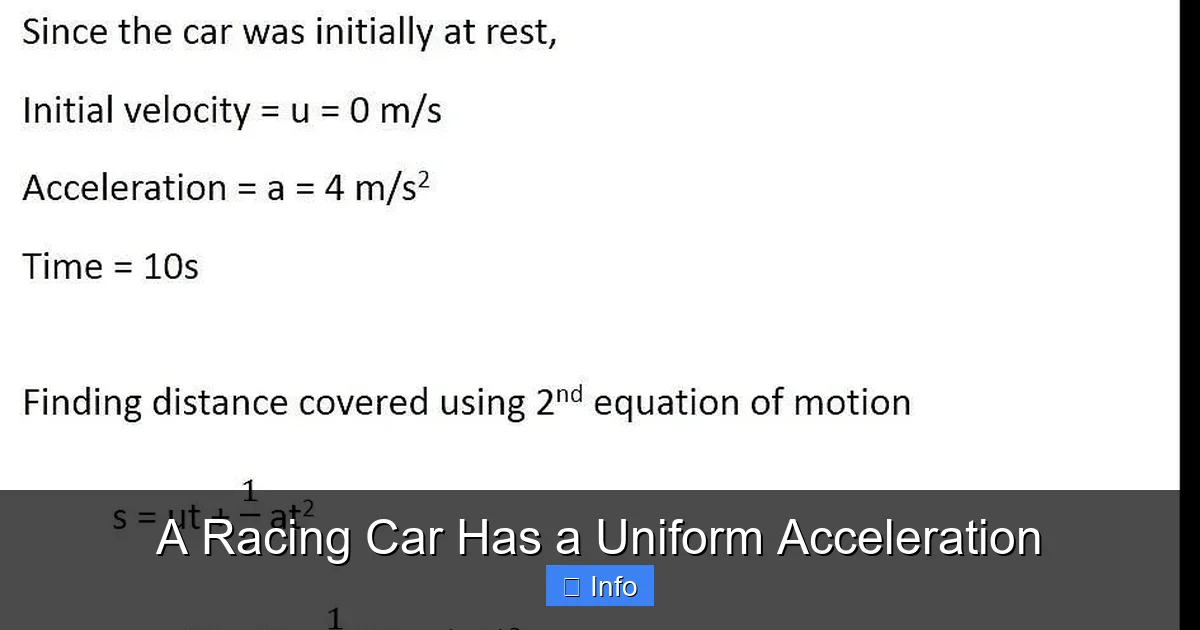
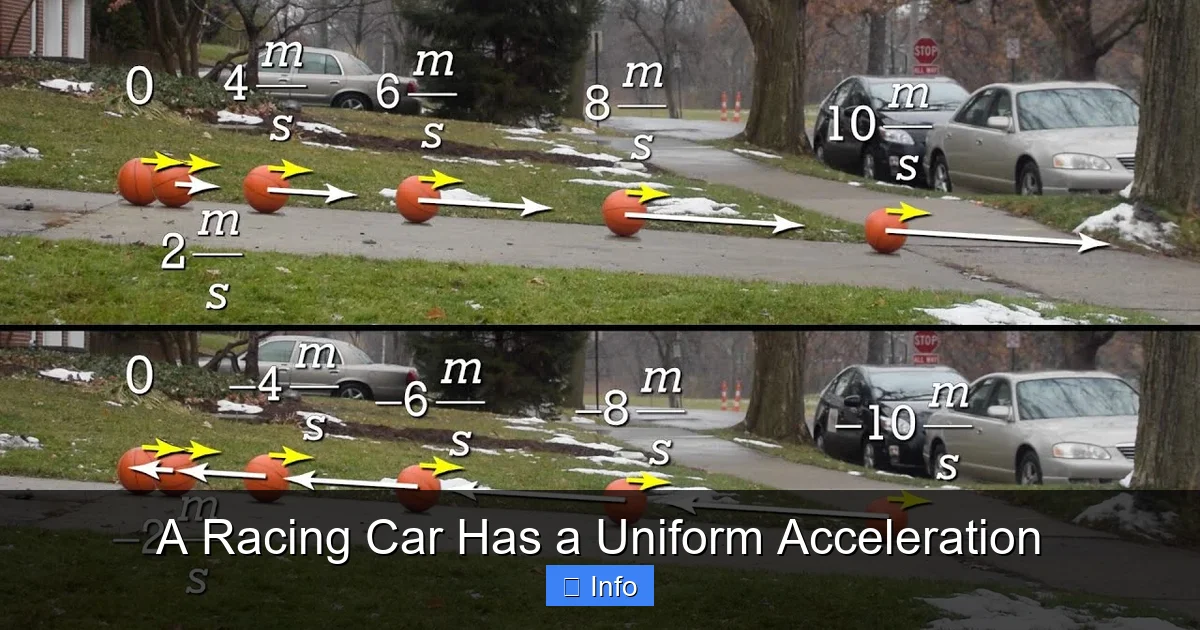
Uniform acceleration occurs when a racing car increases its speed by the same amount each second. The formula v = u + at shows how velocity changes. Here v is final speed, u is initial speed, a is acceleration, and t is time. When a racing car has a uniform acceleration, the graph of speed versus time is a straight line. This makes it easy to predict where the car will be at any moment.
Visual guide about A Racing Car Has a Uniform Acceleration
Image source: cdn.teachoo.com
Key Equations for Racers
The distance covered during uniform acceleration follows s = ut + ½at². If a racing car starts from rest, u = 0, and the formula simplifies to s = ½at². This tells us that distance grows with the square of time, so early acceleration is crucial. The equation also helps engineers design gear ratios that keep acceleration steady.
Why Uniform Acceleration Matters
Uniform acceleration gives the driver a clear feel for the car’s behavior. It reduces the need for constant steering corrections and allows the tires to maintain optimal grip. When a racing car has a uniform acceleration, the power delivery is smooth, which reduces wheel spin and improves lap consistency. This is why professional teams spend so much time tuning their powertrains and suspensions.
Read more about starting from rest: A Car Starts From Rest And Moves With Uniform Acceleration.
Components That Influence Uniform Acceleration
Engine Performance and Power Delivery
The engine is the heart of acceleration. Modern racing engines produce high torque across a wide rpm range. When a racing car has a uniform acceleration, the engine must deliver power without sudden spikes. Turbocharging and hybrid systems can help smooth out the power curve, making acceleration more consistent.
Visual guide about A Racing Car Has a Uniform Acceleration
Image source: i.ytimg.com
Transmission and Gear Ratios
Transmission design decides how engine power reaches the wheels. Properly chosen gear ratios keep the engine in its sweet spot, allowing a racing car to have a uniform acceleration through each gear. Short, close ratios reduce shift time, while lock‑up clutches minimize power loss during gear changes.
Tires and Grip
Tire compound, pressure, and tread pattern dictate how much force can be applied to the track. When a racing car has a uniform acceleration, the tires must stay within their friction limit. Too much power causes wheel spin, breaking uniformity. Teams use data loggers to fine‑tune tire pressure for maximum, steady grip.
Aerodynamics
Aerodynamic downforce pushes the car onto the road, increasing traction. This extra grip lets a racing car have a uniform acceleration without losing bite in corners. Adjustable wings and diffusers let engineers balance drag and downforce for different tracks.
Real‑World Examples of Uniform Acceleration
Formula 1 Car Case Study
Formula 1 cars are built for extreme performance. Their hybrid power units are programmed to deliver smooth power, allowing a racing car to have a uniform acceleration from 0 to 200 km/h in under three seconds. Engineers use precise fuel mapping and ERS (Energy Recovery Systems) to keep acceleration linear.

Visual guide about A Racing Car Has a Uniform Acceleration
Image source: i.ytimg.com
GT Racing Vehicle
GT cars focus on track-day usability. By using a limited‑slip differential and a calibrated throttle map, these cars achieve a uniform acceleration that feels natural on the street and the track. The result is a car that accelerates predictably, making it easier for drivers to push hard safely.
Electric Racing Car
Electric racers like the Formula E machines provide instant torque. However, they must manage this torque to keep a racing car having a uniform acceleration. Battery management systems limit output, creating a flat torque curve that feels steady and controllable.
See a concrete example of 4 m/s² acceleration: A Racing Car Has A Uniform Acceleration Of 4M S.
Practical Tips for Achieving Uniform Acceleration
Driver Technique: Smooth Throttle Control
The driver’s hand on the throttle sets the tone. Light, progressive pressure lets a racing car have a uniform acceleration without sudden jumps. Practicing cadence shifts and heel‑toe braking helps the driver match engine output to road conditions.
Vehicle Setup: Calibration and Fine‑Tuning
Modern ECUs allow custom throttle maps. By shaping the map to deliver steady power, a racing car can have a uniform acceleration across the rev range. Data analysis tools show where the car deviates from the ideal curve, guiding fine‑tuning.
Data Analysis: Measuring Consistency
GPS loggers and accelerometers capture every millisecond of acceleration. Plotting acceleration versus time reveals spikes or drops. When a racing car has a uniform acceleration, the graph should be a flat line. Teams use this data to adjust suspension, gearing, and aerodynamics.
For more on calculating limits, check: Calculate The Maximum Acceleration Of A Moving Car.
Common Myths About Uniform Acceleration
Myth 1: More Power Always Wins
Higher horsepower does not guarantee uniform acceleration. If the traction is poor, extra power just spins the wheels. Balanced setups and good grip are more important than raw output.
Myth 2: Uniform Acceleration Means Constant Speed
Uniform acceleration is about a steady increase in speed, not a constant speed. A racing car having a uniform acceleration will still be speeding up, but the rate of increase stays the same.
Myth 3: Only Pro Teams Can Achieve It
Even amateur racers can work toward uniform acceleration. Simple steps like smooth throttle input, proper tire pressure, and basic data logging can make a noticeable difference.
Conclusion
Uniform acceleration is the backbone of fast, predictable racing performance. When a racing car has a uniform acceleration, the driver enjoys a smooth ride, the tires stay glued to the track, and lap times improve. By understanding the physics, tuning the key components, studying real examples, and applying practical tips, any racer can move closer to that perfect straight‑line push. Start small, gather data, and keep refining. The next time you hit the gas, think about whether your car is delivering uniform acceleration, and watch your performance climb.
Frequently Asked Questions
What is uniform acceleration in a racing car?
Uniform acceleration means the car increases speed at a constant rate over time. This creates predictable handling and smooth power delivery, which helps drivers achieve consistent lap times.
Why does uniform acceleration matter for lap times?
When a racing car has a uniform acceleration, it maximizes traction and reduces wheel spin. This leads to faster, more reliable exits from corners and better overall lap performance.
How can I measure uniform acceleration?
Use a GPS logger or an accelerometer to record speed changes. Plot acceleration versus time; a flat line indicates uniform acceleration. Data analysis tools help identify spikes or drops.
Do electric cars achieve uniform acceleration?
Electric motors provide instant torque, but battery management systems limit output to keep acceleration steady. With proper tuning, electric racers can have very uniform acceleration.
Can a street car have uniform acceleration?
Yes. Smooth throttle control, proper tire pressure, and a well‑tuned ECU can help a street car achieve near‑uniform acceleration, improving both performance and fuel efficiency.
What tools help drivers maintain uniform acceleration?
Telemetry software, lap timers, and real‑time data displays show acceleration trends. Practicing progressive throttle inputs and reviewing data after each run are also effective.