Best Second Hand Car Under 4 Lakhs
Buying a used car under 4 lakhs is a smart way to own a vehicle without breaking the bank. This guide covers the best second hand car under 4 lakhs options like the Alto 800, Hyundai Eon, and Tata Nano, along with essential inspection tips and negotiation strategies to help you make a confident purchase.
Key Takeaways
- Budget-Friendly Options: Cars like Maruti Suzuki Alto 800, Hyundai Eon, and Tata Nano offer great value under 4 lakhs.
- Prioritize Condition Over Age: A well-maintained older car is often better than a newer neglected one.
- Verify Documents Thoroughly: Check RC, insurance, pollution certificate, and service history before paying.
- Get a Mechanic’s Inspection: Always have a trusted mechanic examine the engine, suspension, and electronics.
- Negotiate Smartly: Use minor flaws as leverage to lower the price.
- Consider Total Ownership Cost: Factor in insurance, transfer fees, and immediate repairs into your budget.
- Explore Multiple Sources: Compare certified dealers, online platforms, and private sellers for the best deal.
📑 Table of Contents
- Introduction: Finding Your Perfect Ride Without Emptying Your Wallet
- Why Consider a Second Hand Car Under 4 Lakhs?
- Top Picks for Best Second Hand Car Under 4 Lakhs
- Key Factors to Check Before Buying
- Where to Buy: Dealers vs. Private Sellers
- Tips for Negotiating the Best Price
- Financing and Insurance for Used Cars Under 4 Lakhs
- Total Cost of Ownership: Beyond the Price Tag
- Common Mistakes to Avoid
- Conclusion: Drive Smart, Spend Smart
Introduction: Finding Your Perfect Ride Without Emptying Your Wallet
Buying a car is a big decision. For many of us, a brand new vehicle just isn’t in the cards right now. That is where the used car market shines. If you are hunting for the best second hand car under 4 lakhs, you have landed in the right spot. This budget is a sweet spot in the Indian used car market. It opens doors to reliable hatchbacks that are cheap to run and easy to maintain.
You might think a low budget means compromising on quality. That is not true. With the right knowledge, you can find a car that serves you well for years. This guide walks you through everything. We will look at the top models, what to check before signing papers, and how to negotiate like a pro. Let us help you drive home a winner.
Why Consider a Second Hand Car Under 4 Lakhs?
The used car market in India is booming. A budget of 4 lakhs gives you access to cars that are roughly 5 to 10 years old. These cars have already taken the biggest depreciation hit. That means you lose less money if you decide to sell later. New cars lose value the moment they leave the showroom. A used car lets someone else absorb that cost.
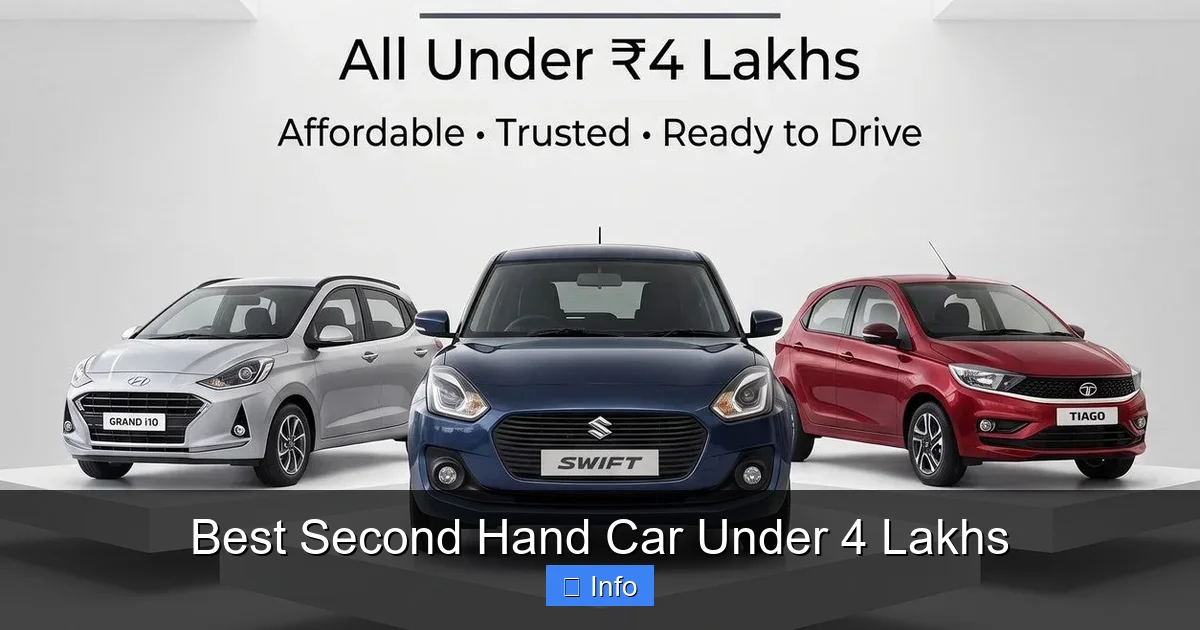
Visual guide about Best Second Hand Car Under 4 Lakhs
Image source: hanshyundaihpromise.com
Lower Insurance Premiums
Insurance costs are based on the car’s current market value (IDV). A car valued under 4 lakhs will have a significantly lower premium than a new car. This saves you money every single year. Third-party insurance is mandatory, but even comprehensive cover stays affordable.
Cheaper Registration and Taxes
Road tax and registration fees are lower for used vehicles. In many states, the re-registration cost for a used car is a fraction of the new car tax. This reduces your upfront on-road cost considerably.
Variety of Choices
This price bracket is packed with options. You get entry-level hatchbacks from Maruti, Hyundai, and Tata. You might even find older models of slightly larger cars like the Wagon R or Santro. The supply is high, so you have the power to choose and negotiate.
Top Picks for Best Second Hand Car Under 4 Lakhs
Now let us look at the stars of this budget. These cars are popular for a reason. They offer a blend of reliability, fuel efficiency, and low maintenance costs. Remember, prices vary by city, condition, and model year.
1. Maruti Suzuki Alto 800 (2014-2019 Models)
The Alto is the king of entry-level cars. It is the default answer for many first-time buyers. The 800cc engine is peppy enough for city traffic. It returns mileage figures of 22-24 kmpl easily. Parts are available at every corner garage and cost very little. A well-kept 2016-2018 model fits comfortably in this budget. Look for the LXi or VXi variants for basic features like AC and power steering.
2. Hyundai Eon (2014-2018 Models)
The Eon looks more modern than the Alto. It has a distinct fluidic design. The 0.8L and 1.0L Kappa engines are refined. The cabin feels airy with good headroom. Hyundai’s service network is vast. The Eon often comes with better standard features like a music system and front power windows on higher trims. It is a strong contender for the best second hand car under 4 lakhs if you want a car that feels a bit more premium.
3. Tata Nano (2015-2018 Models)
The Nano gets a bad rap, but as a used buy, it makes immense sense. It is the cheapest car to buy and run. The rear-engine layout gives surprising cabin space for four adults. The 624cc engine sips fuel. Maintenance is dirt cheap. If your running is strictly intra-city, the Nano is unbeatable value. Just ensure the cooling system and electricals are sound.
4. Maruti Suzuki Wagon R (Older K-Series, 2010-2013 Models)
You can find the tall-boy hatchback in this range if you go for the older K10B engine models. The Wagon R offers unmatched interior space and a high seating position. Visibility is excellent. The 1.0L engine is more powerful than the 800cc rivals. It handles highways better too. Check for rust on the underbody and suspension bushes, as these cars are often used heavily.
5. Chevrolet Beat (Diesel/Petrol, 2012-2015 Models)
Since Chevrolet exited India, prices dropped. This works in your favor. The Beat is a well-built car with a solid feel. The 1.0L diesel engine is a gem – torquey and incredibly fuel-efficient (25+ kmpl). The petrol 1.2L is peppy too. Parts availability is the only concern long-term, but GM committed to parts supply for years. Many independent garages now specialize in them. It drives better than most cars in this list.
6. Honorable Mentions
- Maruti Suzuki Zen Estilo: Quirky looks, Alto mechanicals, very cheap.
- Hyundai Santro Xing: The classic tall boy. Reliable 1.1L engine. Getting old now, so condition is key.
- Fiat Palio / Petra: Great drive dynamics, but parts and specialized mechanics can be tricky.
Key Factors to Check Before Buying
Finding a model you like is step one. Verifying its health is step two. This is where most buyers go wrong. Do not skip these checks. If you are unsure, bring a knowledgeable friend or hire a professional inspector. You can also refer to our detailed checklist for buying a second hand car for a printable guide.
Vehicle History and Documentation
Ask for the original Registration Certificate (RC). Match the engine and chassis numbers on the RC to the car. Check the insurance policy – is it active? Has it lapsed? A lapsed policy means the car needs inspection before renewal, adding cost. Verify the Pollution Under Control (PUC) certificate. Ask for service records. A car serviced at authorized workshops is a big plus. If the seller has no records, be cautious.
Number of Owners
Check the RC for owner count. A first or second owner car is preferred. Third or fourth owner cars have higher wear and tear. They also fetch lower resale value later. Single-owner cars usually have better maintenance history.
Accident History
Look for uneven panel gaps. Check paint texture under sunlight. Overspray on rubber seals or bolts indicates repaint. Open the boot and hood; check the inner structure for welding marks or kinks. A major accident compromises structural safety. Walk away if you find hidden damage.
Mechanical Condition: Engine, Gearbox, Suspension
Start the engine cold. Listen for rattles, knocking, or excessive smoke. Blue smoke means burning oil. White smoke means coolant leak. Black smoke means rich mixture. Rev gently; it should be smooth. Test drive is non-negotiable. Check gear shifts – they should be precise, not notchy. Clutch bite point should not be too high. Drive over bumps; listen for suspension knocks. Steering should be straight and vibration-free.
Electronics and Features
Test everything. AC cooling, blower speeds, power windows, central locking, music system, horn, all lights (including fog lamps and indicators), wipers, and rear defogger. Repairing electrical gremlins can be frustrating and expensive. Ensure the battery is healthy; check manufacturing date.
Tyres and Brakes
Check tread depth. Uneven wear suggests alignment or suspension issues. Check the spare tyre condition and tools (jack, wheel spanner). Test brakes at low speed and high speed. Car should stop in a straight line. No squealing or grinding noises.
Where to Buy: Dealers vs. Private Sellers
You have three main avenues. Each has pros and cons.
Authorized Certified Pre-Owned Outlets (Maruti True Value, Hyundai H-Promise, etc.)
Pros: Thorough inspection (100+ points), warranty (usually 6-12 months), clear paperwork, finance assistance. Cons: Highest price. You pay a premium for peace of mind. The warranty often has many exclusions.
Independent Used Car Dealers
Pros: Large inventory, handle paperwork and transfer, may offer short-term warranty, easier negotiation than authorized outlets. Cons: Quality varies wildly. Some hide defects. Always verify independently. Get everything in writing.
Private Sellers (Direct from Owner)
Pros: Lowest price (no dealer margin), you meet the actual user, know the true history. Cons: You handle all paperwork and RTO transfer yourself. No warranty. Risk of legal disputes if documents aren’t clear. Takes more time and effort.
If you are looking in specific cities, local markets vary. For example, if you are in the capital region, checking listings for a second hand car in Delhi under 2 lakh might show you how prices trend lower in big metros due to higher supply. Similarly, markets like Indore or Ahmedabad have their own dynamics.
Tips for Negotiating the Best Price
Negotiation is an art. In the used car market, the listed price is rarely the final price. Here is how to get a fair deal.
Do Your Homework
Check multiple platforms (CarDekho, Cars24, OLX, CarWale, Spinny) for the same model, year, and km. Know the average market price. This gives you a baseline. If a dealer asks 3.8L and the market is 3.4L, you have data to argue.
Point Out Flaws Politely
During inspection, note every minor issue. Scratches, worn tires, battery age, AC not cooling perfectly, faded paint. Make a list. Present it calmly. “The tires need immediate replacement (₹15k), battery is 3 years old (₹4k), AC needs gas top-up. I can offer ₹3.2L.” This shows you are serious and informed.
Use the “Walk Away” Power
This is your strongest tool. If the seller won’t budge, say “Thank you, I’ll think about it” and leave. Often, they call you back. If not, there are other cars. Never fall in love with a specific unit before buying.
Ask for Extras
If price is firm, ask for value adds. Free RC transfer, 1-year comprehensive insurance paid by them, new floor mats, seat covers, free first service, or a full tank of fuel. These save you real money.
Financing and Insurance for Used Cars Under 4 Lakhs
Paying cash is simplest. But if you need a loan, know the rules.
Used Car Loans
Banks and NBFCs offer loans for used cars. Interest rates are higher than new cars (typically 10-14% vs 7-9%). Loan tenure is shorter (max 5 years, often 3-4 for older cars). LTV (Loan to Value) is lower – you might get only 70-80% of the car’s valuation. The bank does its own valuation. Processing fees apply. Compare offers from your salary account bank, credit unions, and dealer-tied financiers.
Insurance Transfer vs. New Policy
If the seller’s insurance is valid, you *must* transfer it to your name within 14 days. If not transferred, claims get rejected. Transfer requires Form 29, 30, RC copy, insurance copy, address proof, and fee. Alternatively, buy a fresh policy. Compare IDV and premium. A new policy lets you set the right IDV and add zero-dep cover if the car is under 5 years old (rare in this budget).
RC Transfer (Ownership Transfer)
This is mandatory. Submit Form 29 (seller) and Form 30 (buyer) at the RTO. Required docs: Original RC, Insurance, PUC, Address Proof (both), PAN Card (both), Passport photos, Chassis imprint (Form 20). Fees vary by state (approx ₹300-₹1000 + smart card fee). Do this immediately. Until RC is in your name, the seller is liable for accidents/challans. Many dealers/agents handle this for a fee (₹2000-₹5000). It is worth paying to avoid RTO hassles.
Total Cost of Ownership: Beyond the Price Tag
The sticker price is just the start. Budget for these immediate costs:
- RC Transfer & Agent Fees: ₹3,000 – ₹6,000
- Insurance (if buying new/renewing): ₹4,000 – ₹8,000
- Immediate Service: Oil, filters, plugs, fluids, brake pads – ₹5,000 – ₹12,000
- Tyres (if worn): ₹12,000 – ₹18,000 for a set of 4
- Battery (if old): ₹3,000 – ₹5,000
- Cosmetic Touch-ups: ₹2,000 – ₹5,000
Keep a buffer of ₹20,000-₹30,000 over the car price. This prevents a “broke after purchase” situation. A car needing ₹15k work immediately is effectively priced ₹15k higher.
Common Mistakes to Avoid
Smart buyers learn from others’ errors. Here are the big ones.
Buying on Looks Alone
A shiny paint job hides many sins. Always prioritize mechanical health over cosmetics. Dents and scratches are cheap to fix. Engine rebuilds are not.
Skipping the Test Drive
Never buy without driving. At least 15-20 minutes. Drive on rough roads, highways, and in traffic. Test AC, gears, brakes, steering, noises. If the seller refuses a test drive, walk away.
Ignoring the “Too Good to Be True” Price
A 2018 Alto at ₹2.5L? Run. It’s likely stolen, flood-damaged, major accident, or paperwork mess (loan hypothecation not cleared). Verify hypothecation status on the RC. If a bank name is there, get a No Objection Certificate (NOC) and Form 35 before paying.
Not Checking for Pending Challans
Check the vehicle number on the Parivahan website or state traffic police site for pending e-challans. They transfer to the new owner. Clear them before purchase or deduct from price.
Conclusion: Drive Smart, Spend Smart
Finding the best second hand car under 4 lakhs is totally achievable. It takes patience, research, and a systematic approach. The Maruti Alto 800, Hyundai Eon, Tata Nano, and older Wagon R or Beat are your best bets for a hassle-free ownership experience. They are proven, parts are cheap, and mechanics know them inside out.
Remember the golden rules: verify documents religiously, inspect mechanically (or get help), test drive thoroughly, and negotiate based on facts. Factor in the hidden costs of transfer, service, and tires. If you can stretch your budget slightly, you open up a wider range of newer, better-equipped cars. You might want to check our guide on the best second hand car under 5 lakhs for those options. Conversely, if you want to spend even less, the best second hand car to buy under 3 lakhs list has solid ultra-budget picks.
Your perfect used car is out there. Take your time. Don’t rush into a bad deal because you need a car *today*. A week of searching saves years of regret. Happy hunting, and drive safe!
Frequently Asked Questions
Which is the most reliable second hand car under 4 lakhs?
The Maruti Suzuki Alto 800 is widely considered the most reliable option due to its simple engineering, massive service network, and low parts cost. The Hyundai Eon and Tata Nano are also very dependable for city use.
Can I get a good automatic car under 4 lakhs used?
Finding a good automatic (AMT/AT) under 4 lakhs is difficult. You might find older AMT models like the Alto K10 AMT or Celerio AMT (2015-2016) but they often have high mileage. Manual transmissions are a safer, cheaper bet in this budget.
What is the ideal mileage for a used car under 4 lakhs?
Look for cars with 50,000 to 80,000 km on the odometer. Lower is better, but verify it matches the car’s age and condition. Cars over 1 lakh km in this price range often need major suspension or engine work soon.
Is it better to buy from a dealer or a direct owner?
Direct owners offer lower prices and true history but require you to handle paperwork. Dealers handle paperwork and may offer a short warranty but charge a premium. For first-time buyers, a reputable dealer or certified outlet reduces risk.
What documents are absolutely mandatory to check?
You must verify the Original RC (matching engine/chassis numbers), valid Insurance, valid PUC, and Service History. Also check for Hypothecation (loan) entry on RC – it must be cleared (Form 35 + NOC) before transfer.
How much should I budget for immediate repairs after buying?
Keep a buffer of ₹15,000 to ₹30,000. This covers a full service (oil, filters, fluids), brake pads, battery if needed, tyre rotation/alignment, and minor electrical fixes. It ensures the car starts its new life with you on the right foot.