Initially Car a Is 10.5 M Ahead of Car B
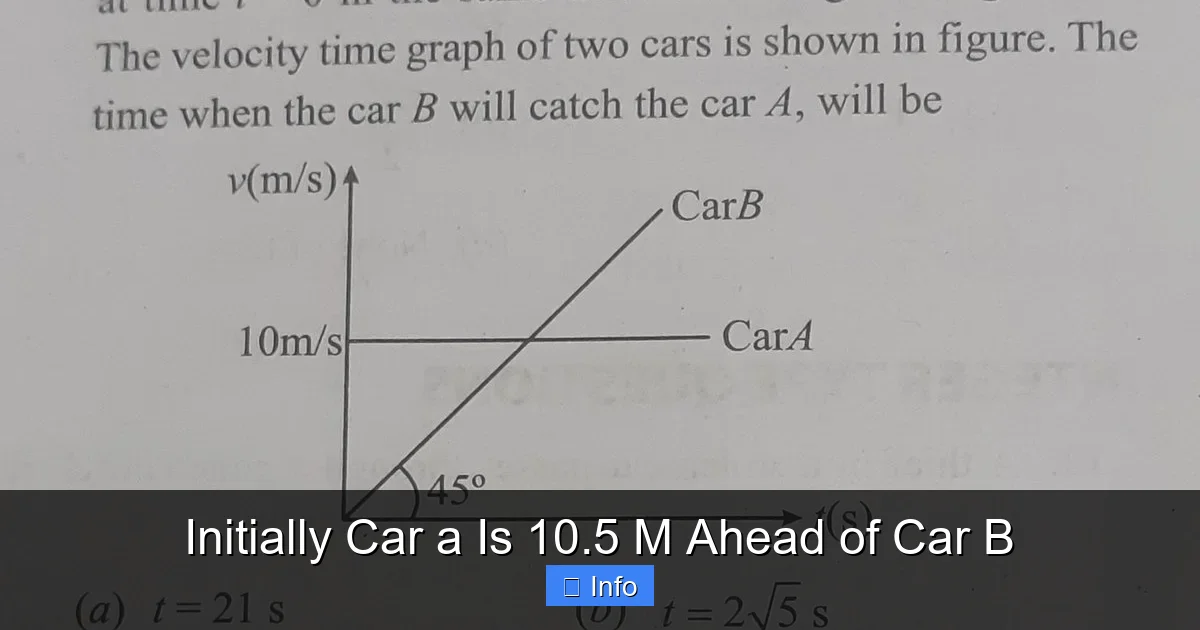
Initially car a is 10.5 m ahead of car b sets the stage for analyzing relative velocity, acceleration, and collision timing. Understanding this initial separation helps predict when and where the two vehicles will meet, making it a fundamental concept in motion problems.
When studying motion, one of the simplest yet most informative setups is to say that initially car a is 10.5 m ahead of car b. This phrase may look like a trivial detail, but it anchors the entire problem. By fixing the starting positions, we can ask questions like: How long will it take for car b to catch up? Will they ever collide if one accelerates? What distance separates them after a certain time? Answering these questions relies on basic kinematic principles that are useful not only in physics classrooms but also in everyday driving situations, such as merging onto a highway or maintaining a safe following distance.
In this article we will unpack the meaning of that initial 10.5‑meter lead, walk through the mathematics step by step, and provide real‑world examples that make the concepts tangible. We’ll also touch on related topics like vehicle maintenance—because knowing what is the right amount of oil in a car keeps the engine running smoothly, just as knowing the right separation keeps traffic flowing safely.
Key Takeaways
- Initial separation matters: The 10.5‑meter gap defines the starting point for all relative‑motion calculations.
- Relative velocity determines catch‑up time: Subtract car b’s speed from car a’s speed to find how fast the distance closes.
- Acceleration changes the equation: If either car accelerates, use kinematic equations to solve for meeting time or position.
- Real‑world applications: This scenario appears in traffic‑flow analysis, safety‑distance planning, and automotive testing.
- Graphical interpretation: Plotting position versus time for each car shows where the lines intersect—the meeting point.
- Practical tips: Always keep units consistent (meters, seconds) and double‑check sign conventions when setting up equations.
📑 Table of Contents
Understanding the Initial Condition
The statement “initially car a is 10.5 m ahead of car b” tells us two things at time t = 0:
- Car a’s position is 10.5 meters greater than car b’s position along the same line of travel.
- Both cars are moving in the same direction unless otherwise stated.
If we set car b’s starting point at the origin (x = 0 m), then car a begins at x = 10.5 m. This simple coordinate choice makes the math cleaner and lets us focus on the relative motion between the vehicles.
It’s important to keep units consistent. The distance is given in meters, so any velocities should be expressed in meters per second (m/s) and any accelerations in meters per second squared (m/s²). If you encounter speeds in km/h, convert them first (1 km/h ≈ 0.27778 m/s). Consistent units prevent costly mistakes when plugging values into the equations of motion.
Relative Velocity: The Simple Catch‑Up Case
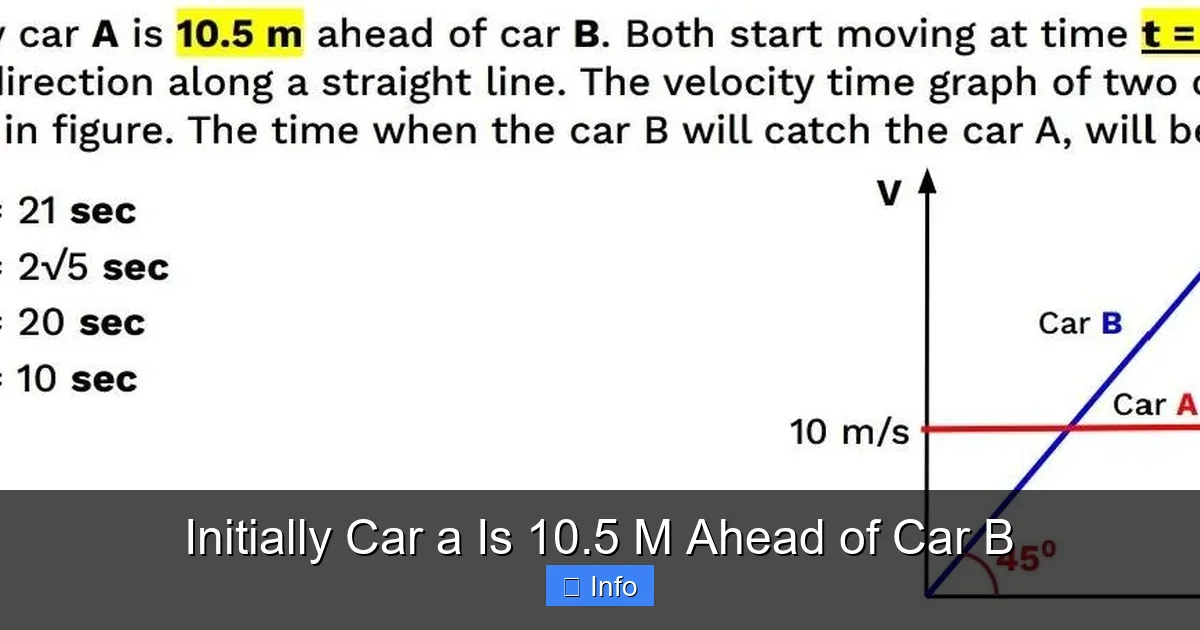
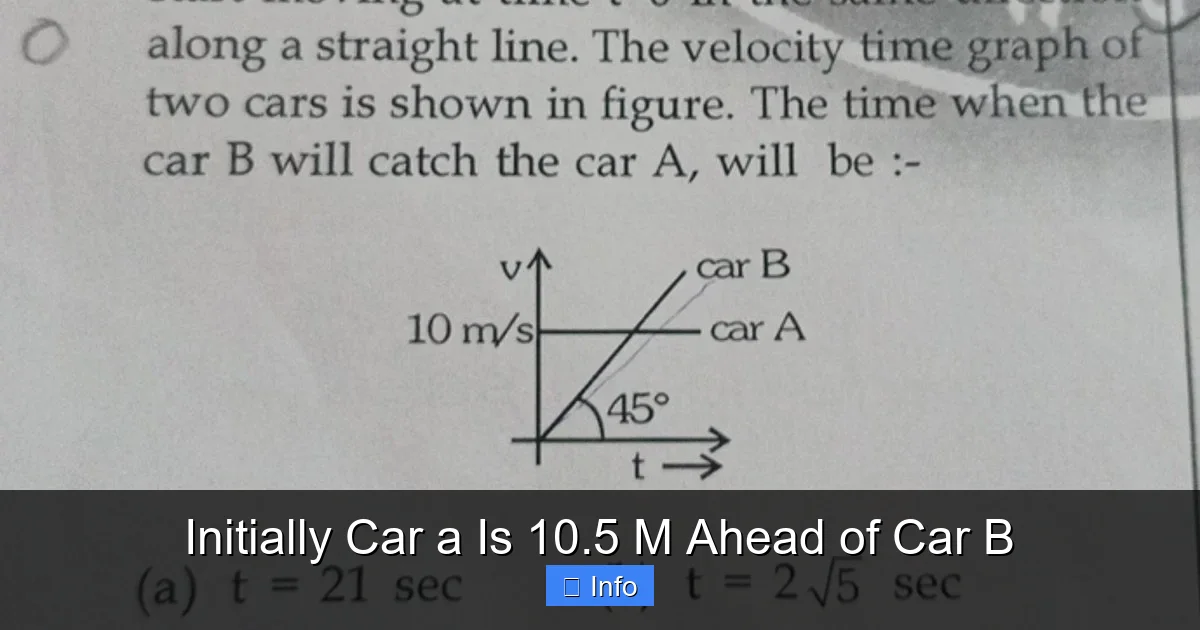
When neither car accelerates, the problem reduces to a constant‑velocity scenario. The key quantity is the relative velocity of car b with respect to car a:
Visual guide about Initially Car a Is 10.5 M Ahead of Car B
Image source: media.kunduz.com
v_rel = v_b – v_a
If v_rel is positive, car b is gaining on car a; if negative, the gap widens. The time required to close the initial 10.5‑meter gap is:
t_catch = Δx₀ / v_rel
where Δx₀ = 10.5 m is the initial separation.
Example 1: Both Cars at Constant Speed
Suppose car a travels at 20 m/s (about 72 km/h) and car b travels at 25 m/s (about 90 km/h). Then:
- v_rel = 25 m/s – 20 m/s = 5 m/s
- t_catch = 10.5 m / 5 m/s = 2.1 s
After 2.1 seconds, car b will have caught up to car a. At that moment, both cars will be at the same position:
x_meet = x_b0 + v_b·t_catch = 0 + 25·2.1 = 52.5 m
Car a, starting at 10.5 m, will also be at 52.5 m because it has traveled 20 m/s × 2.1 s = 42 m, and 10.5 m + 42 m = 52.5 m.
Example 2: When the Gap Increases
If car a is faster—say 30 m/s—and car b moves at 20 m/s, then:
- v_rel = 20 – 30 = –10 m/s
The negative sign tells us the distance grows. After 5 seconds, the separation will be:
Δx = Δx₀ + v_rel·t = 10.5 m + (–10 m/s)·5 s = –39.5 m
A negative value means car a is now 39.5 m ahead of car b; the cars are moving apart.
Introducing Acceleration: When Speeds Change
Real‑world driving rarely involves perfectly constant speeds. Drivers accelerate when merging, brake when approaching a stop, or vary speed due to traffic. When at least one car accelerates, we must use the full kinematic equations:
Visual guide about Initially Car a Is 10.5 M Ahead of Car B
Image source: classroom-images.cdn.askfilo.com
x = x₀ + v₀t + ½at²
We write one equation for each car and set them equal to find the meeting time (if any).
Example 3: Car b Accelerates from Rest
Let car a maintain a constant speed of 18 m/s (≈65 km/h). Car b starts from rest (v₀b = 0) and accelerates uniformly at 2 m/s². Their position equations are:
- Car a: x_a = 10.5 + 18t
- Car b: x_b = 0 + 0·t + ½·2·t² = t²
Set x_a = x_b:
10.5 + 18t = t² → t² – 18t – 10.5 = 0
Solve the quadratic: t = [18 ± √(18² + 4·10.5)] / 2. The positive root gives:
t ≈ (18 + √(324 + 42)) / 2 = (18 + √366) / 2 ≈ (18 + 19.13) / 2 ≈ 18.57 s
After about 18.6 seconds, car b catches car a. At that instant, both are at:
x_meet = t² ≈ (18.57)² ≈ 345 m
Car a has traveled 18 m/s × 18.57 s ≈ 334 m from its start, plus the initial 10.5 m gives ≈344.5 m—matching the result within rounding.
Example 4: Both Cars Accelerate Differently
Imagine car a accelerates at 1 m/s² from an initial speed of 15 m/s, while car b accelerates at 1.5 m/s² from an initial speed of 10 m/s. Their equations:
- Car a: x_a = 10.5 + 15t + 0.5·1·t² = 10.5 + 15t + 0.5t²
- Car b: x_b = 0 + 10t + 0.5·1.5·t² = 10t + 0.75t²
Setting them equal:
10.5 + 15t + 0.5t² = 10t + 0.75t² → 0.25t² – 5t – 10.5 = 0
Multiply by 4 to simplify: t² – 20t – 42 = 0
Positive root: t = [20 + √(400 + 168)] / 2 = [20 + √568] / 2 ≈ (20 + 23.83) / 2 ≈ 21.92 s
Thus, after roughly 22 seconds, car b overtakes car a. The meeting point can be found by plugging t back into either position equation.
Graphical Interpretation
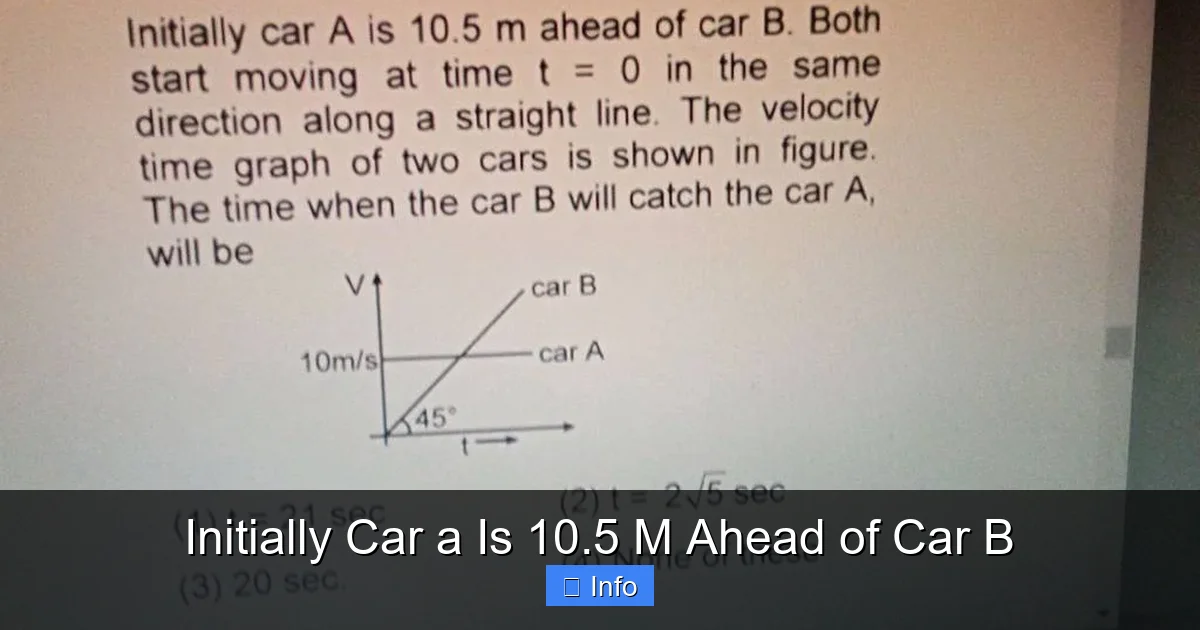
Plotting position versus time for each car provides an intuitive picture. Car a’s line starts at 10.5 m on the vertical axis and has a slope equal to its velocity (if constant) or a curvature if accelerating. Car b’s line starts at the origin. The point where the two lines intersect is the exact moment and location of meeting.
Visual guide about Initially Car a Is 10.5 M Ahead of Car B
Image source: filo-question-diagrams.cdn.askfilo.com
If the lines never intersect—because car a’s line stays always above car b’s—then car b never catches up. Conversely, if car b’s line is steeper from the start, the intersection occurs early.
These graphs are especially useful when dealing with piecewise motions—for example, a car that accelerates for a few seconds, then cruises at constant speed. By drawing each segment, you can visually estimate the catch‑up point before doing the algebra.
Practical Tips for Solving These Problems
- Draw a diagram. Sketch the road, mark the starting positions, and indicate velocity vectors with arrows.
- Choose a reference point. Setting car b’s origin at zero simplifies algebra, but any point works as long as you’re consistent.
- Watch the signs. Ahead means positive separation; behind means negative. Acceleration in the direction of motion is positive; opposite is negative.
- Keep units uniform. Convert km/h to m/s, hours to seconds, etc., before plugging into formulas.
- Check your answer. Does the calculated time make sense? If car b is slower, you should get a negative or “no solution” result for catch‑up.
- Use technology wisely. Spreadsheets or calculators can solve quadratics quickly, but always understand the underlying steps.
Why This Concept Matters Beyond the Classroom
Understanding that initially car a is 10.5 m ahead of car b has direct applications in traffic engineering, automotive safety testing, and even everyday driving decisions.
- Following distance. Safety guidelines often recommend a two‑second gap, which translates to a specific meter distance depending on speed. Knowing how that gap evolves helps drivers avoid rear‑end collisions.
- Merge maneuvers. When a car enters a highway, the merging vehicle (car b) must close a gap with the traffic ahead (car a). Engineers use these calculations to design acceleration lanes of appropriate length.
- Collision avoidance systems. Radar‑based systems constantly compute the relative position and velocity of nearby vehicles, essentially solving the same kinematics problem in real time.
- Racing and performance testing. Engineers measure how quickly a car can close a gap to a competitor, informing strategies for overtaking.
Even routine maintenance ties back to motion fundamentals. For instance, knowing how to tell if a flywheel is bad helps you diagnose vibrations that could affect smooth acceleration, which in turn influences how quickly a car can close a gap.
Conclusion
The simple phrase “initially car a is 10.5 m ahead of car b” opens a doorway to a rich set of physics concepts: relative velocity, acceleration, quadratic solutions, and graphical analysis. By mastering the math behind this scenario, you gain tools that apply to everything from safe driving habits to advanced vehicle dynamics.
Remember to keep your units consistent, draw a clear diagram, and verify that your answer makes physical sense. And while you’re fine‑tuning your understanding of motion, don’t forget the basics of car care—like checking what is the oil capacity of a Toyota or learning how to jack up one side of a car—because a well‑maintained vehicle responds predictably to the very motions we’ve just analyzed.
Frequently Asked Questions
What does “initially car a is 10.5 m ahead of car b” mean in practical terms?
It means that at the start of observation (time = 0), car a’s front bumper is 10.5 meters farther down the road than car b’s front bumper, assuming both are traveling in the same direction.
How do I calculate the time it takes for car b to catch car a if both travel at constant speeds?
Find the relative velocity (v_b − v_a). If it’s positive, divide the initial gap (10.5 m) by that relative velocity; the result is the catch‑up time in seconds.
What changes if one of the cars accelerates?
You must use the full kinematic equation x = x₀ + v₀t + ½at² for each car, set the positions equal, and solve for time—often resulting in a quadratic equation.
Can the cars ever meet if car a is accelerating faster than car b?
If car a’s acceleration is greater enough to keep increasing the lead, the gap may never close. Mathematically, the quadratic may have no positive root, indicating no future meeting point.
How does knowing the initial separation help with safe driving?
It lets you determine whether your current speed and following distance will allow you to stop safely if the car ahead brakes suddenly, helping you maintain a safe following distance.
Are there any real‑world devices that constantly solve this type of problem?
Yes. Adaptive cruise control and collision‑avoidance radar systems continuously measure the gap and relative speed to nearby vehicles, automatically adjusting throttle or brake to maintain safety.