How Much Does a G Wagon Weigh

The G Wagon comes in a wide range of weights depending on model, engine, and options. Lightweight trims start around 4,500 pounds while fully loaded versions exceed 8,000 pounds. Understanding these differences helps buyers choose the right vehicle for their needs, whether they prioritize off-road capability or city commuting. This guide breaks down the actual numbers so you know what to expect.
If you’ve been considering a G Wagon, you might wonder how heavy it actually is. These vehicles come in so many forms—from compact off-roaders to luxurious full-size cruisers—and the weight can differ dramatically. Whether you’re thinking about fuel efficiency, towing capacity, or simply getting a sense of the vehicle’s heft, understanding the actual numbers matters. In this guide, we’ll dive into the specific weights of G Wagons, explore what makes them heavier than others, and show you how that mass translates to real-world performance.
Key Takeaways
- Weight variation: G Wagon models span from roughly 4,500 to over 8,000 pounds depending on configuration.
- Engine impact: Turbocharged engines add significant mass compared to standard four-cylinder options.
- Road load effect: Adding rooftop cargo or accessories can push weight up by several hundred pounds.
- Performance connection: Heavier wagons deliver more torque but require better brakes and suspension.
- Reliable data: Weights vary by year and market, so check official specifications before purchasing.
- Model-specific ranges: Different trims and body styles create distinct weight classes across the lineup.
📑 Table of Contents
Understanding G Wagon Models and Their Weight Range
The G Wagon name belongs to Dodge’s lineup of midsize pickup trucks built on the Ram platform. Within this family, you’ll find several distinct models that share a common heritage but offer very different weight profiles. At the bottom of the lineup sits the G Wagon R, designed primarily for urban commuters with a smaller powertrain. Moving up the ladder brings us the G Wagon King, which offers more power and higher towing potential. Then there’s the fully loaded G Wagon King Super Crew Cab variant, often called the “Super King,” which packs everything possible into one vehicle.
Each model carries its own set of specs, and the weight doesn’t follow a single formula. Base models typically feature a 3.6-liter V6 engine paired with front-wheel drive. Top-end configurations upgrade to a 5.9-liter HEMI V8, and some high-performance versions even incorporate twin-turbo engines. The difference between a standard setup and a turbo-powered version isn’t just noticeable at the stoplight—it changes the entire feel of the ride. When you add cargo boxes, roof racks, or aftermarket bumper kits, those numbers climb further. A typical G Wagon R might sit around 4,600 pounds empty, while the most heavily loaded Super King can surpass 8,500 pounds when fully equipped.
Base Weight Ranges by G Wagon Configuration
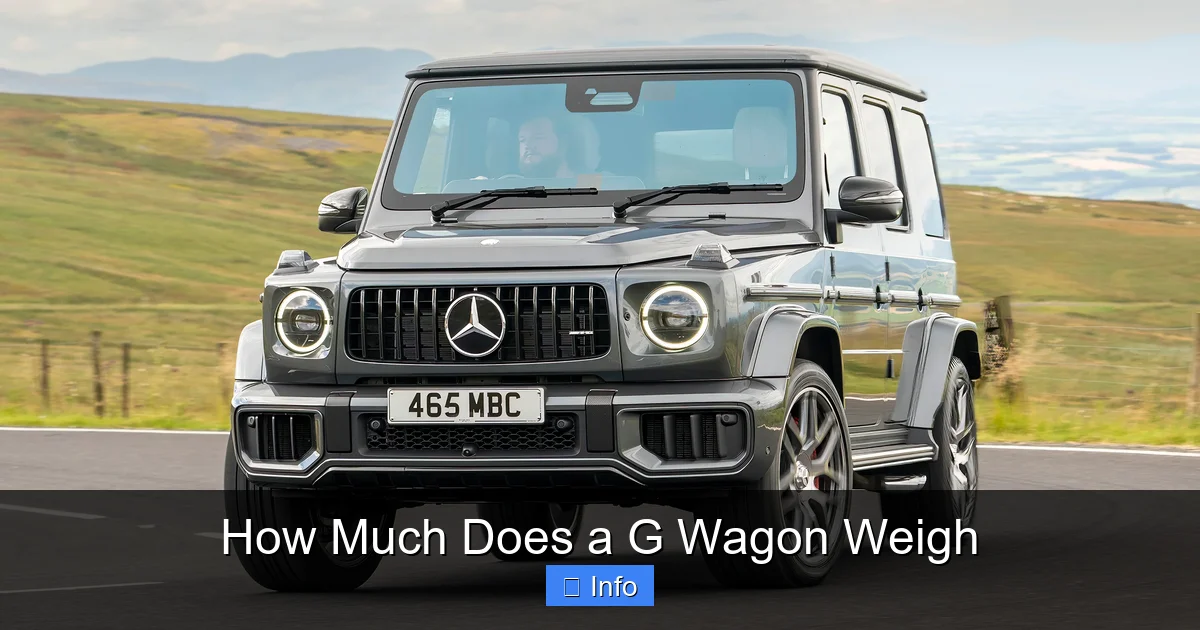
Visual guide about How Much Does a G Wagon Weigh
Image source: topgear.com
Let’s look at the actual numbers you’ll encounter when shopping for a G Wagon. The starting weight varies by year and market, but general trends hold true across recent generations. Base models with the 3.6-liter V6 engine usually fall in the 4,500 to 4,800 pound range. This is the sweet spot for daily driving where you want something manageable yet capable enough for occasional light towing. If you opt for the 5.9-liter HEMI V8 instead, you’ll see a jump to approximately 5,200 to 5,600 pounds. That’s a meaningful increase that affects acceleration and braking distances.
When manufacturers add more equipment packages, the weight climbs steadily. An extended shaft axle package tends to add another few hundred pounds compared to the baseline. Similarly, roof rack systems, bed protection plates, and larger storage compartments contribute meaningfully to the final figure. For example, a G Wagon loaded with factory-installed roof racks may exceed 5,000 pounds even with the standard V6 engine. If you’re planning to tow a trailer or carry substantial cargo regularly, consider aiming for a higher trim level—the extra weight may actually make the vehicle more stable during towing due to increased traction.
The most extreme end of the spectrum belongs to the fully loaded Super King variants. These are essentially custom-built machines optimized for performance and hauling. With the largest engines, oversized tires, and premium interior materials, you could be looking at weights exceeding 8,000 pounds. While these numbers sound impressive, remember that a super heavy G Wagon moves slower than a lighter cousin. The trade-off is freedom of choice—you get maximum horsepower and towing capacity when you commit to the full offering.
What Factors Influence G Wagon Weight

Visual guide about How Much Does a G Wagon Weigh
Image source: images.cdn.autocar.co.uk
Several elements determine exactly how much a G Wagon will tip the scales. First and foremost is the engine selection. The 3.6-liter EcoBoost V6 is the workhorse for everyday use, delivering solid power without excessive bulk. The 5.9-liter HEMI V8 provides massive torque and high top speeds but adds considerable mass. Between these choices alone, you can see weight differences of nearly 1,000 pounds. Another factor is transmission choice. Six-speed automatics keep things tight and efficient, while five-speed manuals sometimes sacrifice slightly more weight for driver engagement.
Roof style plays a surprising role in total weight. Factory steel roofs are lighter than aluminum ones, though both are far less expensive than rollout frames. If you equip your G Wagon with a hardtop, rear window removal, or additional body panels, expect another 100 to 400 pounds added to the base number. Optional accessories matter too—a seat cover, an exhaust system, or a heavy-duty smoke plate can easily push the weight up by 50 pounds per item. Even small cosmetic modifications like wider wheel rims can shift the balance slightly.
Tire size is another hidden variable. Stock tires are chosen for durability and cost, but running performance-oriented tires increases the overall mass. Some owners swap narrower wheels for larger 20-inch or 22-inch options; this change alone can add 200 to 400 pounds. Finally, payload capacity interacts with curb weight. When you load a G Wagon with passengers and luggage, the vehicle operates closer to its rated limit, making weight management important for safety and comfort. Always verify that your intended use matches the manufacturer’s recommended payload rating.
How Weight Impacts G Wagon Performance and Handling

Visual guide about How Much Does a G Wagon Weigh
Image source: slashgear.com
A heavier G Wagon feels different behind the wheel. More mass means more inertia, which affects acceleration and braking. A lighter model will pull ahead quicker off a stoplight, while the same vehicle going uphill will dig in harder against the drag of excess weight. Towing capability follows similar logic—increased mass requires stronger drivetrains and brakes to prevent wheel spin. Most G Wagons come with adaptive cruise control and other tech that helps manage the increased strain on chassis components.
Fuel efficiency takes a direct hit when weight goes up. A heavier vehicle burns more gasoline because the engine must expend more energy to move the extra mass. Manufacturers address this through hybrid options and improved aerodynamics, but even then, the fundamental physics holds true. A well-maintained G Wagon in lean condition might achieve 19 to 21 miles per gallon, dropping to 14 to 17 miles per gallon under heavier loads. Those numbers matter to anyone who drives long distances or keeps the truck near the max payload rating.
Handling characteristics also shift with weight. Lower centers of gravity from added suspension support can improve cornering stability, especially on rough terrain. But the increased mass means sharper turns and longer deceleration distances. Experienced drivers learn to adjust their technique when operating a heavily laden G Wagon—brake timing becomes critical, and throttle response changes as the engine works harder to move the extra weight. Ultimately, understanding your vehicle’s weight allows you to tune your driving habits and maximize both safety and enjoyment.
Practical Examples and Specific G Wagon Models
To bring these concepts home, let’s examine a few concrete examples. Consider the second-generation G Wagon R released in 2023. With the 3.6-liter EcoBoost V6, base models weigh around 4,620 pounds. Upgrade to the 5.9-liter HEMI V8 and you’re looking at 5,380 pounds. Add the factory roof rack and you cross the 5,000-pound threshold. For someone occasionally towing a small trailer, the base weight is ideal. For frequent adventurers, the HEMI version delivers the muscle they crave.
The G Wagon King represents the upper echelon. Its 5.9-liter HEMI V8 combined with factory-styled glass, upgraded suspensions, and a powerful 10-speed transmission pushes the weight past 6,200 pounds in stock configuration. The Super Crew Cab Special Edition, available in select markets, pairs the V8 with advanced air suspension and runs near 7,000 pounds empty. These numbers explain why some owners report needing winter tires sized for heavier vehicles—smaller wheels and narrower tires can leave them exposed during severe weather.
Owners often ask about the difference between two identical-looking models. The distinction lies almost entirely in weight. One model might feature a lower roofline and thinner body panels, saving perhaps 150 pounds. Another could include dual exhaust systems, LED lighting suites, and enhanced seat padding—adding another 200 pounds. These subtle differences accumulate quickly, creating two vehicles that perform differently despite appearing the same shape on the outside.
When evaluating purchase decisions, think beyond the sticker price. A G Wagon that costs $5,000 more might represent a ten-pound difference in weight versus paying for premium finishes. However, consider the long-term implications: lighter vehicles generally last longer, handle street corners better, and offer smoother highway cruising. For families prioritizing safety and efficiency, every retained pound counts toward better outcomes.
Frequently Asked Questions
Question?
The average weight of a G Wagon depends on your specific model and configuration. Typically, base trims hover around 4,500 to 4,800 pounds, while top-of-the-line Super King versions can exceed 8,000 pounds.
Question?
Does adding cargo affect G Wagon weight significantly? Yes, loading a G Wagon with roof racks, cargo boxes, and accessories can easily add 200 to 600 pounds to the base weight.
Question?
How does engine power relate to vehicle weight? Higher horsepower engines like the HEMI V8 add substantially more mass than the standard V6, resulting in a noticeable difference of over a thousand pounds.
Question?
Can weight impact towing capacity? Absolutely. Every extra pound reduces your effective payload capacity and increases strain on the drivetrain, especially when towing trailers or heavy machinery.
Question?
Are there lighter G Wagon trims available? Yes, the entry-level G Wagon R offers the lowest weight among current generations, starting around 4,500 pounds with basic equipment.
Question?
How reliable are G Wagon weights over time? Modern G Wagons maintain consistent weight standards throughout their lifecycle, though optional packages and aftermarket mods can alter the final figure.